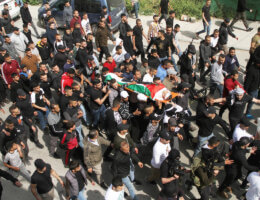
Israeli forces killed two Palestinians during raids overnight in Jenin and Bethlehem, just hours after killing a Palestinian journalist in Hebron and attacking her funeral. Their deaths bring the total number of Palestinians killed by Israel since the start of the year to 60.
A prominent Palestinian leader in Jenin and the brother of political prisoner Zakaria Zubeidi, succumbed to wounds on Sunday after he was shot by Israeli forces over the weekend.
Thousands of Palestinians attended a state funeral procession for slain Palestinian journalist Shireen Abu Akleh on Thursday before her burial on Friday in Jerusalem. Following the state procession in Ramallah, Abu Akleh’s body was transported in a convoy to her hometown of Beit Hanina, although it was temporarily intercepted by Israeli police near the Qalandia military checkpoint. Israeli police have also raided the Abu Akleh family home and questioned family members.
Israeli forces shot and killed Palestinian journalist and veteran Al Jazeera correspondent Shireen Abu Akleh in the head today while she was covering an Israeli raid on the Jenin Refugee Camp. Palestinian news networks and social media have been flooded with an outpouring of grief from Palestinian officials, Abu Akleh’s colleagues, and ordinary Palestinians who grew up watching the veteran reporter on their screens.
The Israeli military killed four Palestinians in four separate incidents across the occupied West Bank between Sunday and Monday, including one teenager, and a widow of six children who was unarmed when she was shot.
Palestinians woke up on Tuesday morning to the news that Israel had killed three more Palestinians, including one minor, in three separate incidents in the occupied West Bank and southern Israel.
The Israeli army concluded its investigation last week into the death of Omar Asaad, an 80-year-old dual Palestinian-American citizen who was killed during a violent Israeli raid on his hometown in the occupied West Bank in January. The internal army investigation, which came after mounting pressure from US officials, concluded that Asaad’s death was a “grave and unfortunate event, resulting from a moral failure and poor decision-making on the part of the soldiers.” The US State Department, however, said they were not satisfied with the findings of the army’s investigation, nor with the disciplinary actions taken against some of the soldiers, and that they expect Israeli officials to carry out a “comprehensive criminal investigation.”