

The Binding, and Unbinding

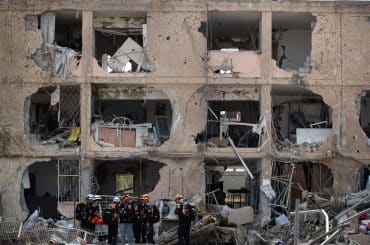
Jews Sans Fronteres has a moving post about sucking in the dust of 9/11 in Manhattan and then breathing it in in house demolitions in Palestine a year later– and this with a foto of the Empire State Building lit green for Eid last night. It's been a long time since 9/11. I feel we're making progress.

I drove to synagogue today, past a family walking to a mosque, and heard the Abraham and Isaac story from Genesis, the binding, with all the terror that story has always had for me. The rabbi offered Rabbi Harold Kushner's interpretation (Kushner wrote When Bad Things Happen to Good People): that the "test" God gives Abraham is to test whether he'll challenge him. Abraham had done so earlier in Genesis, at Sodom and Gomorrah, when he bargained with God over how many good people there had to be in a town for God not to destroy it. On that occasion God had dropped his number. But this time Abraham fails to challenge God, and thereby fails the test, Kushner says; and yet God loves him anyway and rewards him. I don't like that interpretation because it wishes away some of the fearsomeness of the tale and goes against its actual language. "Now I know that you fear God, since you have not withheld your son, your only beloved son  from me," God says, and the angel repeats the same language. They're both honoring the idea of sacrifice. So I see the tyrannical father in that story, both of them, God and Abraham. And a father trying to rationalize physical punishment of his son. A lot of the bible is completely anachronistic. Like the wide acceptance of concubines, and the sacrifice of animals.

There's prophecy in the binding story, too. The angel says that Abraham will be rewarded for his faith. "[Y]our descendants shall possess the gate of their enemies.  And
through your descendants, all the nations of the earth shall be
blessed." That goes right to Jewishness today: the belief among Jews that a nation cannot be strong unless it respects the freedom of Jews inside it. And also: owning the gates of the Palestinians, their homes. That strikes me as the real dilemma of Jewishness. We're exceptional, so valuable to nations, and yet we possess someone else's gates. I say "we" because there was an Israeli flag on the altar, of course.  Our generation gets to figure out that dilemma at last. The unbinding. Happy Rosh Hashanah, Happy Eid.
About Philip Weiss

Philip Weiss is Founder and Co-Editor of Mondoweiss.net.
Posted in Israel/Palestine, US Policy in the Middle East, US Politics

{ 12 comments... read them below or add one }

  1. Richard Witty says:

    Good YomTov Phil, and happy new year to all.

    I went to shul yesterday, and yesterday evening at my son's Chabad house.

    Not today. I'm not that good a Jew (in that sense).

    I still suffer from the threat of losing my job if I take too many days off for Jewish holidays, even though I willingly work on Easter and Christmas.

    My sense of the Abraham/Isaac story is more through the father's eyes. (A shift that you don't have gutturally.) My oldest son was close to death a few hours after he was born, and my wife and I stayed in regional hospital for a week, until he recovered from inhaling fluid and nearly drowning during the birth process. I personally felt like Abraham being asked to not hate God or the universe if my child died. (Not at my hand, at least.) This following the amazing experience of birth, LABOR then joy. Better than sex, of any stripe that I've experienced.

    Abraham relative to Sodom/Gomorroh is my description to xenophobes (whom I do meet and confront) of the relationship of Israel to Palestine.

    Abraham asks after bargaining with God, "if there are ten good men, will you save the cities." "YES".

    Well, I've personally met much more than that quota of very admirable good men among Palestinians. Any suggestion that Palestinians are not deserving of human acceptance is bullshit, however equated through scriptural rationalization.

    Its enough for me to know that Israel invading is not an expression of "God's will" but an expression of rationalized selfish will.

    The tranformation of conflict and anger to reconciliation has to come through other means than conquering.

  2. Richard Witty says:

    The message of Rosh Hashonna is paraphrased:

    "I put before you a blessing, and a curse. If you keep my commandments I will bless you and your descendants forever. If you reject my commandments, your children and world will suffer."

    What the commandments?

    Clarity, kindness, charity, respect for others property, joy, imaginative intelligence, backbone.

  3. Madrid says:

    Oh bull crap, witty, those are not God's edicts in Leviticus and Numbers. Not even close. In fact its just the opposite. Most of the OT is a barbaric rage-filled, primitive slaughter fest, as anyone who has read it will testify to.

  4. American says:

    The bible is a sick myth. I can't believe anyone actually believes it is true. Who the hell would believe in, much less worship a God that asked a man to kill his son? Sickos.
    The Jews are even sicker with their chosen whatever and celebrations of doom and gloom and suffering.
    They and the evangelicals are both psycho cults.

    Sick, sick,sick.

  5. Richard Witty says:

    If you were to summarize the content of Torah.

    Hillel:

    "Love God with all thy heart and mind, and thy neighbor as thyself."

    Phil's and others' definitions of who are the opponents of goodness in the world, adopt the wrong definitions.

    Among the orthodox for example, there are advocates for kindness to all living, and advocates for dutiful and ruthless taking of the land.

    To look an orthodox and assume that their politics is x, is by definition false, racist.

    The definition of goodness, who is good and not, is who accepts the other. Who among Palestinians accepts Jews peaceably residing, and who accepts Palestinians.

    Any other method of generalization is only prejudice.

  6. Paul Easton - Bensonhurst, Brooklyn, Belly says:

    i dont know what to make of sarifice story. will think about it.

    regarding ten just men, obvious application is to israeli jews. because there are a few hundreds or thousands of just ones, maybe god will stay hisher hand.

    or maybe not. god is not always merciful by any means, as we know.

  7. Michael Weis says:

    The story of the binding of Issac is just a commandment that prohibits human sacrifice. Back then, all the nations sacrificed humans. Tanakh is the first place where human sacrifice is prohibited. Even Hammurabi's code doesn't prohibit human sacrifice.

  8. Richard Witty says:

    Michael,
    Its much more than just that now.

  9. LeaNder says:

    I am surrendering to my addiction one last time in the shape of a message-to-Richard.

    First: I liked the story about your son,and very personal relation to the story of Abraham.

    Second: What the commandments?

    Clarity, kindness, charity, respect for others property, joy, imaginative intelligence, backbone.

    The 10 Commandments for a Conversion to Judaism website:

    The Ten Commitments

    This is what we teach a Jew-by-Choice.
    All Jews could apply these Ten Commitments and sanctify their lives.

    1. Yom Kippur Observance -
    Fasting and attending synagogue is symbolic of our commitment to observe the High Holy ways and the Festivals.

    2. Kindle Shabbat Candles -
    Symbolizes our commitment to begin to observe Shabbat at home and in the synagogue.

    3. Mezuzah -
    Symbolizes our commitment to having a Jewish home.

    4. Tzedakah -
    The commitment to give of ourselves, our time and our money, according to ability.

    5. Affiliation -
    The commitment to join a synagogue and become an active member of the synagogue community.

    6. Dietary Laws -
    Accept some aspect that reflects and understanding of their importance for Jewish life. Acknowledge the validity of the discipline.

    7. Worship -
    The commitment to a regular worship experience.

    8. Education -
    Each individual must present an outline or plan for continuing a Jewish education.

    9. Love of Israel -
    Includes support for the Jewish people and the Land of Israel as the historical Jewish homeland and the Jewish State. Support the United Jewish Appeal or other organizations that act on behalf of Israel and Jews in American and around the world.

    10. Raise Children as Jews -
    The commitment to "teach them faithfully to your children" (the v'ahavta prayer). Our commitment to raise children in the Jewish faith.

  10. LeaNder says:

    D: compare this:

    Most Unconvinced on Iraq War

    …The poll also found that support for a possible war appears to be weakening, with 58% saying they support a ground attack on Iraq. In an August Times poll, 64% said they would support a ground attack. Last January, after President Bush first denounced Saddam Hussein in his State of the Union address, the Times and other polls found support for military action greater than 70%.

    Both polls are from Dec. 2002 (12th and 17th)

    That makes the difference between war supporting Americans and Jewish Americans with 1 percent almost meaningless.

  11. LeaNder says:

    sorry, wrong place! I'll move it.

  12. Richard Witty says:

    Leandor,
    I like most of your quoted ten. I do think "love of Israel" is important, but the form of that expression can vary.

Leave a Reply