

A new Nakba

From the Ynet article "Gazans say experiencing 'another Nakba'":

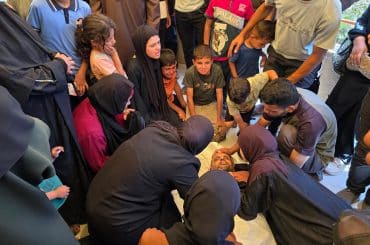
Palestinians reported that many families have left their homes in Beit Lahiya's al-Atatra neighborhood and are staying with relatives in "safer" areas. Hundreds of residents, who are afraid to travel in their own cars for fear of IDF strikes, could be seen leaving the neighborhood on foot toward central Jabalya.

"It was a difficult site and reminded us of images we saw on television during the 1948 Nakba (displacement of Palestinians following Israel's inception)," one resident who left his home told Ynet. "The sense is that of a new Nakba."

About Adam Horowitz

Adam Horowitz is Co-Editor of Mondoweiss.net.
Posted in Gaza, Israel/Palestine, Nakba

{ 20 comments... read them below or add one }

  1. Journalist says:

    "It was a difficult site and reminded us of images we saw on television during the 1948 Nakba (displacement of Palestinians following Israel's inception)," one resident who left his home told Ynet. "The sense is that of a new Nakba."

    Yeah, well, there was no television during the "Nakba." Not in the Mid East anyway.
    How can you tell when a Palestinian is lying?
    He's saying "Nakba" "Zionist" or "Genocide"

  2. doug says:

    Presumably that is a bad quote since television wasn't anywhere in the region in 1948.

  3. samuelburke says:

    Phil you oughta be proud to be a jew today….

    yeah baby you guys are wonderful humans…and with the experience you all had ..youd think that youd be more humane towards your fellow man…..but alas the torah doesnt teach such things….

    greed and envy and anger are a hell of a way to live.

  4. JH - ventriloquist says:

    Have you two intellectual giants thought about documentaries that used old film footage?

  5. Jim Haygood says:

    It is probably a mistranslation of 'images we saw on television OF the 1948 Nakba.'

    Chances are that neither the Gaza resident nor the Ynet reporter are native English speakers.

    'Holocaust I' and 'Nakba I' were separated by a few years, during the 1940s.

    'Holocaust II' and 'Nakba II' are one and the same. Shouldn't have diluted that exclusive brand, Israel. Now 'holocaust' is a generic term, like 'kleenex' or 'cellophane.'

  6. chubby says:

    Ferocious, massively destructive Hamas rocket terrorizing Israelis:

  7. Jim Haygood says:

    Holocaust I is about as significant as Kleenex, if you ask me.

  8. Jim Haygood says:

    Not what I meant, imposter.

  9. Jim Haygood says:

    Hasbara NY Times courageously smuggles a photo out of the Gaza war zone, of the [allegedly] sole Israeli military casualty. This goes front and center on the Slimes website.

    Meanwhile, no iamges of the 500-plus dead Palestinians are available. Sorry.

  10. samuelburke says:

    http://www.juancole.com/

    With regard to the Arab-Israeli conflict, we have entered the age of micro-wars.

    The first wars that Israel fought with its Arab neighbors were conventional struggles in which infantry, artillery, armor and air forces played central roles.

    Israel's enemies had few effective tools in the 1950s and 1960s. Abdel Nasser encouraged Palestinian resistance from Gaza in 1955, but it was more harassment than a serious military operation. The Egyptian, Jordanian and Syrian conventional armies were what Israel's leaders worried about. Jordan was no match for the Israelis and it had a history of secret agreements with the Zionist leaders, so its military was only a threat when, as in 1967, other Arab leaders convinced the Jordanian leadership to join in a collective effort.

    Israel's policies were not merely defensive, contrary to the propaganda one constantly hears from New York. Moshe Sharrett's diaries demonstrate conclusively the expansionist character of the regime. Israel's leaders badly wanted the Sinai Peninsula and therefore a commanding position over the trade of the Red Sea and the Suez Canal in the 1950s and 1960s. There was also some petroleum there. Israel used superiority in armor and air power in 1956 to take the Sinai, in conjunction with an orchestrated Anglo-French attack on Egypt's position in the Suez Canal (which Gamal Abdel Nasser had nationalized that summer). President Dwight D. Eisenhower, afraid that vestiges of Old World colonial thinking would push the Arabs into the arms of the Soviets, made Israel relinquish its prize. But hawks in Israel took the Sinai from Egypt again in the 1967 war, in which Israel again demonstrated that armor plus air superiority always defeats armor that lacks air cover (Israel managed to destroy the Egyptian air force early in the war).

  11. Jim Haygood says:

    Haygoods disagree! It seems like I've seen more than 500 dead Palis on this blog!

  12. Jim Haygood says:

    You lie, imposter.

    You're keeping your suffering parents awake, pounding that smelly keyboard in the basement.

  13. Eva Smagacz says:

    Zbigniew Brzezinski called Quassam rockets as provocative, ennoying and harrassment.

  14. cha says:

    It's just that they all look the same to you, "Jim".

  15. Alan says:

    If this is a holocaust, does the Allied bombing of Serbia also count as a holocaust?

    Civilian casualties as a result of Operation Allied Force were significant. Many of the people killed in the NATO airstrikes were widely reported to be civilians, both Serbs and Albanians. Human Rights Watch confirmed ninety incidents in which civilians died as a result of NATO bombing. It reported that as few as 489 and as many as 528 Yugoslav civilians were killed in the ninety separate incidents in Operation Allied Force. [1]

  16. Eva Smagacz says:

    Stop changing the subject Alan, I'm trying to expiate Polish guilt by getting the world to hate Jews!

  17. observer says:

    Remember when Jews had high verbal IQs?

    Either we're experiencing a reversion to the mean, or it's only the dumb ones left defending Zionism.

  18. Richard Witty says:

    This is about changing behavior, NOT about displacement.

  19. The term holocaust is obviously worse than useless analytically.

Leave a Reply