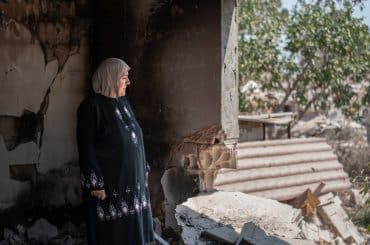
Sometimes a food is more than just something you eat. The herbal condiment za’atar, a mixture of dried thyme, sumac and sesame seed commonly eaten with olive oil and bread, has become well known in recent years outside the Middle East, especially among visitors and solidarity activists. In Palestine, it is a powerful cultural symbol.
Actually “za’atar” is the name of the thyme plant, which grows wild in the hills and fields around the Arab lands of the Eastern Mediterranean. People look forward to collecting the first Zaatar in the spring, and in Palestine “making za’atar” refers to baking an oiled flat bread stuffed with newly gathered fresh thyme and green onions. For many Palestinians it is a seasonal rite as well as a communal cooking project, usually in an outdoor oven.

“Making za’atar” in a Palestinian town within ’48 Israel
Lately, Palestinians in 1948 Israel have had to buy cultivated thyme rather than collect it wild, as was the tradition. The Israeli authorities have declared za’atar a “protected plant” and forbidden its harvesting on “state land.” Whether this is a sincere conservation measure, rather than a form of cultural repression, may be doubted. Cutting the wild thyme leaves allows the roots to remain intact and grow a new crop within a short time. And, of course, what the Israeli government calls “state land” was originally the expropriated collective property of the native Palestinians.
Zionist concern for the pristine natural environment is highly selective, in any case. Altering the original landscape and destroying the indigenous flora for agricultural development – or more likely in recent years for real estate speculation – has been a relentless practice since the earliest days of Jewish colonization in Palestine. Of course, most of the country was never a “desert” and the Zionists did not make it bloom.
The obsession with “tree planting” has long been a means to lay claim to the land and remove the original inhabitants of Palestine. Pennies collected by the children of Diaspora Jews for the Jewish National Fund more often than not went to plant fast-growing pine or eucalyptus trees over the ruins of Arab villages or to forest hillsides with non-native species in a manner that did violence to the indigenous eco-systems but “redeemed” the landscape for the Zionist colonizers. One result was the devastating series of forest fires that scorched thousands of square kilometers in the Galilee last year.

Two refugees, a brother and sister, from the destroyed village of Miske, near Kfar Sava,
with the ruins hidden by Eucalyptus trees in the background.
The process of Zionist “conquering the land” never ceased within 1948 Israel and continues to this day on both sides of the Green Line. In the northern Negev/Naqab traditional Bedouin towns are struggling to survive as ”unrecognized villages,” deprived of public services, utilities, schools and roads — while under constant threat of expropriation and removal. One of these, Al-Araqib, a village of 400 people north of Beersheba, has been flattened by Israeli bulldozers more than once, supposedly to make way for a tree planting scheme partially underwritten by US Christian fundamentalists. The Arabs are being driven off their land to make way for a million trees called “The God Forest.” (On the struggle of the Bedouins to stay on their land, see this report.)

Bedouin protest at Al-Araqib, near Beersheba/Bir Sebaa
Every Sunday the villagers of Al-Araqib, some now living in tents at the site of their destroyed homes — along with many children who have been forced to move in with relatives away from the town — gather to demonstrate at a nearby highway junction for the return of their land. One of their chants goes:
Samidoun, Samidoun,
Ma baqiyye Za’atar wa Zeitoun
We are staying, we are staying
As long as the Za’atar and the Olive remain