

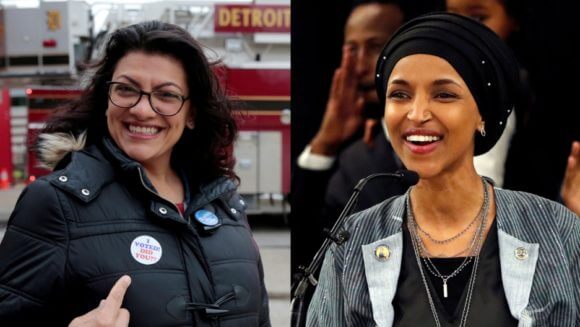
Donald Trump has brought up Israel again and again in his racist tweets aimed at the four Congresswomen he says should leave the country. He says that “the Radical Left Congresswomen” “hate” Israel and the United States and should “apologize” both to America and to “the people of Israel.”
Our media have been forthright in explaining that the demagogic president is appealing to his white nationalist base with the attacks on four women of color. What they don’t say is that Trump is also using the attack in a tactical manner to attempt to divide the Democratic Party over Israel and carry off pro-Israel Jewish donors and voters from their traditional home and into the Republican Party.
Democrats and the media can’t talk about that angle because they are involved in that racket. Liberals want to preserve Democratic Party support for Israel and that has meant doing a similar thing to what Trump has done to the four congresswomen: castigating them for their criticism of Israel.
Listen to David Axelrod and Jake Tapper allude to the politics of Israel in discussing the congresswomen on CNN yesterday. See how they move from condemning Trump to condemning the congresswomen:
Axelrod: We are going to be having this discussion a lot in the next 17 months because [Trump] thinks it’s to his advantage to do it…
Tapper: You can find things that Congresswoman Omar said that are patently offensive… How do Democrats deal with offensive comments, bigoted comments, made within their own ranks, because… I mean Congresswoman Omar has said things that a lot of Jewish Democrats in Congress found blatantly anti-Semitic, her and Congresswoman Tlaib.
Axelrod: The House voted on a resolution and there was a rebuke by the speaker about [Omar’s comments]… I do think you need to call out your own… Democrats need to be strong in condemnation of things that are viewed as antisemitic.
I have no idea why Tapper is accusing Rashida Tlaib of blatant anti-Semitism. But it is important to review Everything that Ilhan Omar, a Muslim and Somali immigrant, has said that has resulted in this false charge, issued by Donald Trump and liberals alike. Four statements are the heart of it.
#1. In 2012 Omar tweeted that Israel “has hypnotized the world, may Allah awaken the people and help them see the evil doings of Israel.” She was responding to the Pillar of Cloud operation against Gaza, which began with a targeted assassination of a Hamas official by Israel. Israel killed more than 100 civilians in Gaza. Militants in Gaza killed four Israelis in that conflict. Omar later deleted the tweet and apologized for causing offense but said she was criticizing the Israeli government. At the time of the tweet, she was a nutrition expert at the Minnesota Department of Education and worked on state and local election campaigns.
#2. In February, Omar had been in Congress five weeks when she responded to news that the Republican leadership wanted to punish her and Tlaib for criticism of Israel by tweeting: “It’s all about the Benjamins baby.” She was obviously referring to financial contributions from the Israel lobby.
#3. When challenged by Batya Ungar-Sargon of the Forward to explain the meaning of her Benjamins tweet, Omar said, “AIPAC!” a reference to the Israel lobby group the American Israel Public Affairs Committee. Ungar-Sargon accused Omar of anti-Semitism, and there followed a heated and irrelevant discussion of whether AIPAC does political fundraising or not, a false issue when it raises a huge amount for its own budget and also directs pro-Israel donors on who to give their money to in political races, and serves as a gatekeeper to pots of money for aspiring congresspeople (according to the head of Emily’s List).
#4. In late February, Omar took part in a “progressive town hall” at Busboys and Poets in D.C., at which she seemed to challenge the allegiance of Israel supporters. “I want to talk about the political influence in this country that says it is OK for people to push for allegiance to a foreign country,” she said. Omar never referred to Jews or Israel in the comment, but it was widely (and I believe correctly) interpreted to be aimed at the Israel lobby. Countless pro-Israel advocates said that she was invoking an anti-semitic “trope,” of dual loyalty. Omar ultimately apologized for the comment– though I pointed out that many Israel supporters have themselves said the issue of dual loyalty is not a “myth” in the context of pushing Israel’s story in the U.S.
Omar’s comments brought rebukes by Democratic leadership, including Speaker Nancy Pelosi; and the House promptly passed a resolution against “hateful expressions of intolerance,” which did not mention Omar but was understood as aimed at her remarks.
Omar’s comments have resulted in one of the biggest political storylines of 2019: allegations of antisemitism inside the Democratic Party’s progressive wing for its criticism of Israel.
And so we have the spectacle of Israel once again playing a central role in our politics, and– surprise– the Israel lobby setting the limits on how we are to discuss its influence. Were Omar’s comments raw and forceful? Yes. That’s robust political discussion. But what the political establishment has made clear throughout this controversy is that the following issues are simply never to be addressed:
–Are Sheldon and Miriam Adelson using their money to attempt to control US foreign policy, from moving the embassy to trashing the Iran deal? There is general silence on this most important question. Only one NYT columnist had the temerity to say Sheldon Adelson is more powerful than the secretary of state. The liberal cable networks avoid the Adelsons’ Israel-centric view of the world, and never show Sheldon calling on the last president to nuke Iran.
–Isn’t Donald Trump’s tactical aim an exodus of Jewish donors and voters from the Democratic Party over the party’s supposed betrayal of Israel? Isn’t this really about the Benjamins? How much of the wedge Trump is driving is financial, aimed at hemmorhaging the major artery of Democratic financial support — as much as 60 percent or more of Democratic contributions, a “gigantic” “shocking” percentage of Dem moneys, as even J Street acknowledges. The “donor class,” as liberal Zionist Michael Koplow puts it: the Dems are “squeezed between a pro-Israel legacy and a donor class that is more supportive of Israel on one side and an activist base that is far more critical of Israel.”
–When Robert Kraft pledges the $20 million pot from his prize in Israel to fighting the Boycott, Divestment and Sanctions campaign targeting Israel, it is evidence that a lot of Zionist money is flowing into an issue in American state houses that Israel really cares about. When Bill Ayers commented on this matter– “Oy!”– Jake Tapper called him a Nazi. (And when Florida Governor DeSantis holds a Florida Cabinet meeting in Israel to sign anti-boycott legislation, isn’t that about getting Florida for Trump in 2020?)
Anybody with any sense knows that support for Zionism, or silence on Israel’s abuses, is a litmus test for membership in the foreign policy establishment. You cannot be an anti-Zionist and get a newspaper column or even a perch on a cable show for ten seconds. Ilhan Omar and Rashida Tlaib’s big offense is that they are for BDS targeting Israel; and Democrats and liberal Zionists are all falling in line to cast a nonviolent boycott campaign as anti-Semitic, with 27 states and the Congress acting to punish speech critical of Israel. Yesterday Marc Lamont Hill, who lost his job at CNN for saying there should be one state with equal rights, was smeared for alleged anti-semitism because in comments at Netroots Nation he suggested that CNN is a Zionist organization. But again, anti-Zionism is a red line for the cable stations. A Time Warner exec wrote speeches for Netanyahu without any consequences and a top exec at Comcast raises money for the Israeli Defense Forces, no problem. But Marc Lamont Hill loses his job because he spoke out against Jewish nationalism.
Liberal Zionists have set the limits on this discussion, and set the table for Donald Trump’s racism. It’s time for progressives to take their power, and speak about Zionism as a force in the US political establishment. Israel and its friends have too much damned influence in our country; and Ilhan Omar has been right to call them out.
Thanks to Scott Roth.


I read NYT comment sections a little too often for my mental health ( or as the kids say today, so you don’t have to). In that demographic it is common to read people who “ defend” the Squad from Trump’s racism, but who also think that Omar is an antisemite or that the “ Squad” is too radical or both.
And when the MSM summarizes Omar’s history, they always say she was accused of antisemitism and never give the background about how the anti- BDS movement really does push local and state governments to side with Israel.
I can’t prove this— I don’t have polls to cite— but it is my impression that the mainstream propaganda war against Omar has been successful in branding her as an antisemite or at best as a wild- eyed nut who needs guidance from other Democrats. Or anyway, that’s the impression I get from reading NYT comment threads. There are exceptions.
Off topic- Seeing as how Mister Trump has made Israel an issue I am tempted to weigh in on Mister Trump and the wider issues raised here, but instead:
Report from Jerusalem. Since moving away from Israel after a five year “aliya”, I have visited Jerusalem every summer for the last 7 years 2012-2019 and I arrived in Jerusalem today.
I didn’t sleep much on the flight, which was a nonstop from JFK to Ben Gurion Airport. When I first arrived at Lod Airport in 1972 at the age of 16 , Ben Gurion was still alive (he died in December of 73, less than two months after the Yom Kippur war) and in fact at that time arriving passengers and the general public were allowed to mingle. (this was in February, four months before the Lod Airport massacre.)
The trip from the airport to Jerusalem was not very pleasant because the cabby told me that he would only take me to the center of town and not to the neighborhood where my apartment is located. (I ended up spending an extra 11 bucks on another cab once i was dropped off in Jerusalem.) We traveled through the West Bank on highway 443 because the first passenger was dropped off in a suburb of Jerusalem in occupied territory. When we got close to Jerusalem I could see the Bridge of the Strings, which is supposed to resemble or symbolize David’s harp and it can be seen from a distance. there are some tall buildings that constitute Jerusalem’s skyline when approached this way, but the sculpture is more artistic than any of those buildings.
I visited my parents in West Jerusalem in a neighborhood with a marked presence of ultra orthodox. My father does not talk much these days and my mother is not very political, although when I mentioned Mister Trump and the squad, my mother’s derogatory remarks were aimed at the squad and not Mister Trump. i dropped the topic.
When I left my parents I caught the train that travels on Highway 1, the seam between West Jerusalem and East Jerusalem. It was very hot today and there was a mix of Palestinians and Hebrew University types and ultra Orthodox on the train. The second stop after boarding the train is the Damascus Gate stop. I get a kick out of the 3 languages used to describe the stop: in English: The Damascus Gate, in Hebrew The Shechem Gate (Shechem is the Biblical term for Nablus) and in Arabic Bab el Amud, The gate of the pillar (right inside the gate there is the remnant of a column from the Roman era.)
I got off the train in the center of town and did a few errands: loading my transit card with cash and since I had already replaced my American Sim card with an Israeli Sim card, I now had to buy a month’s worth of internet and phone usage.
because I had been in Jerusalem in early April for less than a week for a wedding of a niece the usual thirst to see Jerusalem was not up to par. But still Jerusalem is my second home and hanging out in Zion square was reassuring. I then caught a bus to my neighborhood. (the place where I lived for 4 and a half years when I was an oleh, and the place that i have rented for at least a month every summer but one since then.)
PHIL- “Liberal Zionists have set the limits on this discussion, and set the table for Donald Trump’s racism. It’s time for progressives to take their power, and speak about Zionism as a force in the US political establishment. Israel and its friends have too much damned influence in our country; and Ilhan Omar has been right to call them out.”
Hear, hear! Glad to hear you say it. Something which I realistically cannot say. Even on Mondoweiss.
I hope Axelrod and Tapper realize how depraved is their defense of Israel’s ethnic cleansing, terrorism, mass murder, and mass land theft. I hope they realize how depraved is their covering up Israel’s crimes against America, trashing the US Constitution, stealing nuclear secrets and materials, ruthlessly attacking the USS Liberty, corrupting America’s major media and politic figures. Like Axelrod and Tapper. It makes me wonder what sort of leash Israel may have on them.
” It makes me wonder what sort of leash Israel may have on them.”
Perhaps Mr Epstein can help you.