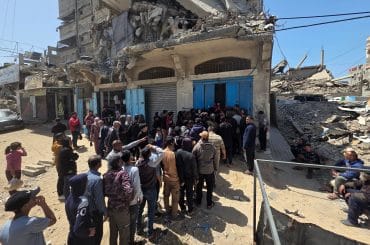
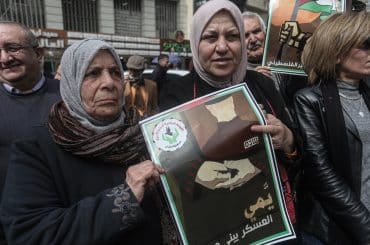
(Photo by Sameh Habeeb, from his show Victim's Victims at Dadabase)
My wife's friend in Gaza has sent me another report on life there, following on from my earlier challenge to her to tell me how it feels there, and to compare it to a book or film:
I cant say that it reminds me of any book or movie, because nothing can capture the feeling of living in a giant open air prison, and you really feel it, you feel so cut off here, the seige is really tangible. Life is as normal as it was before the war, but since 2006 life here has been very difficult. Many items like certain types of medicine, machinery equipment, lightbulbs, etc. are impossible to find, andthere is no way of ordering them, or bringing them in. The unemployment rate is somewhere between 50-80%, though no one knows exact numbers. Between Israel and Hamas the people here live in constant fear. Most children are suffering from traumas of different kinds. My friend, who lives next to the central police station, which is now gone–during the war the whole family stayed in one room in the house which they thought was the safest, because it was the furthest away from any windows. Now the daughters refuse to go back into that room. I have heard other children refuse to go to bed because they think that when they fall asleep there will be more bomb attacks and their parents might die while they are asleep.
This weekend I cried as I heard about the death of 6 members of the Batran family:
In the last major attack in Al Boreij refugee camp, on January 16th, six members of the Batran family were killed. The father is a Hamas official, and happened to be in the living room while his wife and five of his children were in the dining room and this is where the bomb hit. The youngest son (1.5 yrs) survived, as did his father, who ran with one daughter to the hospital, though she died soon afterwards. The other 4 children and his wife were immediately killed. I met their aunt, who is now taking care of the youngest son. He is not speaking yet, but when he sees the pictures of his mother, he keeps grabbing at the image of her. The aunt described to me how they had to search for the body parts of each child so that the hospital could sew them together so the bodies could be presentable for the funeral. They were finding hands, legs, feet, not knowing which child
they had belonged to. The oldest son's head was found on a tree outside the house. The doctors needed to use wooden sticks to hold the parts together. The aunt was hugging her daughter, and kept repeating how her daughter had wanted to have dinner at their house that night, and she had said no. This was the only reason that she could be holding her daughter right now. "You can only go through so much as a human being, I feel as though I have fallen apart and can never recover from this."
I must say that living in Haifa for half a year before this and seeing how the Israelis treated my Palestinian friends there made me really hate the Israeli treatment of Palestinians. I would go to restaurants and bars with my friends and I would walk through the door first and be welcomed, but when the hostess saw my friends she would say that the place was full, even though many empty tables were in plain view.
And at work I was dealing with cases of discriminatory laws in Israel, and just seeing the accepted institutionalized racism was awful. I was often attack by Israelis when they found out that I was working at a law firm that deals with human rights violations of the Palestinians within Israel, or when they found out I spoke Arabic and had Palestinian friends.
Here in Gaza, because the situation is so hard on a daily basis, and there is so much work to do, I don't have time to concentrate on hating Israel. And this is the same for most of the people I have met here. They are angry at Israel as well as Hamas, but they don't spend time talking about it. They are just trying to wake up each morning and be able to feed their children.