

Haj Ibrahim Abu el-Hawa has shaken the hand of President Jimmy Carter, listened to Ravi Shankar perform in his honor, met the singer Alicia Keys, was a great friend to the moderate settler leader Rabbi Menachem Froman, and is also indebted to the city of Jerusalem for nearly $100,000 in fines and taxes—all of which was disclosed in the first five minutes of meeting him. The 73-year old Palestinian proprietor of the Jerusalem “Peace House,” a modest hostel in the Mount of Olives that was opened by his grandfather after the June 1967 war, built an extension to his personal family house. Because of this addition, Abu el-Hawa, a fixture of Jerusalem’s coexistence camp, has been entangled in legal woes that could end in his imprisonment and the demolition of his family home if he cannot cover the fines.
“I want to be king, why not, the mother of my ten children, I want her to be queen. I want to have this old home so I can welcome you,” said Abu el-Hawa from his rooftop a short drive from the hostel, overlooking Jerusalem’s Zeitoun checkpoint and Israel’s separation wall. Abu el-Hawa moved into this building six years ago. His family of more than 40 persons is cramped. They need more space and so in 2008 the decision was made to begin construction on 10 new rooms, intending to fix two additional apartments inside of the structure.

But Peace House was Abu el-Hawa’s childhood home. Like his children and grandchildren now, he was reared in the company of foreign travelers. Today, the building in East Jerusalem is a guesthouse to globetrotters on budget trips to the holy land, and Abu el-Hawa is the esteemed manager and tour guide, offering visitor a glimpse into Jerusalem through the affairs of his personal life.

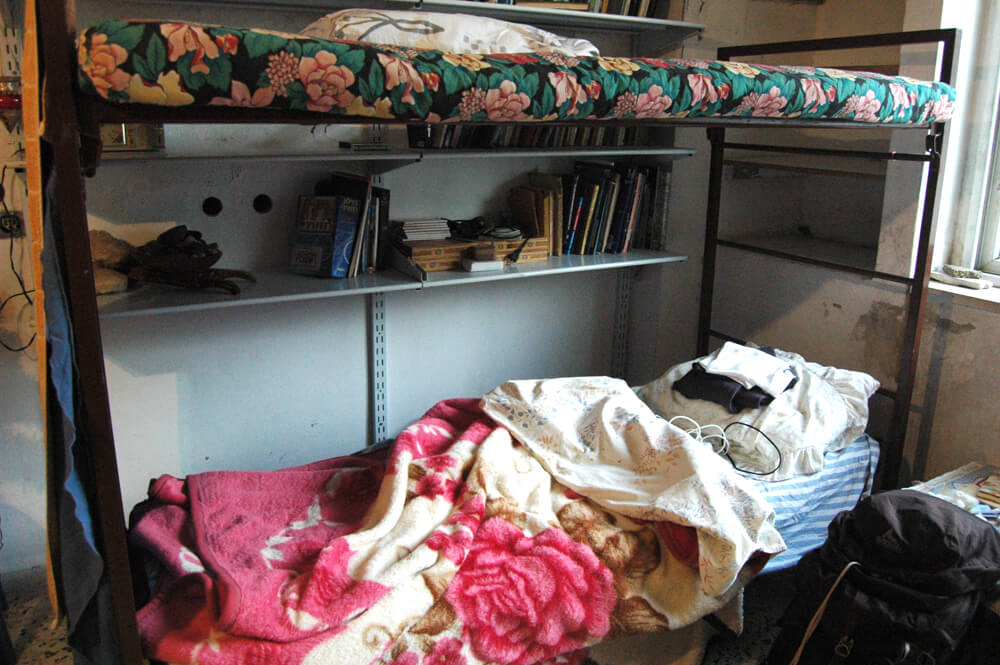
Two of his grandchildren sat on the stairs to the second floor bedrooms, now filled with bunk beds. Abu el-Hawa pointed to where one of his cousins was born in the late 1800s. Tacked to a bulletin board he showed a large photograph of the late A.J. Howar (née Yosef Abu el-Hawa), a Palestinian émigré who achieved success in America as a real estate mogul and the founder of the first mosque in the U.S., the Washington D.C. Islamic Center. It is one of many photographs slap dashed to the walls of the one-time prominent Jerusalem family that has struggled to make ends meet since the Peace House was opened.
The rooms used to be free of charge as part of his grandfather’s altruistic vision of bringing together followers of different faiths. “I believe in a way we are all the children of Adam and Eve and we are all one and we have to love one and another. But the leaders don’t want us to live together,” said Abu el-Hawa. However, like many Palestinians, financial burdens befell him.

To cover his bills Abu el-Hawa now asks the guests at his hostel for donations. The money the travelers leave him goes directly to the city of Jerusalem. Every month until 2018 Abu el-Hawa needs to muster $128 (500 NIS) for the cost of a building permit, and an additional $1,230 (4,800 NIS) to keep himself out of jail, a punishment for building without the permit. Even if his home is demolished, he will still owe the city thousands of dollars in punitive damages. In years past he used to earn a meager salary, but now Abu el-Hawa’s wages are garnished.
More recently, Abu el-Hawa was ordered to pay a lump sum to the municipality of $7,700 (30,000 NIS) for his constructing without a permit. That amount was first requested in 2013 through a court order. Abu el-Hawa had a stroke during the proceedings. “They moved me directly from court to the hospital,” he said, continuing that he was in a wheelchair for two months following the cardiac event. The trial was postponed until last month when Abu el-Hawa was given 30 days to pay the balloon amount. He said at first he was frightened of going to jail because of his failing heatlh and family responsibilities. “The judge told me, don’t be worried about this, old man. Everyone in prison is sick and we have doctors for them,” relayed Abu el-Hawa.
But with the assistance of an Israeli friend who set-up an Indiegogo crowd funding webpage Abu el-Hawa was able to receive the sum he owed the court in just under a week. Because of his Peace House, Abu el-Hawa has connections to donors across the world. “I’ve visited America 26 times and I’ve been to 44 states,” he boasted.
The situation of home demolitions in East Jerusalem is not unique to the hostel owner. The United Nations estimates that one-third of all Palestinians in East Jerusalem live in houses without permits. The city of Jerusalem also limits the amount of space where Palestinians can legally build to around 13-percent of the eastern half of the city. And an average of five-percent of Palestinian requests for building in East Jerusalem are approved each year, and the processing takes between five and 10 years, according to the legal group St. Yves.
Outside of the family home Abu el-Hawa’s son who lives in the same structure in a separate apartment, Mohammed Abu el-Hawa, 36, a plumber, said the family would move, but there are no houses for sale in the area with building permits. He shares a two-bedroom flat with his wife and four children. “I was born in the guesthouse,” he said continuing that he is proud to have been raised by a community of internationals. “We love it. It’s our life, we lived in this way since we were young children.” Many afternoons he still passes by for coffee or tea.
Pointing to rows of houses on the same street, Mohammed noted which residents were in jail for not being able to cover their fines for building without a license. Then motioning to the pavement below him Mohammed said, “We made the road not the government. We don’t have a permit.”

Sounds like he’s for normalization. SHouldn’t MW be cheering this demolition on?
haj ibrahim is well known , well regarded and even loved by many israelis. it is unfortunate the situation he finds himself in. i am not sure what the article is suggesting, if anything, other then the story that new construction permits in Jerusalem are hard to obtain. imagine if israel allowed unfettered new construction without adherence to style, aesthetics and topography constraints. (and no-i can see nothing particularly out of character or style about the ‘new’ addition). they would be accused by the world of allowing jerusalems unique beauty to be destroyed. israel most definitely has a bureaucracy with layers of red tape, corruption and a system of fines and punishments for violations not always meted out with blind justice. jail is obviously a threat but no more then jail is also the ultimate threat if one were not to pay a NYC traffic violation. its rare that jail is used in these situations-just as it is in other bureaucratic nations. and I doubt it will come to this. while the palestinian angle in jerusalem surely exists it is not as if an israeli jew without deep pockets and possibly ‘connections’ could build w/o a permit without landing in hot water as well.
also-with sites like MW growing in readership-I would’t be surprised if abu el-hawa would benefit greatly from a crowd sourced campaign-either a spontaneous one born of sympathy-or an organized one.
it would be interesting-and totally out of character-for mw to feature an article on the rampant and wild construction of new villas, pats and so forth by cronies of abbas and the PA in ramallah and other areas. as if ordinary palestinians in palestine have ANY say over what gets built and how it affects their current and future state. surely there must be some way to write an article like this and still adhere to the mw standard of showing israel as evil and bad.
“The rooms used to be free of charge as part of his grandfather’s altruistic vision of bringing together followers of different faiths. “I believe in a way we are all the children of Adam and Eve and we are all one and we have to love one and another. But the leaders don’t want us to live together,” said Abu el-Hawa.”
He’s correct, of course. But, really, the GoI wants him and his family gone~ forever.
And DaBakr~ Israel has despoiled the character of Palestine, and continues to do so with it’s ugly “architecture” and more.
Bless him and his family, and those who are trying to avert this crime.
I’m sure David Siegel is more than willing to share his dwelling with these unfortunate folks…
@-
DEBKA,DaArab, DaBakr,Q: also-with sites like MW growing in readership-I would’t be surprised if abu el-hawa would benefit greatly from a crowd sourced campaign-either a spontaneous one born of sympathy-or an organized one.
R: Dude, is that an unoccupied hilltop I see there right behind you?
Shoo, get busy!