Israeli-American Ronit Dinson makes the decision to leave Tel Aviv and return to the U.S., “Am I coward for saying “khalas” (Arabic for “enough”), I want out of here? Or, are there just too many avenues that have dead-ended here in Israel? I want the same thing that all Israeli Jews, Arabs, and asylum seekers want, to live in peace with my family and for my future children to have equal opportunities. I don’t see this happening here in Israel unless the apartheid structure finally ends and all people have equal rights, regardless of their nationality, race, or religion.”

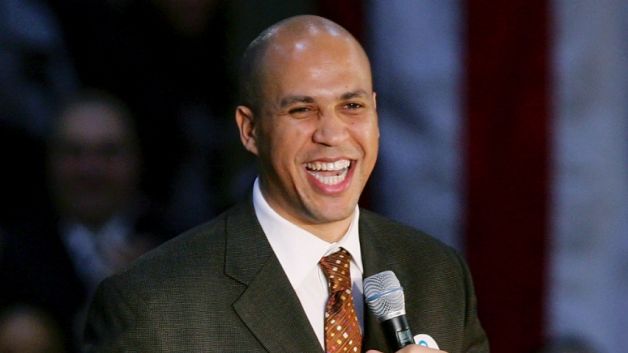
Senator Kirsten Gillibrand may want to run for president in 2020 and she is on the defensive from Israel lobby groups for withdrawing her name from anti-boycott bill. She pushes back, saying it is an “important part” of her oath to defend the Constitution that she protects the alliance with Israel. Sen. Cory Booker is under similar pressure.
On the 50th anniversary of Israel’s occupation of Palestinian territory architect Eyal Weizman re-released his book Hollow Land, which examines the political and vertical matrix that the Israeli military implements to control Palestinian land and lives. Weizman writes “Israel’s system of control, which evolved in fits and starts throughout the occupation’s first four decades, has, during its fifth decade, hardened into an exceptionally efficient and brutal form of territorial apartheid, in which verticality is the operative principle.”
Politicians from Senators Marco Rubio and Orrin Hatch to Chuck Schumer and Ron Wyden have been outspoken in their condemnation of Saturday’s Unite the Right March in Charlottesville and the vicious acts of terror it spawned. Yet, the same senators are united by their ardent support for a racist regime that is no less inspired by racial supremacy. By supporting the Israel Anti Boycott Act all have placed protecting Israel and its racially discriminatory policies above the rights of activists who are inspired by the same commitment to justice as the demonstrators who opposed the open display of racism and anti-Semitism in Charlottesville.
It is a familiar scenario. A Palestinian voice that defies a rigidly enforced popular narrative rises and is heard. Gatekeeper pro-Israel organizations, purporting to represent the entire Jewish community, spring into outraged action and whip up Islamophobic hysteria that terrorism and antisemitism lurk where Palestinian political expression is allowed. This scenario is playing out today, as the right-wing, pro-Israel brigade vilifies Reem’s California, an Arab street-corner bakery in Oakland, CA, as promoting terrorism and hatred of Jews and seeks to drive it out of business. Against this background, the local community, as well as social justice organizations, have rallied to Reem’s side.
In late July, dozens of Israeli settlers raided and occupied the Abu Rajab family home in the Old City of Hebron near the Ibrahimi Mosque. Since then they have slowly moved in under the constant protection of armed Israeli soldiers. Abu Rajab family members are now subjected to daily harassment from the settlers, while soldiers control the family’s every move in and out of the parts of the home where they have been able to remain.
While Palestinian protesters are generally armed with rocks and a few sporadic Molotov cocktails, Israeli forces are armed with some of the world’s leading crowd control weapons that they designate as “non-lethal.” But medical professionals say that considering tear gas, rubber-coated steel bullets, sponge rounds and .22 caliber live bullets as non-lethal is misleading. Mondoweiss spoke with Doctor Nasser al-Jaberi, the Director of the Emergency Room Department at the West Bank’s Arab Society Hospital, to get a better idea of what these weapons are capable of.
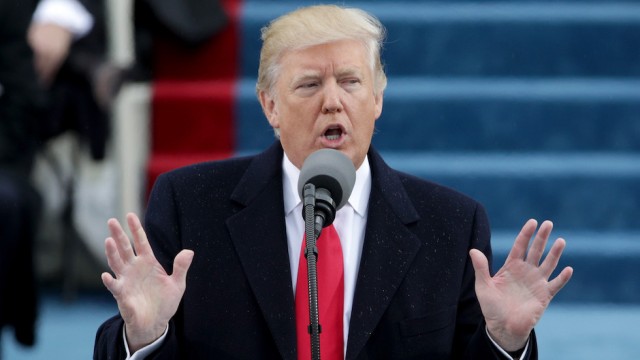
Jonathan Ofir compares Donald Trump’s weak and vague statement on the Charlottesville white supremacist attack with his earlier failure to address a specific question on anti-Semitism. Fir says Trump doesn’t notice bigotry because he fosters it.
Imagine that the women’s liberation movement was relegated to back yard barbecues? Imagine if the boycott campaign against South African Apartheid amounted to writing an op-ed and carrying a megaphone? Deep expressions of free speech and activism are absent from Senator Ron Wyden’s circumscribed description of free speech in justifying the Israel Anti-Boycott Act he favors.