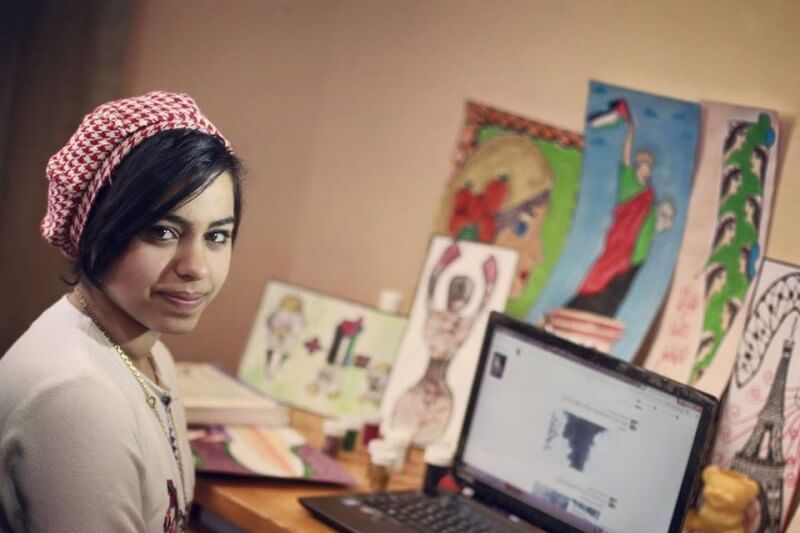
Last month, the case of Palestinian artist Malak Mattar made international news, as the young painter’s well-deserved scholarship to study in Turkey was slipping through her fingers. While Mattar herself is exceptional in myriad ways, her situation is far from the exception. Nada Elia says that Mattar’s challenges are exemplary of the decades-long violation of the Palestinian Right to Education, where increasingly it seems the Palestinian Authority is serving as an accomplice to limit Palestinian educational opportunities.
Dan Freeman-Maloy writes, “The worsening crisis in Palestine reflects more than a local record of colonial crimes, severe as these have been. Responsibility for it is global. Arundhati Roy was right to describe the Palestine tragedy as one of “imperial Britain’s festering, blood-drenched gifts to the modern world.” It is also a product of a history of racism and empire that extended across most of the West. On this centennial of the Balfour Declaration, reflection on this shared culpability should serve as a reminder of the responsibility for the political action that comes with it.”
Following a report released by Danwatch in January, Denmark’s third largest pension fund, Sampension, moved to exclude four publicly traded companies from their portfolio due to their investments in illegal Israeli settlement activities. Ana Sanchez, speaking on behalf of the Palestinian BDS National Committee, welcomed the move, telling Mondoweiss it represents, “the latest indicator of the mounting pressure on businesses that are deeply complicit in Israel’s violations of Palestinian rights to stop profiting from Israel’s military occupation and apartheid.”
Susan Rice repeatedly groveled to the Israel lobby group AIPAC when she was in the Obama administration and trying to get its support for the Iran deal. Now when she is out of power she calls Bullshit on the group. A cynical-making glimpse of the Israel lobby’s power, and of its growing partisan divide.
The Israeli Ministry of Education dropped an explicit prohibition on racist answers by students on civic exams. So if they answer, Different population groups should be allowed to live in separate neighborhoods, thereby justifying apartheid, teachers should let it go.
Esther Koontz, a Wichita public school curriculum coach and wife of a Mennonite pastor, endorsed Boycott, Divestment and Sanctions (BDS) against Israel because she came to believe through her church that it will end the occupation, in the same way that boycott ended apartheid in South Africa. Now she is suing the state of Kansas over a law prohibiting contractors from boycotting Israel, saying it violates her First Amendment protection of political beliefs and associations.
Organizers began the D.C. Palestinian Film and Arts Festival with the goal of creating an environment for Palestinian artists in the diaspora to express themselves outside the political frame that has become synonymous with Palestine. One example of this in the recently concluded 7th annual festival was a unique and memorable space for Palestinian storytelling.
After being censored for a year, “The Siege” by the Jenin Freedom Theatre premiered at the Skirball Center at NYU. Phil Weiss reviews the production: “For an hour and a half you are transported entirely inside the Palestinian narrative. There is no coerced attempt at balance, there are just Palestinians, joking, swearing, fearful, resisting, wondering at their fate. It’s all that anyone seeks to do in a work of art: to tell their truth. I have not seen this consciousness conveyed so genuinely before in a mainstream cultural space.”
Steven Salaita travels to Ireland and has an unexpected encounter with a border agent who shows support for Palestine: “By the time I was shivering in Dublin’s oceanic air, it occurred to me that the customs agent hadn’t provided special treatment; he was merely treating me with the sort of dignity proffered to anybody seen as human. I am unaccustomed to that kind of normalcy. In the anti-Zionist’s world, venality is routine.”