
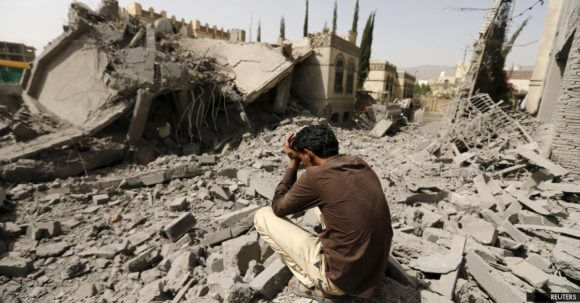
The United Nations refers to Yemen as the worst humanitarian crisis on earth and there’s no recent news to indicate that title is on the verge of being bestowed elsewhere. In recent weeks, Yemen has been devastated by severe storms that have killed more than 130 people and displaced 350,000 families. This is on top of a destroyed economy, a COVID crisis, a looming famine, and consistent Saudi-led airstrikes on the country. Things are set to get even worse, as the U.N. is facing a massive funding crisis that prevents them from supplying the amount of aid needed.
“[Yemeni children] — and many other people — will die without your help,” Assistant Secretary-General for Humanitarian Affairs Ramesh Rajasingham recently told the U.N. Security Council. “They feel like they’re being punished unfairly by a world that promised to help but is now turning its back. In the next few weeks, the cuts will go even deeper. At the end of the month, we will reduce water and sanitation programs by half in 15 cities. In September, we’ll stop supporting nearly 400 additional health facilities, cutting off 9 million people from medical care. We’ll also stop treating more than a quarter million severely malnourished children.”
The U.S. connection to Saudi Arabia’s war on Yemen is well-documented, as the bombing was backed by Obama and now Trump. As of July, The Yemen Data Project estimated that the Saudi-led coalition has killed more 8,700 civilians and most of those deadly attacks were carried out with weapons purchased from the United States. During the previous administration, there was a fair amount of public handwringing about Saudi atrocities, but no real attempt to hold the country accountable or curb military aid in any way. In fact, the Obama administration ended up giving Saudi Arabia more than $115 billion in weapons and training, more than any other president in history. Remind you of that administration’s policy toward another country?
The massive gap between the Obama team’s human rights rhetoric and its actual foreign policy was on full display in 2016, after Saudi bombs destroyed a bridge that was used to transport United Nations aid to the people of Yemen. The U.S. government had put the bridge on a “no strike” list, but that request was ignored. Ambassador to the U.N. Samantha Power tweeted a picture of the destruction and wrote, “Strikes on hospital/school/infrastructure in #Yemen devastating for ppl already facing unbearable suffering & must end.” The United States continued to refuel the jets used in such attacks.
In a piece on Yemen published in The Atlantic at the end of Obama’s presidency, Samuel Oakford and Peter Salisbury wrote, “Increasingly skeptical of America’s ability to shape events on the ground in the Middle East, Obama sees little incentive to overturn the status quo, even if that means supporting the apparently reckless military forays of a government he disdains.”
Shortly before leaving office, Obama restricted the sale of precision-guided weapons to Saudi Arabia, citing “flaws” in the way that the country carried out air strikes. The meager move was obviously rolled back right away by the Trump administration. Now this brutality is supported without pretenses. There’s no concerned tweets from Pulitzer Prize-winning officials or internal disdain over the government’s own decisions.
Last year, congress passed a historic war powers resolution aimed at stopping U.S. support for the attacks. The effort came about after years of tireless organizing from activists. It was predictably vetoed by Trump. “This resolution is an unnecessary, dangerous attempt to weaken my constitutional authorities, endangering the lives of American citizens and brave service members, both today and in the future,” he declared.
What would Yemen policy look like if Biden is elected? As usual, foreign policy has barely been discussed by the media during this election season and, insofar as the Democrats talk about it, it’s usually about “standing up to China” or attacking Trump’s alleged connections to Russia.
Biden has mentioned Yemen specifically a few times and ending the war is in his platform. “We should bring the vast majority of our troops home — from the wars in Afghanistan and the Middle East — and narrowly focus our mission on al-Qaeda and ISIS,” he said last July. “And we should end our support for the Saudi-led war in Yemen. Staying entrenched in unwinnable conflicts drains our capacity to lead on other issues that require our attention, and it prevents us from rebuilding the other instruments of American power.”
It’s unclear how Biden would go about doing any of this, or what “narrowly” focusing on terrorism would potentially encompass.
I asked Shireen Al-Adeimi, an assistant professor at Michigan State University, about the potential impact of a Biden victory. Al-Adeimi is from Yemen and has been raising awareness about the Saudi-led war since it began.
“I think that it’s important to remember this war started with the Obama/Biden administration, and wouldn’t have been possible without their extensive military support,” she told me. “While Biden’s platform includes a statement about ending support for the Saudi-led war in Yemen, it’s important for activists to ensure this is fulfilled to its fullest extent (not just ending weapons sales but also ending all forms of military cooperation between the US and Saudi/UAE.) This is the least we can do given Obama/Biden’s complicity in the war. If Trump wins, of course, then we continue doing what we’re doing now, which is to push for legislative action to force an end to the war, this time with a veto-proof majority.”
BDS Backtrack
The Massachusetts primary is next Tuesday. Last week I wrote about the foreign policy stances of some of the progressive challengers. There’s been an interesting development in the 4th congressional race, where a number of candidates are trying to fill the seat that Joe Kennedy vacated to run against Sen. Ed Markey.
Jesse Mermell (whose website refers to her as a “bold and progressive leader”) filled out a questionnaire, for the group Massachusetts Peace Action, where she said she would oppose any anti-BDS legislation and that she’d support H.R. 2407, Rep. Betty McCollum’s historic bill promoting the human rights of Palestinian children. Over 10,000 Palestinian children have been detained by Israeli security forces since 2000 and the bill would prohibit U.S. funds from being used for the practice.
Now Mermell is walking those responses back, telling the Jewish News Syndicate (JNS) that there “was an error due to misunderstanding a very opaquely worded question.” Mermell now says that she supports House Resolution 246, a bill that condemned BDS and effectively tagged the movement as antisemitic. As for the McCollum resolution, Mermell’s campaign now claims she was actually talking about H.R. 4391, a previous version of the legislation.
“She has great concern for the issue of children’s rights, including those flagged in this bill, but as the substance of the bill changed over time, she has become increasingly concerned about overreaching language and unintended consequences, including reducing Israel’s ability to defend itself,” a spokesperson told JNS.
Mermell is not the first person to claim she supported the original version of McCollum’s bill, but not the more recent one. There are actually multiple lawmakers who cosponsored H.R. 4391, but haven’t signed onto H.R. 2407, including Rep. Ro Khanna. Last year, Khanna’s office told me that the congressman was “currently evaluating” the bill because it had changed. He has yet to cosponsor the new version.
So, what’s the difference between the two bills? I asked Brad Parker, a senior policy advisor for Defense for Children International – Palestine, that question last year. Parker worked alongside McCollum to help develop the measures. Here’s what he told me:
Working with Rep. Betty McCollum again in early 2019, H.R. 2407 was the result as it maintains the same specific prohibitions that were included in H.R. 4391, but includes them as generally applicable language as an amendment to existing U.S. law. The bill adds an amendment to the Leahy law. The way the Leahy law works is there are specific types of violations that would trigger the Leahy law prohibitions on training and assistance. H.R. 2407 doesn’t apply specifically to Israel, it applies to any country in the world that prosecutes children in military courts and denies basic due process rights. I think it’s a step forward from the last bill.
So, in other words, people have cooled off on the effort because it has moved beyond symbolism and aims to actually hold Israel accountable on a deeper level now? H.R. 2407 currently has 23 cosponsors and recent Democratic primary winners like Cori Bush and Jamaal Bowman have indicated that they’d support such efforts when they reach Congress.
The most progressive candidate running for the 4th district seat is Ihssane Leckey. The former bank regulator has said she would oppose any anti-BDS legislation and that she supports the McCollum bill. Responding to a Boston DSA survey, Leckey wrote, “I support the ending of the Israeli oppression of the Palestinian people, including supporting the BDS (Boycott Divestment Sanctions) movement, but do not support sanctions.”
Her campaign has since aimed to clarify that statement. “This is a complex issue that requires nuance and cannot be simply answered with a yes or no,” a campaign spokesperson recent told Jewish Insider. “Any attempt to remove nuance and shut down dialogue does a disservice to this issue and the fight for justice for both the Palestinian and Israeli people.”
Odds & Ends
? Mary Ann Mendoza, a member of Trump’s advisory board, was pulled from the Republican National Convention lineup after she retweeted a thread about how the world is enslaved by Jewish people. The tweets that she shared were written by a QAnon conspiracy theorist. In addition to detailing a Jewish banking plot that has allegedly been designed to “rob the goyim of their landed properties”, the tweets also claimed that The Titanic was sunk to protect The Federal Reserve and that the antisemitic Protocols of the Elders of Zion hoax was actually real.
“Do yourself a favor and read this thread,” Mendoza told her followers, but after The Daily Beast reported on her social media activity, she deleted it and apologized “for not paying attention to the intent of the whole message.”
? In an extremely on-brand move from the Trump administration, Secretary of State Mike Pompeo apparently violated The Hatch Act so he could address the RNC from Jerusalem. Executive branch employees are prohibited from political advocacy while in office. “Pompeo dives into GOP confab from Jerusalem, defying precedent and possibly law,” read the unintentionally hilarious headline from The Times of Israel.
? Last year, New England Patriots owner Robert Kraft pledged $20 million to create a foundation that fights antisemitism and the BDS movement. “My vision is to work to end the violence against Jewish communities,” Kraft declared after accepting an award from Benjamin Netanyahu. “To counter the normalization of anti-Semitic narratives that question Israel’s right to exist, disguised as part of legitimate debate on campuses and in the media.”
Kraft’s foundation recently revealed its first major initiative, [Together Beat Hate]. The project’s website links to the controversial International Holocaust Remembrance Alliance (IHRA) definition of antisemitism, which equates some criticisms of Israel with anti-Jewish prejudice. It also recommends Bari Weiss’s book as a resource on the subject.
Jewish Insider reports that Kraft is constructing a “digital command center” at Gillette Stadium, where the Patriots play their home games. It will be used to “track more than 300 million websites and social media platforms across the internet and dark web, compiling data on incidents and trends in antisemitism.”
? The Society for the Study of Social Problems (SSSP) was founded back in 1951. It’s comprised of scholars and students, and its purpose is to “promote and protect sociological research and teaching on significant problems of social life and, particularly, to encourage the work of young sociologists…”
Recently at the group’s annual meeting, a majority (53%) of members voted to support the BDS movement. However, because of a new rule that now requires a two-thirds majority, the motion failed to pass. A spokesperson for the motion’s cosponsors said, “SSSP as a society strives to model solidarity and social justice to foster alternative visions and practices. SSSP members are committed to full human rights and academic freedom for all, including Palestinians who have formulated specific requests for effective solidarity. We will continue to work to ensure that the values of SSSP are upheld at our annual 2021 conference in Chicago.”
?? In a call with donors, vice presidential nominee Kamala Harris promised that Biden wouldn’t condition aid to Israel under any circumstances. “Joe has made it clear he will not tie security assistance to any political decisions that Israel makes and I couldn’t agree more,” said Harris. “The Biden Harris administration will sustain our unbreakable commitment to Israel’s security, including the unprecedented military and intelligence cooperation pioneered during the Obama-Biden administration and the guarantee that Israel will always maintain its qualitative military edge.” A 2019 poll found that 71% of Democratic voters support conditioning aid.
? Solidarity with all the athletes standing up for justice this week.
Stay safe out there,
Michael

