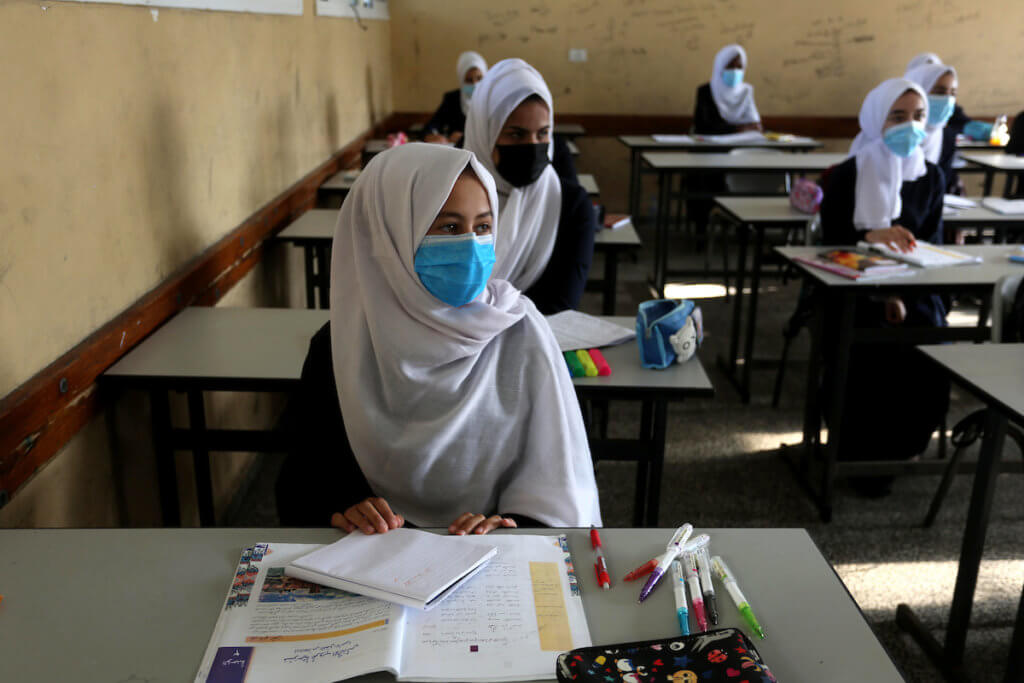
Palestinian students wear face masks as schools partially reopened amid the coronavirus pandemic in Deir al-Balah in central Gaza on October 28, 2020. (Photo: Ashraf Amra/APA Images)
The latest:
- 64,741 Palestinians tested positive for COVID-19; 57,234 recovered; 553 deaths
- Of Palestinians who tested positive for COVID-19, 46,728 are in the West Bank; 11,666 are in East Jerusalem; and 6,347 are in the Gaza Strip
- 313,701 Israelis tested positive for COVID-19; 299,822 recovered; 2,514 deaths
For a second week in a row Israel will continue to scale back lockdown measures that went into effect in mid-September, but some form of closure will continue until at least early 2021.
On Thursday Israel’s cabinet approved extending the state of emergency until January 3 next year. At the same time the government moved forward with phase two of reopening, a gradual six-part process with no specified end date.
While children will largely still be kept home from schools, this week first and second grade students will return to classes for half of the week. Synagogues, churches and mosques will reopen this week beginning on Sunday and 10 people will be allowed to gather indoor for services and 20 for outdoor.
Bed and breakfasts will be allowed to reopen this week, with bans on gatherings in communal areas. Next week street level stores will reopen.
Israel’s Prime Minister Benjamin Netanyahu told reporters Thursday, that if cases of new infections began to increase again, he would reinstitute broader closures:
There is a link between the restrictions that we impose and the spread of the disease. If the disease increases, we impose more restrictions. If the disease decreases, we lift the restrictions. However, there is one thing that cannot be lifted and that is the masks. We reached the point in which we can maintain a routine in the shadow of the coronavirus until the arrival of the vaccines, but all of this is conditional on our continuing to follow the directives and mainly to continue acting together and with mutual guarantee.”
“Let it be clear to everyone,” Netanyahu warned, “if morbidity goes up in this or that city, I will not hesitate to recommend that the cabinet close that city, cordon it off.”
Students head back to in-person instruction in Gaza
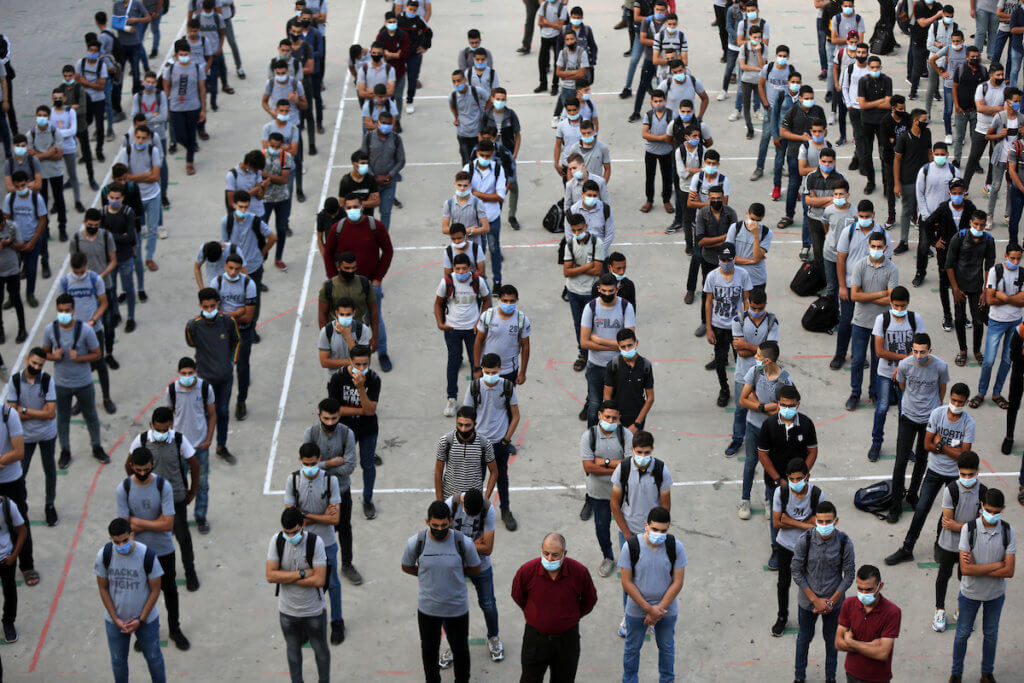
Palestinian students wearing face masks stand six feet apart during a morning activity as schools partially reopen amid the coronavirus pandemic, in Deir al-Balah in central Gaza on October 28, 2020. (Photo: Ashraf Amra/APA Images)
In Gaza, lockdown measures implemented almost two month ago will continue to be lifted this week after restrictions were first eased two weeks ago. Seventh through 11th graders will return to classes beginning Sunday, amounting to around 125,000 students. They will join 12th graders who were the first cohort sent back to classes last week.
Mosques will reopen at reduced capacity. A general overnight curfew is still in place across Gaza, banning travel between 8 p.m. and 7 a.m. Local hotspots Beit Hanoun al-Bureij refugee camp and the Sheikh Radwan neighborhood will continue to be under full lockdown and travel in and out of those areas is banned.
According to the World Bank’s latest situation report, during the month of October the total number of COVID-19 cases increased by 13,696, with a daily average of new cases reaching 472 cases.
The highest number of total active continues continues to be in Hebron, with one-third of active cases coming from Palestinians in Gaza.
A sanitizing innovation
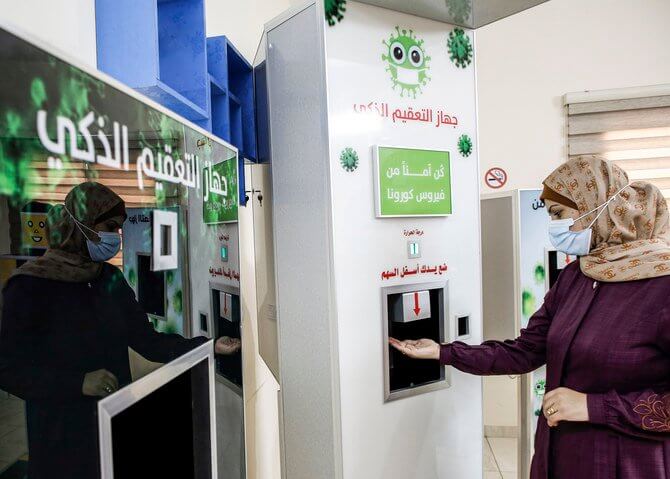
Palestinian entrepreneur Heba al-Hindi demonstrates a locally-designed and manufactured sterilization device in Gaza City. (Photo: Mohammed Abed/AFP)
This week AFP profiled a 37-year-old mathematician and inventor, Heba al-Hindi, who built a commercial sanitizing station and temperature check. The six-foot device is used outside of restaurants and places of business and flashes a red signal if a patron using the machine is running a fever.
“In Gaza, we have basic devices imported from abroad to measure temperatures, and others to disinfect, but our devices combine multiple technologies in one,” Heba al-Hindi told AFP.