

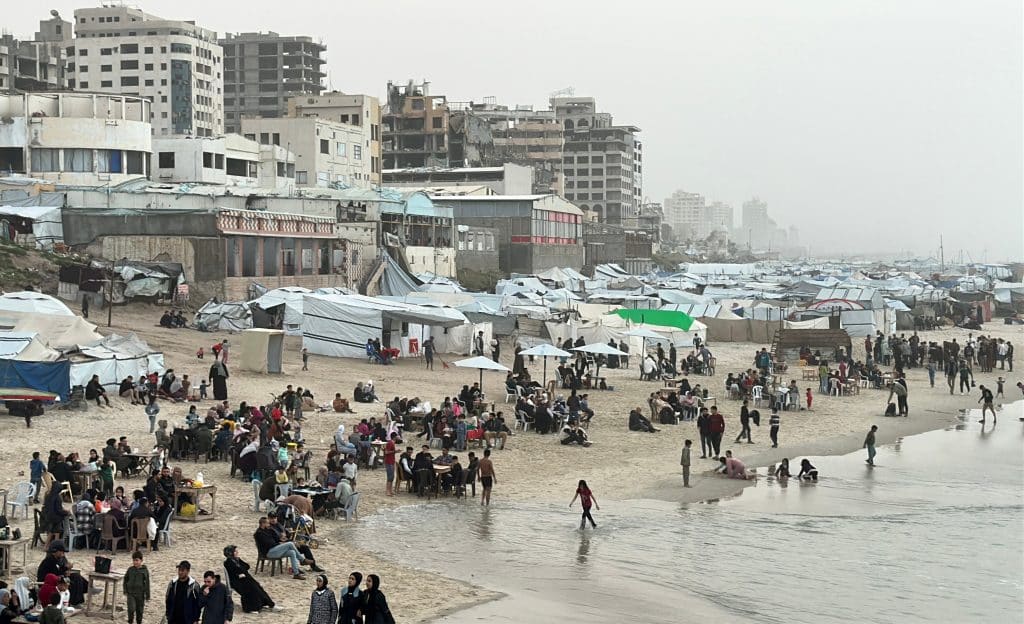
Lovers and poets often describe first love as something lasting and difficult to replace, even if it fades after a few years. But what happens when that first love is a homeland, the place where a person was born and where their memories with family and loved ones were formed?
A person can fall in love again, and sometimes even more deeply than before. But what does someone who has lost their homeland say? When the place they lived in is erased and destroyed and no longer exists — can they heal from their wounds? Can they find an alternative homeland? And can they love another country as they loved their own, or even more?
All these questions never leave my mind. When I see something beautiful in another country, I find myself comparing it to Gaza—imagining how it might have looked there. Perhaps in Gaza it would have been more beautiful than this, and perhaps we would have had libraries, airports, wide, paved roads, and order. If only we had not been struck by misfortune, and if the Zionists had not come to our land to steal it from us.
The questions extend further: why have we been denied a homeland until now? Why was it taken from us, forcing us into exile? And why is this occupation destined to last our entire lives, and the lives of our children, and of their children?
All that a Palestinian wants is a homeland where they can belong, the same place that continues to be taken from them, piece by piece.
Palestinians are scattered all over the world, searching for safety and for a place where they do not face daily killing. If you were to meet any Palestinian anywhere in the world and ask them if they’re happy with leaving their country behind, they would answer without hesitation: if there had been no occupation of their homeland, they would not have thought about leaving it for a moment.
We speak of our country as beautiful—its climate, its seasons, its landscapes. In a single day, one could move from the sea in Gaza to the mountains of Nablus and Hebron, passing through plains and valleys along the way. These are not distant places, but parts of a whole that we cannot freely experience together.
Since I left Gaza in April 2024 until this very moment, I think daily about the same question: why do we not have a homeland? And why must we remain like this in life, searching for a homeland, when we are born in the most beautiful of homelands?
Meanwhile, the world watches Palestinian suffering unfold on screens each day — children dying in their mothers’ arms and women’s bodies decomposing under the rubble. I say to myself that perhaps after decades, world leaders will gather to decide on finding an alternative homeland for Palestinians as a result of such oppression and injustice, just as they once gathered to decide that Palestine would be an alternative homeland for Jews who were persecuted in Europe.

Thank you Tareq. Your article made me think of the many drivers for emigration. I lived in Spain for a while to learn the language before returning to do postgraduate work in the UK. I often wonder what life might have been like had I stayed in a country I am still really fond of. My cousin Sue and her husband moved to New Zealand when he was offered a senior university post in Wellington and are now happily retired there. I went to school with the sons and daughters of Polish and Czech soldiers who stayed in London rather than return to their homelands under Soviet repression. I have a friend who fled Syria (being quite a well-known dissident). He has returned since the fall of the Assads, but has roots now in England with his English wife and binational daughters. My parents and half their siblings left Ireland to escape poverty and joined that riotous diaspora of which I am an honorary member.
But we all have one thing in common: a place to return to, should we wish or should it somehow become necessary. And that is what the Palestinians in their diaspora are denied by their oppressors.