PALESTINE BLEEDS FOR YOU
By Ramsey Hanhan
226 pps., Fomite Press, $35
What would you do if your homeland was taken over by fascists, racists who built and seek to entrench a political system of supremacy, in which truth is distorted and “lesser” and non-citizens are oppressed, detained, and expelled?
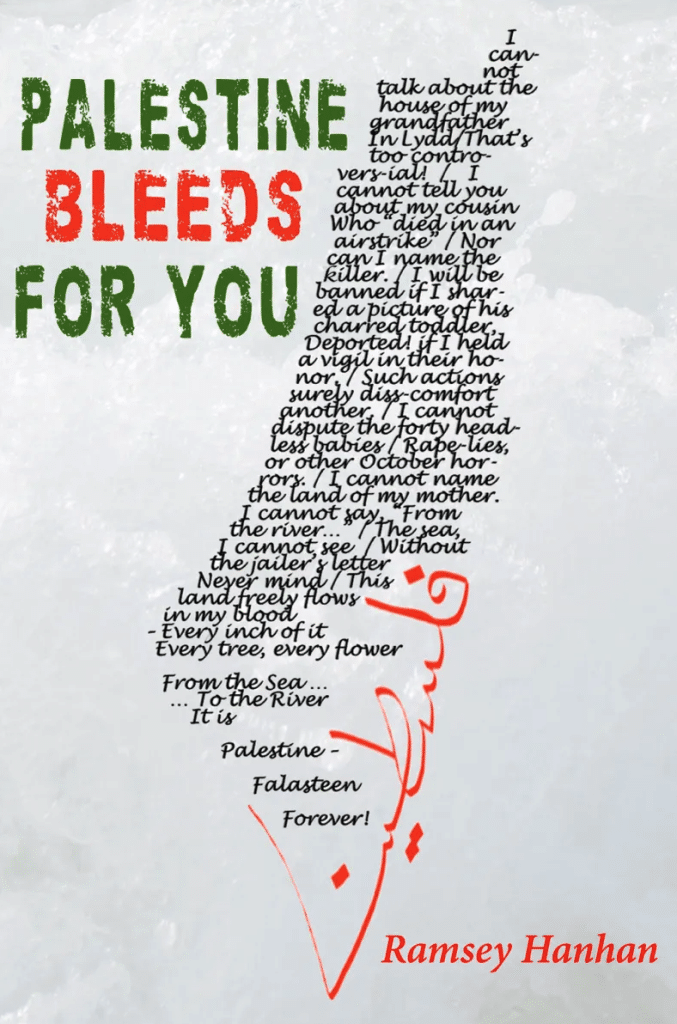
Ramsey Hanhan’s response is to confront that apartheid system with thoughtful scholar-activism, thoroughly grounded in the land and people. A Palestinian Christian and activist in the DC metro area and beyond, he just published his second book, Palestine Bleeds for You to counter “Empire” and especially its protégé, Israel, purveyor of oppression.
Ramsey is among growing numbers of writers who understand Palestine stands in the intersection of advocacy for genuine equality, the struggle over truth-telling to a biased Establishment, the meaning of freedom, the implications for democracy, and so many “tactical” issues of our era, from corporate control of the media to moral oversight of artificial intelligence. While the common Zionist perspective, which privileges the lives and narratives of Israel’s Jews over all other considerations, opposes Palestine’s freedom, Hanhan’s work shows us that in winning freedom for Palestine we’ll open many other doors as well.
Thus, while at first cut the title Palestine Bleeds For You may seem overwrought, it’s simply leaning into its front-line mission. As Hanhan notes:
“Whatever is being done to Palestinians right now will be repeated on other groups shortly. The precedents are being set and the repressive laws enacted…Palestine protesters on college campuses and elsewhere are therefore fighting for you and your liberties!”
Ramsey’s path to championing Palestinian rights wasn’t automatic; he sought a “normal” life in the sciences for decades but was transformed by writing a letter to his daughter—akin to Ta-Nehisi Coates’ letter to his son that became Between the World and Me. For Ramsey, this explanatory missive became his first book, Fugitive Dreams: Chronicles of Occupation and Resistance.
Ramsey’s journey is the extension of a multi-generational struggle over his homeland. His grandparents and their children—Ramsey’s mother is from Yafa and his father from Ramleh—were expelled in 1948. Many Palestinians in Yafa (“Bride of the Sea”) fled south by boat to Gaza, but Ramsey’s grandparents landed in the West Bank. From there, at sixteen—his mom’s age when she was driven from Yafa—Ramsey came to Michigan.
PBFY combines poetry, essays, and graphics—the front cover is Ramsey’s beautiful poem, “From the Sea to the River,” its words forming the map-shape of Palestine—in the style of Halasa and Elgrably’s Sumūd. PBFY’s compositions though are chronological, like the pithy texts of We Are Not Numbers. Since the genocide started in Gaza, such essay-poetry combinations proliferate, including Mohammed El-Kurd’s Perfect Victims and You Must Live by Sherah Bloor and Tayseer Abu Odeh.
A sensitive and thoughtful writer, Ramsey approaches his craft with tenderness—often signing off “with love”–and a duty to defend his people. Even so, he doesn’t hide his anger against Israel’s oppression or his bitterness at Palestine’s abandonment by the government of his second homeland. He abides in hope—and action—for eventual freedom. Ramsey’s essays and poems are often topical, inspired by events and the politics of the day, or sparked by the whimsical, or built from biblical insights.
PBFY’s real-time essays begin on October 7, 2023—Ramsey was in the West Bank to visit his brother, Basman. Like most Israel-watchers, he feared the worst, and so Part I, “Dispatches from Palestine,” begins with a prescient and desperate poem, “Airplanes”:
What do I pray for, when planes roar overhead?
…

The planes roar overhead;

What is there left to pray?
Ramsey’s account of the first week of the genocide is essentially written in real time. Each subsequent day until his return to America is reflected in a brief essay on a different topic: sumoud (steadfastness), “sky terrorism,” Jesus as a Palestinian revolutionary, an Israeli contact’s post that on October 7 “the war came into our living room,” his pride in Congress member Rashida Tlaib. This section concludes with a discussion of Zionist efforts to silence those speaking out for Palestine and draws inspiration from Proverbs 31: “Open your mouth for the mute, for the rights of all who are destitute.”
The poems, mostly in Part II, have many sources. “A rose among gods of stone” muses on the first days of genocide during a walk in Ramallah.
We reach a road deserted.

But for speeding police cars.

…

No cover from drive-by rat-tat-tat

We turn back.
One of the more sad and beautiful poems is “A Date With Palestine.” The poet’s lover is the mysterious land, its lives and losses, and native character. She seems coy, but perhaps is simply stolen:
She sees me not

From behind her chosen veil

…

I kiss a stolen orange blossom

Only to feel the sting—

Of silence
Part III, “Essays from America,” is as titled. Themes from U.S. politics include censorship, PTSD, Empire and its watchdogs, mass shooters, and “othering.” In one piece, a water service interruption around Ramsey’s home near Baltimore occasions an hour-by-hour comparative meditation on Israel’s deliberate deprivation of water to Gaza’s Palestinians…“two million Gazans pushed out of their homes…none could carry as much water as I hoarded for seven hours.”
A deliberation on the power and meaning of language in “’Free Palestine’: What it Means to Me” is instructive. For instance, the slogan “Let Gaza Live” is defeatist, rendering “Gaza” an object, its fate dependent on the occupier. For whom else has the power suggested in the slogan?
“The Olive Harvest” describes the growing risks since October 7 that Palestinians will encounter a settler-organized pogrom during their annual harvest of olives, in contrast to the comparatively joyful fall harvest in Ramsey’s youth. This resonates: “Olive trees are almost sacred, revered for their strength, stability, and productivity…Certain olive trees in Jerusalem are said to be living witnesses to Jesus’s prayers underneath them….the olive branch a symbol of peace, brotherhood, and hope.” John and Samuel Munayer delve deep into such themes in The Cross and the Olive Tree.
Old and New Testament themes are prominent, highlighting biblical and spiritual parallels to today’s developments.
That buzz over head

Not bees but the wrath of the golden calf of history!

Bless’d by gods with hearts of stone.
The drone is a manifestation of a false idol, Israel’s military prowess. Its use mirrors the hardcore Zionist idolization of the Israeli state, which Peter Beinart brilliantly dissects for replacing veneration of Judaic principles in On Being Jewish After the Destruction of Gaza.
The book isn’t perfect, but its flaws are tactical. There is some repetition regarding Israel’s 1948 expulsion of Ramsey’s parents’ families that results from his narratives being standalone vignettes. Some arguments seem naïve and impractical, such as the exhortation to oppose Empire by ending our consumerism. Since PBFY isn’t an argument about living off the land, the reader may feel stranded. In contrast, not buying Israeli products is a sensible BDS stance, pointed and nonviolent; objectionable only to those who see an “antisemite” driving every action against Israeli oppression.
That said, Ramsey’s principles are sound. In explaining why he left his university position, he cites Senator William Fulbright’s The Price of Empire: universities lose their independence by accepting research funds from government agencies, especially for military research. He’s not wrong, though everyone’s not called upon to oppose Empire by resigning their Establishment job.
On balance, PBFY is a gem from the heart of a conscientious and indefatigable author-activist. Its poetry is a sensitive and astute expression of grief and resistance to oppression. In equal measure, its essays offer insights from a Palestinian American’s perspective on the impact of American politics on Palestine, on Palestine’s refraction of our own politics within the broader narrative struggle for Truth, on foundational principles such as Freedom, Equality, and Free Speech, and on the spiritual legacy of the Holy Land.
In this election year, we’ll also begin to learn whether we can overcome what Ramsey describes as the dilemma of the 2024 presidential campaign: “being pressured to vote for the person killing our relatives in Gaza because the other guy would deport us.”
Kirk Campbell
Kirk Campbell is a career Middle East analyst and founder (2008) and coordinator of the DC-area running group Iqraa (“Read!” in Arabic), which raises funds for university scholarships for Palestinians in Gaza, the West Bank, and Jordan. Among his many activities, Ramsey is an Iqraa alum.