There is a Hebrew phrase that has been etched into Israeli culture and is perhaps one of its most authentic expressions. The phrase is yorim ve-bochim, or “shooting and crying,” and it has become a staple of Israeli cultural production. Its first iteration is dated to a novella written in the wake of the Zionist forces’ deliberate expulsion and ethnic cleansing of Palestinians in 1948, what we Palestinians call the Nakba. The novella Khirbet Khizeh, written by S. Yizhar and named after a fictional Palestinian village, follows a young soldier as he attempts both to belong fully to a unit tasked with “ethnically cleansing” the village and to grapple with guilt and moral uncertainty. The soldier decides to defer the reckoning to a later date, to finish the job and then do the emotional labor.
Over half a century, the genre has acquired its own conventions: it usually features a sensitive Israeli soldier who delivers an elegiac voiceover and admits to crimes only when the admission can no longer change anything. Yizhar’s novella itself played a big role in shaping the writing of a generation of Israeli authors, and many Israeli films, including Waltz with Bashir and The Law in These Parts, and even the sloppy Fauda. All of them feature elements of the “shooting and crying” trope.
These works are made by people who remained committed to the Zionist ideal of land and sovereign power exclusively for Jews, but who still struggled to mitigate the toll that a colonial project exacts on the “soul” of its agents, hardening their moral aptitude and producing a soulless, masculine, and unbothered militant figure. In many ways, one can read this genre as a fear of what they will become as they unleash violence and participate in the eradication and destruction of Palestinian life.
So, when I went to watch NAZA, I was ready for this transaction. I expected to watch Israeli soldiers reckon with the crimes they committed and display remorse. I expected to watch Israelis redeem themselves through the performative moral gestures of confession, and through complex takes on necessity, politics, and moral cost. My suspicion was, here we go again, another movie where Israelis emerge as more interesting, more human, and more capable of a full range of feelings, while Palestinians remain the “primitives” serving as background to the civilized creatures who shoot and cry.
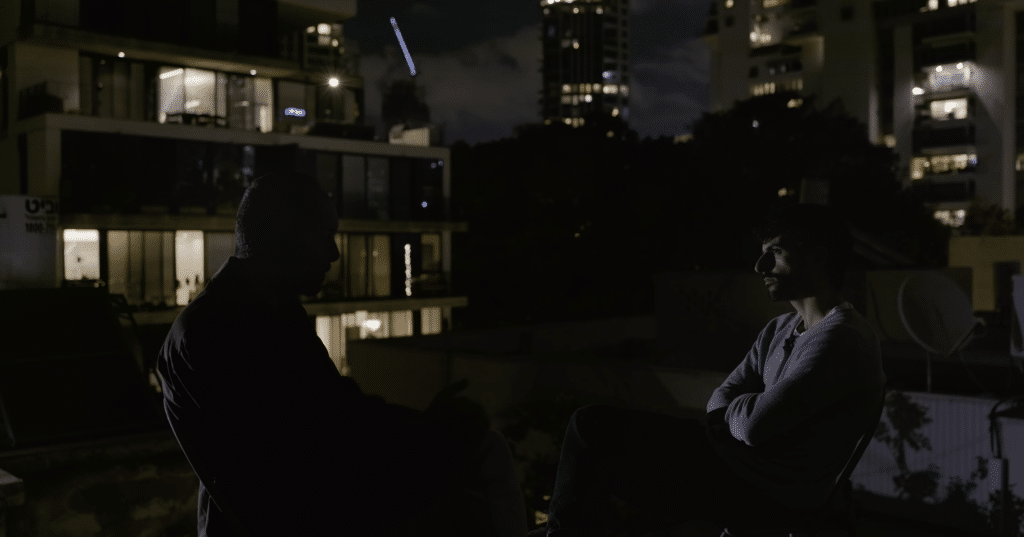
What I found instead was something more harrowing and more honest. The subjects are hidden out of fear of Israeli criminal prosecution: not for committing crimes against Palestinians, but for confessing to those crimes and making the confessions public.
We do not hear their voices, and we are told that, as they sit on rooftops across Tel Aviv, most of the confessors are “liberal,” upper-class types, the sensitive Israelis the 1949 novella depicted. These are not the crude settlers who kill in the name of the coming messiah; they are the secular liberal humanists who, as one of the anonymized protagonists of the film claims, “do not hate the Arabs.”
My first reaction, beyond anger and a grief that bordered on shock, was a thought I distrusted even as I had it: that there is something to be said for Ben-Gvir when he is set beside these yoga-practicing, avocado-eating, sourdough-baking software engineers from Tel Aviv.
Let me be clear and leave no room for misunderstanding. Ben-Gvir and his ilk are the scum of the earth, but their racism, sense of supremacy, and contempt for Palestinian life are declared and, in many ways, displayed in their full truth, without hesitation. What disturbs in the confessions of these Israelis is not only the resemblance to Eichmann — meaning the “thoughtlessness” and banality of evil in the procedures that the Israeli war machine has perfected, embedding violence in machinic systems and mathematical equations — but is also the absence of a moral reckoning with such crimes, beyond explanations of what they did and how they did it.
Yes, we get the “I couldn’t take this anymore,” or the silence when Yuval Abraham confronts them with the contradiction between claiming that “you do not hate Arabs” and belonging to units responsible for most of the deaths in Gaza. But what truly disturbs is the sense of “enjoyment” that comes across subtly in the subtext of what is being confessed. The enjoyment in being a quasi-divine authority who gets to decide on who lives and who dies, the sense of pleasure at watching videos of a child’s corpse being eaten by a dog.
We are told by these Israelis that the machine is good, because if decisions were left to humans, the deaths would be more. The machine is a restraint — an efficient way of killing, yes, but a restraint all the same. We are told that it was like a “video game,” and while the army wanted to bring in a psychologist, there was “no need for it.”
The Israeli confession here has become cruder and less sensitive, bearing all the fatigue of an army corps that relies on machines to do its thinking. The system is larger than any one of them: “I am only a cog in a larger machine.” At the outset, these statements could seem like self-justification, placed to advance the classic Israeli line in which one cries over what had to be done. But here the confession seems to ask something else: “Should I be sorry for enjoying what I have done?” It might be a genocide; it might, as one of the interviewees says, resemble the Nazis, but should one be sorry for feeling a sense of all-encompassing power?
The Israeli confession here seems less assured of its moral direction, incapable of exulting as the Ben-Gvirs do after they shoot, and equally incapable of the crying that the classic Israeli non-apology once offered. Today, these are confessions that speak of an addiction, and of a realization, among some of the anonymized figures we hear, that their addiction to mediated forms of killing, and their decision to “cleanse,” “clear,” “kill,” “snipe,” “maim,” and “destroy,” might be unhealthy.
Throughout the conversation that Abraham brings to the fore, there is a craving for the power to decide a family’s fate and a sense of catharsis in the work they have done. A sense of addiction is made apparent by the words of one confessor, who speaks of all the hormones at play in completing a mission and moving on to the next. One building down, another to go. These men experienced this sense of power mostly behind screens, sitting in offices and watching the destruction they wrought upon the whole of Gaza.
This is the inversion of the old genre that Israeli culture produced. Shooting and crying offered the Israeli subject advance forgiveness, as long as the Israeli could cry for the crimes that “Arabs” made them do. NAZA’s confessors claim little in this specific form. What comes out in their confessions is a dependency, the ordinary brush with the drug of the divine, and then its withdrawal when the service ends and the machine releases the “engineer” or the intelligence officer back to the cafés of bustling Tel Aviv. If there is mourning, it is for this loss of power.
This is also why the language of addiction should be handled with care and qualified. An addict evokes some pity, perhaps even an intervention from close friends and family. These men and women chose, daily and for months on end, to kill en masse. Yes, it became a habit, perhaps even second nature, but they chose it. The apparatus they worked within removed them, as far as possible, from facing their victims, and gave them both a spectacle and a heightened sense of themselves as people who could shape worlds and lives. They enjoyed it. Arendt’s Eichmann felt no appetite for his work, and that absence was her point. What these confessors describe is thoughtlessness and banality with an excited pulse.
Shooting and crying promised Israelis redemption, even if deferred. Shooting and craving makes no such promise; it leaves its subjects wanting more, and it does not console us, the Palestinians. What remains are two archetypes of Israelis bound to the army and its killing machine: those who kill in the name of the end times and a God to come, and those who take pleasure in cosplaying as God.