

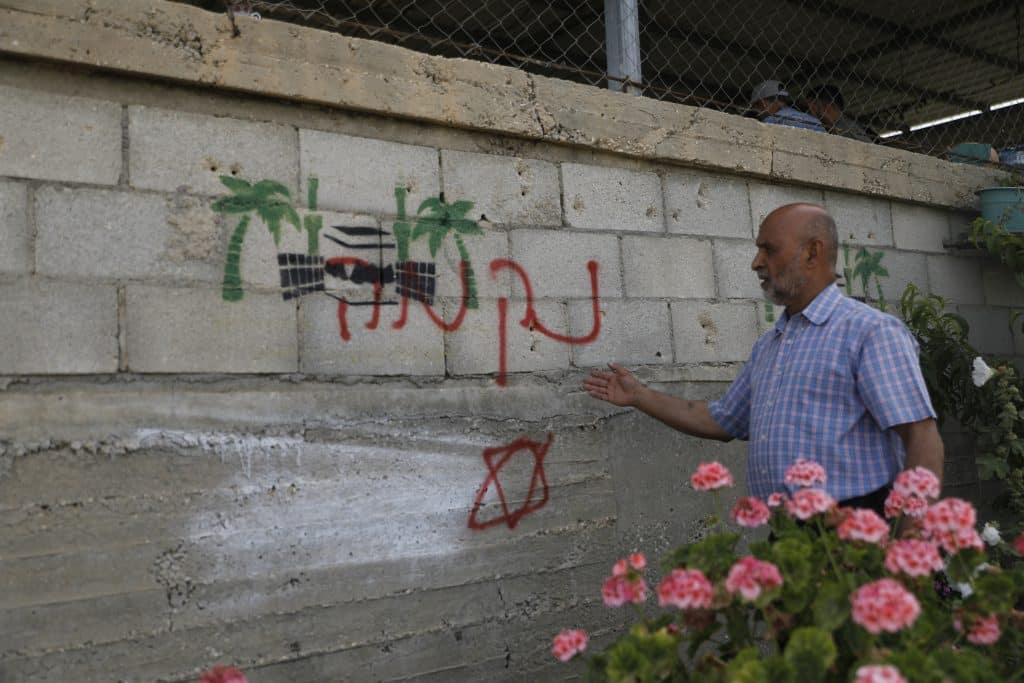
Last Sunday, I attended a close relative’s wedding in our family’s hometown of Taybeh, northeast of Ramallah. Weddings in Palestine are much more than social occasions. They are opportunities for extended families and their surrounding communities to come together and celebrate their collective identity and heritage, something we don’t often get to do in Palestine. For a few hours, we all forgot the larger context we were living in — until it was time for me to go home, less than 12 kilometers away.
Normally, it would take 10 to 15 minutes to drive. My brother decided to drive me home and get back to my parents quickly, but on the way, we were thrown back into the reality of our country. The Israeli army was raiding the neighboring town of Deir Jarir, and they had closed the town’s exits, blocking internal streets and imposing a curfew on the town as groups of soldiers raided homes and arrested residents. We were forced to take a one-hour detour, which my brother had to drive all the way back, arriving home at 3:00 a.m. By the time he was back home, the Israeli raid on Deir Jarir was still ongoing. The next morning, I checked the news and saw that 51 Palestinians had been arrested from the town that night.
Exactly a week earlier, my friends and I were out in another of our attempts to snatch a bit of normality from the occupation’s teeth. We were in Ramallah, watching the FIFA World Cup final in a public cafe. While we were cheering for Spain, Israeli settlers were storming Deir Jarir, trying to steal sheep from a local farm a few hundred meters from our neighborhood in Taybeh.
Dozens of young men from the village had poured into the streets to confront the settler attack, and an armed settler opened fire at them, killing two Palestinians. They were aged 26 and 55. The latter was a family friend.
The Israeli army then raided Deir Jarir until late after midnight, closing down the main road running through the town. My friends and I drove home after the World Cup match taking the same familiar one-hour detour, behind a convoy of cars escorting the ambulance carrying the bodies of the two slain Palestinians, which was transporting them from the Ramallah Public hospital back to Deir Jarir to prepare them for burial the following day.
Between my shy attempts to live a normal life and the reality of a snowballing Israeli assault, there is my job as a journalist. Maybe it’s due to my own idiosyncrasies, but “capturing a story” in this context isn’t so self-evident to me. But I think this is also a common condition for other Palestinian journalists: when we try to catch up on our own personal lives, we naturally have to withdraw from the public reality we cover at work. It’s part of being human to adapt in this way to an abnormal reality, and as Palestinians — especially journalists — we’ve grown more adept at doing this than most.
If we need to take a longer route because the roads are blocked, it becomes part of the routine, the same way we might carry an umbrella to deal with the rain. And the more the Israeli occupation keeps tightening the limits of what we have to cope with, the more we’re forced to unconsciously integrate it into our lives.
That’s why it takes some effort to step back and remember that there is nothing “normal” about driving one hour around the central West Bank just to cross 12 kilometers after a party or football match just because there’s a pogrom going on next door.
As journalists, we compartmentalize our work, our personal lives, and our share of our community’s anguish — while living through all three simultaneously. The next morning, at our desks, we start piecing things together. We’ve been doing it for decades.
But what’s different today is that we now have to face an additional layer we never thought we’d have to confront: the climactic moment when we’re staring down the barrel of Israel’s ethnic cleansing.
The Israeli settler assault on Palestinians in the West Bank is at its peak, and the Israeli army and government are a part of it. Israeli leaders are now explicitly talking about displacing entire Palestinian towns, all while more settler outposts are being legalized closer than ever to our homes, our streets, and our bedrooms. It is clear that in the logic of the Israeli establishment, the moment has come to “decisively” end the conflict with the Palestinian people in the West Bank, as articulated by hardline Israeli Finance Minister Bezalel Smotrich’s so-called “decisive plan.” Its implication? Removing us from our homes and emptying the Palestinian countryside.
What effort does it take to separate the awareness of such a moment in history from your personal and family life? And what effort does it take to look at this moment professionally and narrate it as a journalist? That is something Palestinian journalists have been trying to learn since October 2023, when the moment of truth began to unfold in Gaza. Now it’s approaching the West Bank.
We don’t have a blueprint to follow, and a lot of the time, we don’t know if the effort’s worth it. We keep doing it all the same, because the story we’re living deserves to be told, and because you deserve to know it. Then it’s up to you to decide what to do with it.
Qassam Muaddi
Qassam Muaddi is the Palestine Staff Writer for Mondoweiss. Follow him on Twitter/X at @QassaMMuaddi.
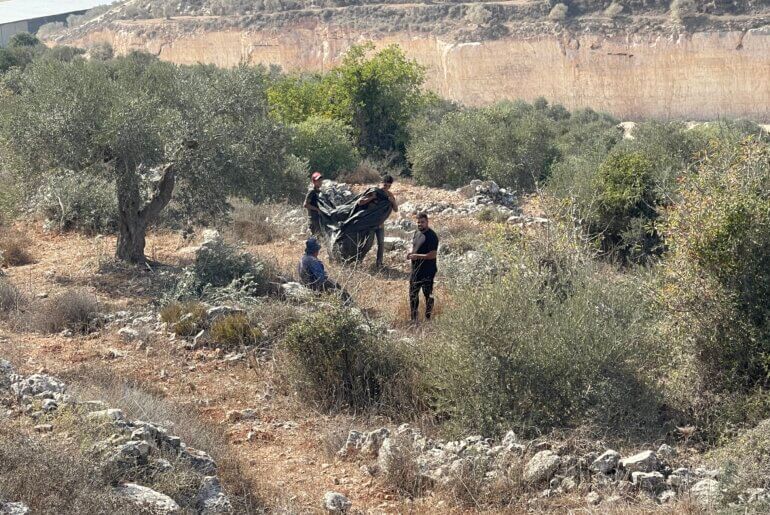
The “Elders” head members Mary Robinson and Helen Clark visit West Bank and speak out in very strong words about the war crimes being committed by the Israeli government military and illegal Israeli land thieves/ settlers.
Heard Robinson on BBC this morning. Looking for the incredible interview.
https://www.facebook.com/theElders/videos/following-their-visit-to-israel-and-the-west-bank-mary-robinson-and-helen-clark-/1689117672645130/
Mary Robinson’s “a policy in Israel now to get rid of Palestinians”
https://www.instagram.com/reel/DbMC8hzoXYb/
““The aggressive way it’s done, the hate speech that supports it, it’s no longer a matter of individual settlers.
It’s a policy now. It’s a policy of getting rid of Palestinians from villages…literally obliterating the West Bank over time.”
Mary Robinson, Former Irish President & Former UN High Commissioner for Human Rights
Mary Robinson visited the occupied West Bank last week. Today, she joined me on the show to discuss what she witnessed firsthand.
The conversation comes at a pivotal moment, as the Israeli military begins preparations for a large-scale operation in the occupied West Bank following clashes that left four Palestinians and two Israelis dead.”