
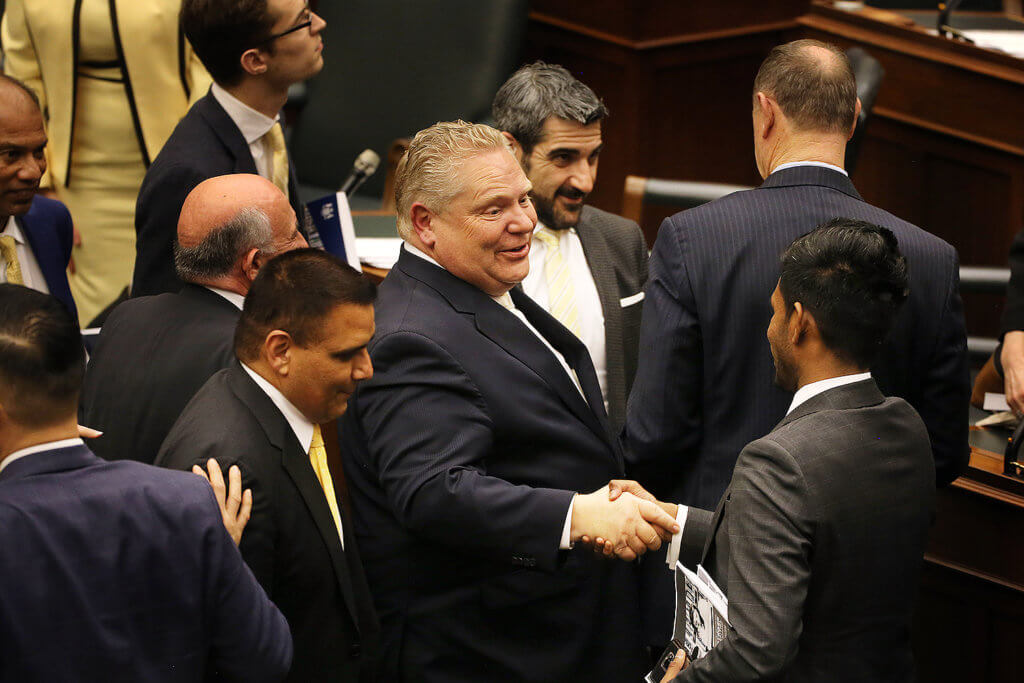
On October 25, Doug Ford’s Conservative government, through an Order in Council, adopted the International Holocaust Remembrance Alliance’s (IHRA) “Working Definition of Antisemitism.”
Not only is this unilateral move in keeping with the Ford government’s anti-democratic tendencies, the flawed IHRA definition poses a direct threat to freedom of expression. It also fails, as David Feldman wrote in the Guardian, to “make any ethical and political connections between the struggle against antisemitism and other sorts of prejudice.”
More worryingly, the only form of racism specified in the Order in Council is antisemitism, leaving out descriptions of definitions of racism faced by other racial and religious minorities in Ontario.
An Ipsos poll published in April 2019 revealed that almost half of Canadians “admit to having racist thoughts they would not voice.” The same poll found that 26% of Canadians “believe it has become more acceptable to be prejudiced against Muslims/Arabs.”
A different report released in June 2020 by the Institute for Strategic Dialogue (ISD), a United Kingdom-based think tank, concluded that Canada has a well-established network of right-wing extremists very much comparable to those in the United States and Britain. The study identified 6,352 Canadian Twitter users who posted right-wing extremist content on social media and identified a reach of 1,669,720 accounts following extremist content originating from Canada.
According to the ISD report, on Facebook, “Muslims were the most widely discussed minority community, and the most common target of posts containing explicit hate speech (23%), with anti-Semitism being the second largest grouping of hate speech (16%).”
A poll conducted by Mainstreet Research in June 2020, reveals that a majority of Canadians believe Black and Indigenous people are treated less fairly than white folks “when dealing with police, the criminal justice system, and employment practices.”
Elsewhere, a July 2020 Ipsos poll for Global News found that 60% of Canadians agree racism is a “serious” issue in Canada, up 13% since last year. That number was even higher among younger Canadians, or 70% of 18 to 34 year olds.
A June 20 Angus Reid poll found that 43% of Canadians of Chinese ethnicity who were interviewed said they have been “personally threatened or intimidated” at least once, 13% said it happens frequently, and 8% said they have frequently been “physically attacked by strangers.”
These studies indicate that many groups including Indigenous peoples, Black Canadians, Chinese Canadians, Muslims and Jews face racism in various forms across this country. Clearly, then, Ontario needs comprehensive tools to combat all forms of hatred and bigotry, not a vague definition that has been widely criticized for conflating legitimate criticism of the Israeli government and its military as antisemitic. At minimum, the provincial government should not ignore the statistics that report extreme prejudice and hate against Muslims in Canada.
While it goes without saying that fighting antisemitism and all forms of oppression is essential, by adopting the IHRA definition the Ontario government is implicitly creating a hierarchy of victimhood and, by extension, downgrading the urgency with which other targets of racism must be protected.
The IHRA definition is problematic in a number of ways. Not only does it assert, “Jewish identity and Zionism are inseparable” critics at Jewish Voice for Peace say, it also treats those “who wish to take part in the struggle for liberation from colonial rule” as nothing but bigots and racists, says Neve Gordon.
As Lara Friedman, president of the Foundation for Middle East Peace, has written, the IHRA definition is being used to “exclude criticism of Israel from the bounds of acceptable discourse.”
In fact, five of the 11 illustrative examples provided by the IHRA conflate criticism of Israel or Israelis with Jewish people.
In July 2018, the Jewish majority in the Knesset passed the Basic Law: Israel as the Nation-State of the Jewish People (informally known as the Nation-State Law) which stipulates that “The Land of Israel is the historical homeland of the Jewish people,” and “The exercise of the right to national self-determination in the State of Israel is unique to the Jewish People.” This blatantly racist piece of legislation subordinates the rights of 26% of its citizens who are not Jewish, a majority of whom are Palestinian Christians and Muslims.
One of the IHRA’s illustrative examples claims that “denying the Jewish people their right to self-determination, e.g., by claiming that the existence of a State of Israel is a racist endeavor, is antisemitic. The Nation-State Law can be read as a tacit endorsement of this definition as it dismisses any historical account concluding that the formation of the Israel in 1948 was accomplished through violent processes of dispossession and ethnic cleansing.
This part of the IHRA definition could be used to target anyone who supports the rights of the Palestinian people to self-determination, or anyone who advocates for equality in a democratic, non-sectarian country instead of an explicitly “Jewish state”—one that grants superior rights to Jews (as Israel currently does). Paradoxically, this is tantamount to punishing genuine calls for racial and ethnic equality in the name of stopping the spread of antisemitism.
The Ford government’s adoption of the IHRA definition is troubling, because it gives license to those who would like to paper over the institutionalized discrimination faced by nearly two million Palestinian citizens of Israel. It also harms other anti-racist initiatives by setting a troubling standard for freedom of expression while also threatening academic freedom, as has been pointed out by the Ontario Confederation of University Faculty Associations.
Ontarians must stand up to antisemitism and all instances of racism and discrimination wherever they appear, but the IHRA definition is flawed and, at worst, limits society’s ability to fight oppression in all is forms.

1 of 3
From Canada:
https://canadianjewishrecord.ca/2020/11/18/its-not-about-antisemitism-its-about-free-speech/
Nov. 18, 2020
By AMOS GOLDBERG
“On Oct. 26th, Ontario adopted the International Holocaust Remembrance Alliance’s (IHRA) definition of antisemitism through an Order in Council.
“On the face of it, what could be more appropriate than adopting a clear definition of antisemitism that helps fight this scourge? It would seem obvious that all decent people should unite in this just & essential fight.
“Unfortunately, this definition – & especially the 11 examples appended to its original text – help very little, if at all, to fight antisemitism. Rather than helping to stamp out antisemitism, several of these examples actually serve to curb free speech on Israel & its policies against the Palestinians, shaping the debate over Israel-Palestine in a way that practically silences the Palestinian voice.
“Let’s take a look at one example: ‘Denying the Jewish people their right to self-determination, e.g., by claiming that the existence of a State of Israel is a racist endeavor’ is considered antisemitic. The first question that comes to mind is: if denying Jews the right of self-determination is antisemitic because it’s a universal right, how should we define denying the Palestinian right for self-determination? Why is denying Palestinian self-determination a legitimated political opinion and, in fact, Israel’s practical policy, while denying Jewish self-determination is considered antisemitic? The second question that comes to mind is that almost all countries on the globe are accused of being racist. Why should Israel be shielded from such legitimate allegations?
(cont’d)
2 of 3
“But there is more to it. The reasons almost all Palestinians, including the most devoted supporters of the two-states solution, reject Zionism is not because they are antisemites, but because they experience Zionism as oppressive & colonial. None other than the great Zionist leader Ze’ev Jabotinsky, the forefather of the ruling Likud party, acknowledged this already in his 1923 article ‘The Iron Wall.’ There, he asserted that like all colonized peoples, the Palestinians reject Zionism because they oppose what they perceive – & from their perspective rightly so – as foreign invaders. Following Jabotinsky, we can say that denying Jews’ right to self-determination in Palestine as such is not antisemitic even for ardent Zionists like Jabotinsky. One can certainly reject this view but there is nothing antisemitic in it.
“Insisting on the opposite practically delegitimizes, silences and criminalizes all Palestinians (and very many non-Zionist Jews) who, as Jabotinsky observed, reject Zionism for understandable (even if rejectable) reasons. Opposing Zionism is hence a legitimate view secured by the right of free speech and, in fact, a legitimate Jewish opinion. (cont’d)
3 of 3
“This is only one of many examples of how the definition actually prevents free speech and an honest discussion on Israel-Palestine while disguising itself as a fight against antisemitism. In fact, the definition actually distorts the very essence of this fight. Most scholarly accounts of modern antisemitism connect it to the rise of nationalism and the emergence of the nation-state. Fighting antisemitism is about protecting a vulnerable minority against the violent homogenizing tendency of the majority society. The IHRA definition does precisely the opposite. It protects a powerful state, Israel, from criticism of its well-documented violations of the human rights of its vulnerable minority and occupants. In short, the IHRA definition has become a powerful silencing mechanism that serves only to increase the massive power imbalance between Israel and the Palestinians.
“Kenneth Stern, who, 15 years ago, was the lead author of the IHRA definition (for research, not legislative purposes) and is now one of its chief critics, has written: ‘I’m a Zionist,’ but ‘anti-Zionists have a right to free expression.’ The IHRA definition has been deployed to undermine that right, he asserts. We should be very attentive to his words and call on the Ontario legislature to take great care in how it interprets this harmful definition.”
On the topic of anti-semitism 972 has run some outstanding articles:
How Trump and Netanyahu made American antisemitism come alive – For four years, Netanyahu
has equated Jews with the Israeli government, while Trump has made common cause with white nationalists. I wish ore Israelis understood why this was so terrifying…
https://www.972mag.com/how-trump-and-netanyahu-made-american-antisemitism-come-alive/
A point I wanted to make earlier can go here.
Justice4all linked to an article on a website. Jon s said that the website was anti-Semitic. Nothing unusual about that. Just the usual whining.
But what is noteworthy is that Jon did not comment on the truth of any of the claims in the article. This is because he is not interested in truth. He just wants to push his ideology.
Of course, Zionists are not the only ideologues to do this sort of thing. Lots of others do it as well.
And everyone who does that makes him/herself an enemy of the truth, and thus an enemy of the human race.
For without truth we cannot have justice. We cannot step past prejudice. We cannot improve our lives by dealing with reality. We remain trapped within our beliefs.
So Jon’s approach – labelling by reference to ideological purity – is exactly the wrong way to proceed. Instead, what has to be done is to examine the claims themselves. And it does not matter whether or not the claims are
racistsexistableistsocialistclimatedenialistSatanworshippingartsiefartsietransphobiclattedrinkingglobalistIslamophobiccommunistantiSemiticneoMarxistantivaxxerFrench or even pro-Trump.
What matters is whether or not they are true.
We will not always be able to determine whether or not a claim is true, or agree on which claims are true or not, and we will undoubtedly believe some claims are true when they are not, but that is no reason to stop trying. We should always endeavour to find the truth.
Even if some can’t handle it.