

As I write this blog post, we’re halfway through Hanukkah and the darkness remains.
The major cause for all the gloom is Covid-19 and the havoc it’s caused around the world. As ever, the most vulnerable and least secure have been hit the hardest by the crisis. That’s certainly the case for Palestinians living on the West Bank and in Gaza. The Palestinian economy has taken a battering, according to the latest report by the World Bank, while in Gaza the health infrastructure (already weak) is at breaking point with infection rates amongst the highest in the world.
However, the Israeli occupation has been one of the few things immune from the pandemic. The illegal destruction of Palestinian property by the Israelis has spiked during Covid-19 according to United Nations monitoring.
“The period from March to August 2020 saw the demolition or confiscation of 389 Palestinian-owned structures in the West Bank, on average, 65 per month, the highest average destruction rate in four years.”
And the killing and maiming of Palestinian children by Israeli soldiers goes on too, as shown by the death of fifteen-year-old Ali Abu Aliya, shot in the stomach during a protest against Israeli land theft in the village of al-Mughayyir near Ramallah in the first week of December.
The last four years have proved that it really does matter who sits in the Oval Office. During Trump’s one term administration, he’s succeeded in delivering more of his ambitions and promises on Israel/Palestine than Obama did in his eight years in the White House. As for Joe Biden, he does not have the inclination or the political capital that would be required to completely undo the damage to the Palestinians caused by his predecessor.
But of course, for most Jewish families, thinking about the Israeli treatment of Palestinians (or the aiding and abetting of this by the United States) is unlikely to be at the forefront of our minds as we light our Hanukkah candles.
But perhaps it should be?
Open to interpretation
After all, the times in which we live have always been the lens through which we celebrate our festival of lights. Hanukkah appears particularly susceptible to multiple theological and political readings.
In the late 19th century, Zionists saw the Maccabee rebellion against the Greek Assyrian empire as an inspiration for muscular Judaism and nation building. As Theodor Herzl wrote in ‘The Jewish State’ in 1896:
“And what glory awaits the selfless fighters for the cause! Therefore I believe that a wondrous breed of Jews will spring up from the earth. The Maccabees will rise again.”
At other times, Hanukkah’s themes of resistance and cultural identity have been drawn on to give strength in the very darkest moments of our history. The Warsaw ghetto diarist Chaim Kaplan wrote in 1940:
“Never before in Jewish Warsaw were there as many Hanukkah celebrations as in this year of the wall… Polish Jews are stubborn: The enemy makes laws but they don’t obey them. That is the secret of our survival.”
More recently, Jewish climate change activists have adopted the festival’s Temple lamp miracle story as an early lesson in energy conservation.
So far though, the lens of Palestinian oppression has not been one we’re willing to look through as we mark Hanukkah.
Teaching Hanukkah with self-awareness
In 2020 in Israel and across the world, Jewish communities are largely successful and empowered. There is nothing to stop us celebrating our heritage and identity. At the same time, we continue to sense that we are vulnerable and that our current acceptance as a people is in truth fragile and susceptible to political whims.
So, here’s the 21st century Jewish paradox. Both the empowerment and the vulnerability are true. We are for the most part, a safe and secure people. We are also vulnerable to the same historical vagaries which have always plagued us. And there’s the rub. Our on-going vulnerability coincides with an historical moment in which we are the oppressors of another people. Some of us are doing the oppressing directly, some of us defend it, some of us stay silent. Whether we are close to, or far from, the harm we cause, that sense of vulnerability along with the oppression we bring to others are intimately linked – historically, politically, religiously and psychologically.
When our children were young, I used to be invited into their local primary school to give a talk each year about Hanukkah. Today I ask myself, how I would teach Hanukkah to Palestinian school children, or indeed to their parents? How comfortable would I find it to tell this story of Jews denied the right to express their culture, identity and history? What would go through the children’s minds as I explained our annual celebration of an armed Jewish revolt against an occupying power? And could I convey convincingly the idea of on-going Jewish vulnerability in Israel, the United States, or anywhere else?
But this is exactly the self-awareness we need today when we celebrate Hanukkah.
Hanukkah, antisemitism and IHRA
Without this essential Hanukkah-inspired inward looking/outward looking self-awareness, you end up in some foolish and unethical places. Our Jewish institutional leadership’s obsession with the International Holocaust Remembrance (IHRA) definition of antisemitism, is one such place we should not be.
We are now stuck with a thoroughly contested and problematic document that’s creating anger and resentment from Palestinians who find themselves in a perverse inversion which turns them from campaigners to end their oppression into cold-hearted antisemites. A recent letter to the Guardian from 122 Palestinian and Arab academics from around the world sets our clearly why the IHRA document is so divisive and unreasonable. They conclude with some clear analysis and some much-needed common sense.
“The suppression of Palestinian rights in the IHRA definition betrays an attitude upholding Jewish privilege in Palestine instead of Jewish rights, and Jewish supremacy over Palestinians instead of Jewish safety. We believe that human values and rights are indivisible and that the fight against antisemitism should go hand in hand with the struggle on behalf of all oppressed peoples and groups for dignity, equality and emancipation.”
If you only see the Hanukkah story from a Jewish perspective, you end up thinking that the IHRA is the gold standard for understanding antisemitism and indeed the threats to 21st century Jewish life. But if, as a Jew, you employ some self-awareness and some self-reflection, you see the document’s narrow field of vision. But of course, that narrow perspective and the consequential inversion of Palestinian reality is the whole reason for our Jewish leadership’s fanatical championing of the IHRA. If they (and the UK Government) were genuinely focused on tackling antisemitism (and not outlawing Palestinian advocacy) then they would choose a very different document to promote. By now, that much is abundantly clear.
And if you prefer to hear from a distinguished Jewish academic voice, then try David Feldman, director of the Pears Institute for the Study of Antisemitism at Birkbeck, University of London, who also sees IHRA as not fit for the purpose its now been given.
Hanukkah for Palestinians
Tonight, with my family, we’ll light another candle on our menorah. We’ll tell the story of resilience and resistance, of struggle and self-determination. Once again, we’ll thank God for the consoling deeds he performed for our ancestors and how in their hour of need, He heard their plea, judged their cause and delivered the strong into the hands of the weak.
We could stop there and keep Hanukkah all for ourselves. Or we can use it to expand our horizons and enlarge our theology.
Just as the Exodus story became a universal paradigm of freedom, Hanukkah should help us to hear the pleas of others and recognise ourselves in their struggle.
Hanukkah is for Palestinians too.
This post first appeared on the Patheos site.
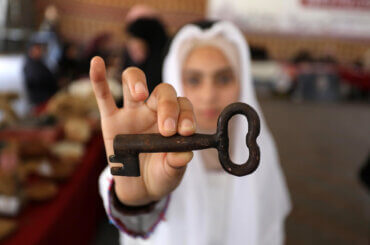

Ah yes, “Israel, a light unto nations [NOT!!]”
Israeli Soldiers Abducted 413 Palestinians, Including 49 Children, In November – – IMEMC News
“Israeli Soldiers Abducted 413 Palestinians, Including 49 Children, In November”IMEMCE NEWS, Dec.13/20
EXCERPT:
“A report issued by several human rights & information centers groups in occupied Palestine stated that Israeli soldiers abducted at least 413 Palestinians, including 49 children & seven women, in the occupied territories in November.
“The Palestinian Detainees Committee, the Palestinian Prisoners Society & the Ad-Dameer Prisoner Support & Human Rights Association, & Wadi Hilweh Information Center in Silwan (Silwanic), issued a fact sheet, based research & documentation, revealing the number of Palestinians abducted by the Israeli occupation army in November.
“They said the soldiers abducted 157 Palestinians in occupied Jerusalem, 40 from the Ramallah & al-Biereh governorate, 74 in Hebron, 31 in Jenin, 33 in Bethlehem, 30 in Nablus, 18 in Tulkarem, 18 from Qalqilia, 3 in Jericho, 7 in Tubas, 1 in Salfit, & one from Gaza.
“The report indicated that the number of Palestinian detainees imprisoned by Israel is about 4400, including 41 women, 170 children, & 380 who are held under the arbitrary Administrative Detention orders, without charges or trial.
“Also in November, Israeli courts issued 102 Administrative Detention orders; 47 of them were issued against the detainees for the first time, & 55 were renewed orders.
“The groups denounced the escalating Israeli violations, especially the illegal collective measures targeting the detainees & their families, in addition to the nearly absent measures that would protect the detainees during a coronavirus pandemic, in addition to Israel’s ongoing policies preventing the detainees from receiving basic rights, including the right to adequate & professional medical treatment.
“In a recent report, the Palestinian Information Ministry has confirmed that Israeli soldiers have killed seven Palestinian children in the West Bank & the Gaza Strip, since the beginning of this year.”
Thank you, Robert, for this inspirational piece. I, a secular humanist of Arab descent, and my Jewish wife, participate in, and enjoy, the Hanukkah candle lighting ceremony. However, we are both anti-Zionists that believe in the academics’ message “— the fight against antisemitism should go hand in hand with the struggle on behalf of all oppressed peoples and groups for dignity, equality and emancipation.” We will continue to carry this message in our daily lives.
Indeed. Somehow the Palestinians are hidden from the Hanukkah story. Somehow its creators decided to ignore them from the story of the Holy Land of 2200 years ago. It’s crazy to think that Jews have been ignoring the Palestinians for 2200 years.
The Maccabean (or “Hasmonean”) revolt can be seen as an inspirational story of resistance to foreign occupation and tyranny. It was also a popular movement of the lower classes against the Hellenized elite, which made it acceptable to Marxists (such as Howard Fast).
These days, Hanukkah is a great family holiday of warmth and light with traditional rituals and food, not anything to object to. This year ,of course, there are Covid19 restrictions which inhibit family get-togethers. Hoping next year will be better.
One correction to Mr. Cohen’s essay: it wasn’t the “Greek Assyrian empire”. It was the Hellenistic Seleucid kingdom.