
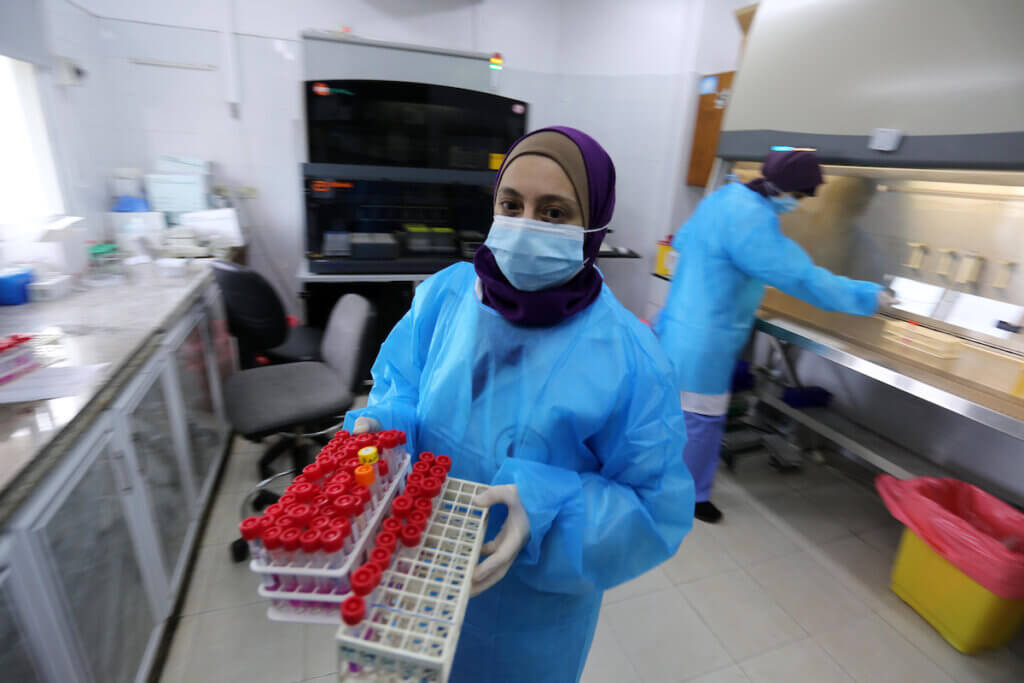
This week will mark the one year anniversary since the first cases of the coronavirus were reported in Palestine, and a state of emergency was declared in the occupied West Bank city of Bethlehem, where Palestine’s COVID-19 outbreak began.
Around this time last year, there were less than 10 confirmed cases of the virus in the West Bank, yet the feeling of panic and impending disaster was unshakeable. Bethlehem became unrecognizable to its residents, who were accustomed to seeing the city’s streets bustling with tourists from around the world.
The city was completely shut down — the streets were empty, save for the dozens of police and security checkpoints in and around the city; the few coronavirus patients that we did have were all sequestered in the Angel Hotel, where the outbreak began; and hot spot tourist destinations like Manger Square and the Nativity Church were completely deserted.
Bethlehem’s lockdown restrictions quickly spread to other areas of the West Bank, along with the virus. Still, there was hope that the nightmare would be over soon, and life could return back to normal.
And for a time, life did return back to normal. Over the summer lockdown restrictions were lifted, quarantine measures were eased, businesses were up and running again, and people were out and about in the streets once again.
One year on, however, Palestine’s COVID-19 nightmare seems to only be getting worse. Coronavirus cases are surging in the West Bank, causing health officials to declare a third wave of the virus, as many hospitals across the territory reach maximum capacity.
The total number of coronavirus cases in the West Bank, East Jerusalem, and the Gaza Strip surpassed 216,000 as of Thursday, with more than 2,000 new cases of the virus being reported in the past 24 hours alone — the majority of which were in the West Bank.
The Palestinian Ministry of Health said in a statement last week that more than 85% of hospital beds allocated for COVID-19 patients in the West Bank are full, and that 62% of ventilators in the territory are being used — the highest since the beginning of the pandemic.
A nurse from Bethlehem described the situation to me as “terrifying,” saying that COVID-19 patients in need of treatment are being turned away at the local governmental hospital because the hospital doesn’t have the capacity to take in and treat new patients.
Health officials say many of the new cases they are seeing consist of new coronavirus variants, that are spreading faster throughout the population and displaying stronger and more devastating symptoms, specifically in younger people and people who had no prior health conditions.
Palestinian Minister of Health Mai al-Kalia described the situation in Palestine at the moment as “very disturbing,” noting that one of the COVID-19 patients who succumbed to the virus last week was a young man in his 20’s who had no prior illnesses or medical conditions.
In a random sampling of 460 cases of COVID-19, the MOH recorded 352 cases of the British variant, and 57 cases of the South African variant of the virus.
Earlier this week the MOH announced a 12-day shut down of schools in the West Bank in an attempt to curb the spread of the virus. Meanwhile in Gaza, the COVID-19 situation seems to be improving, with declining numbers being reported by health officials in the territory.
Despite the rapidly worsening situation in the West Bank, any plans to begin vaccinating the general public are still far out of reach. So far, the PA has claimed to only have received around 12,000 vaccine doses to date, the majority of which have allegedly been used to vaccinate medical personnel and healthcare workers.
The MOH said on Monday that vaccines were also given to players on the Palestinian national soccer team in order for them to travel and “represent Palestine in a match,” to ministers in the PA, security officers working for President Mahmoud Abbas and Prime Minister Mohammed Shtayyeh, “embassies of some countries in the State of Palestine to vaccinate their cadres,” and Central Election Commission workers.
The announcement that a number of the essential vaccine doses had gone towards vaccinating PA officials and their security, the Palestinian national team, and foreign officials, rather than ordinary Palestinian citizens who are at-risk due to their age and pre-existing conditions drew angry reactions on social media.
One Facebook user commented on the MOH’s post, saying “Shame on you. A full list of names should be published…these figures confirm the rampant corruption [in the government].” Another user wrote: “You stink of corruption.”
The PA has maintained claims that it is ready to begin vaccinating the population immediately, but is waiting on delayed shipments of the vaccine that it is blaming on “manufacturing companies, the global competition market and shipping procedures.”

1 of 2
https://www.haaretz.com/middle-east-news/.premium-israelis-demand-palestinians-get-vaccinated-too-or-the-pandemic-won-t-end-1.9580772?utm_source=mailchimp&utm_medium=content&utm_campaign=haaretz-news&utm_content=139cd77874
“Israelis, Demand Palestinians Get Vaccinated, Too. Or the Pandemic Won’t End” Haaretz, March 2/21 by Nadav Davidovitch & Joseph Bruch.
“Earlier this week it was reported that the Israeli government had approved a campaign to vaccinate Palestinian laborers working in Israel & in West Bank settlements. This decision came days after reports that Israel had pledged at least twice as many doses of its surplus supply of vaccines to allied countries as it had to Palestinians living in Gaza & the West Bank.
“The effort to vaccinate Palestinian laborers is welcome news, but it is not sufficient. As part of the public health community, we call on the Israeli government to take responsibility & assure the vaccination of all Palestinians. We demand that any excess supply of coronavirus vaccines is prioritized for Palestinians.
“We do not argue this imperative on legal or political grounds (such arguments necessitating Israeli government to assume responsibility, as per the Geneva Convention & the Oslo Accords, have been argued elsewhere).
“Instead, our demand is unequivocally justified by the urgency of the public health emergency in the West Bank & Gaza, as well by public health ethics.
“COVID-19 cases are surging in Gaza & the West Bank with 2,236 fatalities in these regions (including East Jerusalem) & 16,000 active cases as of the beginning of this week. To combat the surge in COVID-19 cases & the current strain on intensive care units, the Palestinian Authority announced tighter lockdown restrictions in the West Bank including nightly curfews, a continued ban on social gatherings, & enforced movement restrictions.
“However, the public health situation in Gaza & the West Bank is only getting worse. Providing Palestinians with vaccinations is thus a public health imperative. (cont’d)
.
2 of 2
EXCERPT:
“Previous studies have demonstrated that Israel, Gaza, & the West Bank act as one epidemiological unit whereby infectious diseases in one region can result in cross-border infections & disease transmission. Trends in Covid-19 mortality & morbidity for Israel, Gaza, a& the West Bank follow similar trajectories and appear to be influenced by each one’s closures with 2-3 weeks lags.
“Cross border transmission along with the emergence of new variants & continued high rates of infections in certain Israeli populations, ensure that the pandemic is not going to end in the immediate future without a joint public health response. Failing to respond to the crisis in Gaza and the West Bank will make it more difficult to return to normal in the entire area & stop the rise in infections.
“Even prior to the pandemic, Palestinians experienced substantial health issues. A report by the Director-General for the World Health Organization found that Palestinians in Gaza & West Bank have higher rates of mental health disorders, noncommunicable diseases, infant mortality, & lower life expectancy. Palestinians are also exposed to higher rates of violence & injuries related to the Israeli occupation & conflict.
“The pandemic has made these disparities even more visible, yet many will likely be exacerbated without a coordinated public health response.
“Compared to Gaza & the West Bank, Israel has a well-resourced public health system, including COVID-19 testing services, epidemiological surveillance operations, & advanced healthcare delivery settings.
“It is in Israel’s own best interest to deploy its public health infrastructure to address the pandemic in Gaza & the West Bank. Vaccine nationalism, as described by the World Health Organization, occurs when wealthy countries sign vaccine agreements with pharmaceutical companies for their own populations, often limiting the available vaccines for less wealthy nations.
“This hurts everyone & threatens the international community’s collective ability to suppress the virus worldwide: in the WHO’s words, ‘The virus will not be eliminated anywhere…if it is not eliminated everywhere.’
Just imagine a Palestinian state run by these corrupt, despotic donkeys. Unable to get on with their Hamas brothers, unable to manage their own civil society, blaming Israel incessantly for their own incompetence.