Palestinian volunteers clean the Al-Aqsa mosque compound ahead of the Muslim holy month of Ramadan, in Jerusalem’s Old City on April 10, 2021. (Photo: Jamal Awad/APA Images)
The Latest:
- 306,961 Palestinians have tested positive for COVID-19; 271,906 recoveries; 3,223 deaths
- Of Palestinians who tested positive, 189,831 live in the West Bank, 88,304 live in the Gaza Strip, and 28,826 live in East Jerusalem
- 836,726 Israelis have tested positive for COVID-19; 827,555 recoveries; 6,315 deaths
Over a year into the pandemic, a rugged third wave has left Palestinian hospitals at nearly full capacity for more than a month. So far, just 3% of Palestinians have been vaccinated for COVID-19. The slow start to the national vaccination campaign, which began in late March, is amplifying hospital bed shortages.
In the West Bank, ICU patients are down 12% from last week, and there are 11% fewer using oxygen ventilators, but ICUs are still at around 100% full, according to the World Health Organization’s latest situation report. Regular hospital beds are 97% full.
In Gaza, which currently accounts for 64% of all active cases in the occupied Palestinian territory, there was a 100% increase in patients on ventilators from last week and a 14% increase in overall ICU cases. More concerning, the positivity rate in Gaza has spiked once again to 37%, when it was under 10% three weeks ago.
Possibly as early as next week Gaza could find its hospitals also overwhelmed.
“As of 15 April, the overall occupancy rate of COVID-19 dedicated hospital beds in the Gaza Strip is 79%,” the WHO reported. “Currently, 56 of the 61 Intensive Care Unit (ICU) beds (92%) are occupied.”
Even with this rapid rate of increased spread, this week was the first week since the start of March where the number of new cases for the epidemiological week was under 1,200.

A deserted street amid a vehicle ban in Deir al-Balah in the center of Gaza on April 2, 2021. (Photo: Ashraf Amra/APA Images)
With vaccines scarce–Gaza has vaccinated under 35,000–health officials are once again using what seems like the only resource at their disposal: stricter lockdowns. Cars will be banned from the roads this weekend and weekday evenings after 6:00 p.m. Schools and universities are back to distance learning. And a complete overnight curfew banning any movement in the streets will take place from 9:00 p.m. to 6:00 a.m.
The big picture: The closures come amid the first week of the Islamic holy month of Ramadan, where Muslims abstain from food and drink during daylight hours. Ordinarily, the observances are festive with large family gatherings that will be muted for the second year in a row owing to the pandemic.

A Palestinian man distributes free food for families experiencing poverty during the holy fasting month of Ramadan, in al-Shijaiyah neighborhood in Gaza City on April 14, 2021. (Photo: Ashraf Amra/APA Images)
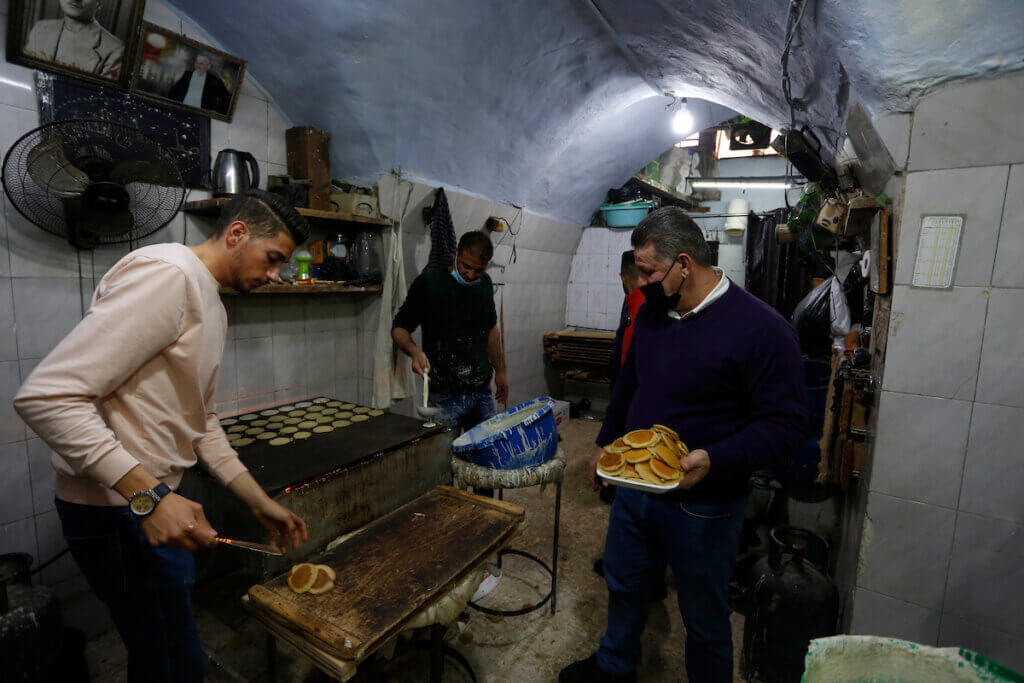
Palestinians shop at a market on the first day of the Muslim holy month of Ramadan in the West Bank city of Nablus on April 13, 2021. (Photo: Shadi Jarar’ah/APA Images)
Last year the Al-Aqsa mosque was closed over the holiday month because of the coronavirus, but this year the mosque will remain open.
Reuters reported this week that it was still unclear if Palestinians from the West Bank would be allowed to enter Jerusalem for prayers at the mosque, as customary. Despite the pandemic, the neighborhood around the holy site’s complex in Jerusalem’s Old City was far more festive this year than last, as Palestinians in East Jerusalem are vaccinated under Israel’s national program.
Here’s Reuters:
“Although Jerusalem is still without foreign tourists, far more people were roaming the Old City, where shops reported brisk business.
‘Because of coronavirus, the situation has been bad for the merchants and the people. Now with coronavirus vaccination, the situation got better,’ said one shopper, Mohammad Abu Sbeih.”
Israel honors Fauci for vaccine equity, amid charges of vaccine inequity
Nada Elia wrote this week that the top infectious disease expert, Dr. Anthony Fauci, has been recognized by Israel’s version of the Nobel Prize, the Dan David Prize. The decoration comes with a $1 million award. Elia wrote Fauci should turn down the award, citing stark gaps between Israelis and Palestinians in obtaining vaccines.
“Access to health care, just like this pandemic, must be global,” Elia wrote, adding:
“Dr. Fauci’s denunciation of disparities in medical access in the U.S. will sound hollow if he accepts a prize from a country that is denying people under its illegal military occupation access to life-saving vaccines, while bribing allies with the extra doses.”
Israel’s robust vaccination program has inoculated some 5 million of the country’s population of 9 million with both doses of the Moderna vaccine. In comparison, only around 3% of the total Palestinian population have been vaccinated, through a combination of purchased and donated doses. Just 121,866 in the West Bank have received at least one shot, and 34,580 in Gaza, most of whom are frontline workers.
On Tuesday the first shipment of AstraZeneca purchased by the Palestinian government, around 48,000 doses, arrived. The Ministry of Health said a total of 2 million doses will be rolled out over 2021. This will be bolstered by additional shipments on Saturday, from the COVAX facility, the global vaccination program coordinated by the WHO. The donations include 43,200 doses of AstraZeneca for the West Bank and 28,800 for Gaza.
By early next week, 105,000 Palestinians with permits to work in Israel who were eligible for vaccines under Israel’s national program will receive their second dose.
In the summer, Palestinians will receive another 144,000 doses of AstraZeneca and 102,960 doses of Pfizer from COVAX’s next batch of shipments.