


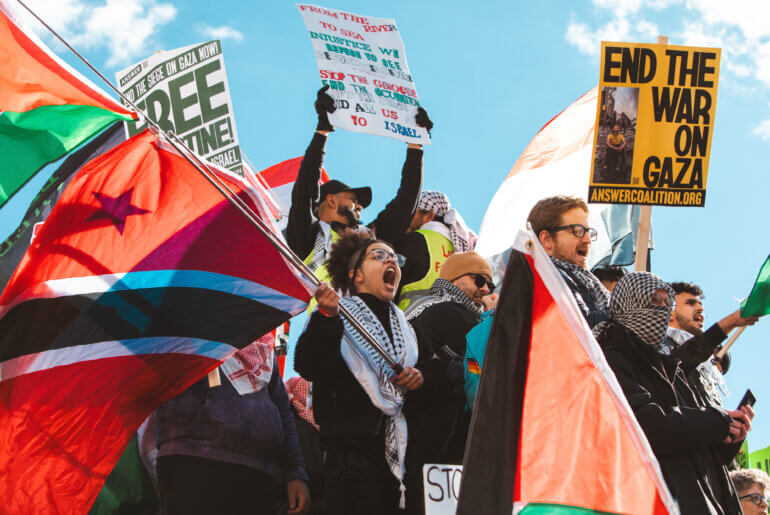
On the 28th of May, university students across the country are gathering in unity with the Palestinian people to demand immediate divestment from companies complicit in Israeli apartheid and settler-colonialism as a part of Apartheid Off Campus’s national day of action.
The recent forced expulsions in Sheik Jarrah, the brutal attacks on Al-Aqsa mosque and the ruthless bombing of Gaza have brought students together in grief, anger and deep solidarity with Palestine. As a result, protests will be taking place on campuses of UK universities that are complicit in these human rights violations. In total, the Palestine Solidarity Campaign database calculates UK universities to be investing £455,815,954 in companies that directly or indirectly assist the violent Israeli regime of dispossession and incremental genocide of the Palestinian people.
The events of the last few weeks has captured international attention, but the brutalisation of Palestinians in nothing new. Each time Israel has decided to “mow the lawn” and wage war on the captive people of Gaza, meting out death and destruction on a population who are mostly refugees, mostly children, the international community arises from its slumber only for as long as it takes for a cease-fire to be announced. Gazans are left alone to reconstruct some semblance of life and to continue to suffocate beneath an inhumane siege, until Israel’s next criminal assault.
It would be natural for the victims of this endless cycle of brutality, momentary global interest, and then neglect and amnesia, to grow cynical towards any claim that something might really be changing, that some decisive shift in public consciousness might truly be underway. But United Nations spokesperson Chris Gunness was correct when he described Gazans as possessing an “indomitable dignity” and Palestinians in the West Bank and within the Green Line have also shown time and again that they will never be docile in the face of apartheid and settler-colonialism.
The growing Unity Intifada represents the complete rejection of a defeatism which Israel, with each barbaric wave of massacre and ethnic cleansing, has endeavoured to instill in Palestinians. “The Dignity and Hope Manifesto” circulated widely across Palestine, and published in Mondoweiss, reflects their irrepressible will for life and liberation:
“This Intifada will be a long one in the streets of Palestine and in streets around the world; an intifada that fights the hand of injustice wherever it tries to reach, that fights the batons of cruel regimes wherever they try to strike.”
The question then falls to those of us living in the West, will we stand shoulder to shoulder with those courageous enough to resist their violent dispossession? Will our solidarity this time be unflagging, or will it evaporate in the next few weeks when Palestine no longer dominates news headlines?
Will we stand shoulder to shoulder with those courageous enough to resist their violent dispossession?
Earlier this year, Human Rights Watch and Israeli human rights organisation B’Tselem both published exhaustive reports accusing Israel of subjecting Palestinians to an apartheid system. The 1973 Apartheid Convention defines apartheid as “inhuman acts committed for the purpose of establishing and maintaining domination by one racial group of persons over any other racial group of persons and systematically oppressing them” and it is recognised as a crime against humanity under international law. For decades, Palestinians have been ringing the alarm against Israeli apartheid, and with Israel’s most recent act of criminal aggression in Gaza and East Jerusalem, a heightened awareness of Israel’s settler-colonialism appears to be blossoming in the UK – most especially among students.

As university students, we cannot allow the endorsement and material support of settler colonialism to continue. We have a moral obligation and duty to the Palestinian people to resist against the forces that profit from their oppression. Our dedication to justice and our anti-colonial, anti-imperialist, transnational solidarity means that we will use our collective voice to support the fight against Israeli apartheid and the ethnic cleansing of the Palestinian people.
In 1971, the National Union of Students and the Anti-Apartheid Movement set up a network to co-ordinate student campaigns. Over the next decade, students at nearly every university and college in Britain organised anti-apartheid action, which included calling on these institutions to divest from South Africa. Students have, evidently, fought against apartheid through collective action & divestment campaigns in the past, and we, at Apartheid off Campus, wholeheartedly believe it can happen again. If universities say that they are committed to ‘decolonising’ themselves, then this is non-negotiable; this is the only the most basic, elementary action that can be taken, and any decolonisation which neglects it is performative. We hope you join us in linking arms with our Palestinian siblings and, once again, resisting apartheid in our institutions until Palestine is liberated.
Apartheid off Campus is a non-hierarchical student network of activists that organises for UK universities to adopt BDS. This involves pressuring universities to break their links with and divest from companies complicit in Israeli Apartheid and sign an Apartheid Free Pledge to commit to disengaging with apartheid regimes.
You can find us on the following social media pages to find your closest protest, follow our work and join the student network:
- Facebook page – Apartheid Off Campus
- Twitter – @AOC_movement
- Instagram – @apartheidoffcampus


1 of 2
The End of Israel’s Illusion by Shlomo Ben-Ami – Project Syndicate (project-syndicate.org)
“The End of Israel’s Illusion” by Shlomo Ben-Ami, Project Syndicate, May 13/21
EXCERPTS:
“The prevailing consensus among Israelis that Palestinian nationalism had been defeated – and thus that a political solution to the conflict was no longer necessary – lies in tatters. And even as the violence escalates, it has become clear to both sides that the era of glorious wars and victories is over.”
“TEL AVIV – The sudden eruption of war outside and inside Israel’s borders has shocked a complacent nation. Throughout Binyamin Netanyahu’s 12-year premiership, the Palestinian problem was buried and forgotten. The recent Abraham Accords, establishing diplomatic relations with four Arab states, seemed to weaken the Palestinian cause further. Now it has re-emerged with a vengeance.
“Wars can be triggered by an isolated incident, but their cause is always deeper. In this case, the trigger, the eviction of Palestinians in favor of Israeli nationalists in the Sheikh Jarrah neighborhood of East Jerusalem, touched all the sensitive nerves of the Israeli-Palestinian conflict. Israel’s occupation of East Jerusalem, its humiliating control of access to the Al-Aqsa mosque, the ever-present memory of the 1948 Nakba (the displacement of 700,000 Palestinians when Israel was founded), and the grievances of Israel’s Arab minority are all fueling the current flare-up.
“It may be true that the contested real estate in Sheikh Jarrah did belong to a Jewish family before 1948. But Palestinians saw the incident as part of Israel’s unrelenting drive to ‘Judaize’ Jerusalem, and a striking injustice, because the state of Israel was built partly on the abandoned properties of Palestinian refugees. While Jews are entitled to reclaim property they owned before Israel’s founding, Palestinians may not. Those facing eviction in Sheikh Jarrah cannot recover the homes in Jaffa and Haifa that they once owned.” (cont’d)
2 of 2
“On the face of it, the latest escalation of violence is following the template of all inter-ethnic wars. Muslims observing Ramadan shouted nationalist slogans and clashed with Israeli right-wing groups chanting ‘Death to the Arabs.’ The Israelis haughtily marched with their national flag on Jerusalem Day, marking Israel’s capture in 1967 of East Jerusalem and the Temple Mount, the site of the biblical Second Temple, and of Al-Aqsa, completed in the year 705. Battles in and around the Al-Aqsa compound erupted, with worshipers inside throwing stones at the Israeli police, who responded by firing rubber-tipped bullets and other projectiles, wounding hundreds.
“But the young Arab protesters could claim victory, for they forced the postponement of an Israeli Supreme Court ruling on the evictions in Sheikh Jarrah. They also forced the police to change the route of the Jerusalem Day march away from the Muslim Quarter in the Old City.”
“But Jerusalem has emerged as the crucible of conflict. It offered Hamas a golden opportunity to assert its predominance over Israel’s collaborators in the West Bank’s Palestinian Authority and sweep away PA President Mahmoud Abbas’s moribund leadership. Under Israeli pressure, Abbas had just canceled legislative elections for fear that Hamas, which has ruled Gaza since 2006, would win and extend its control to the West Bank.
“Abbas framed his decision as a protest against Israel’s refusal to allow the Palestinians in East Jerusalem to participate in the elections. But the truth is that the PA’s presence in East Jerusalem had practically vanished, with the vacuum filled by a mostly secular young Palestinian generation that turned the Temple Mount (Haram Al-Sharif to Muslims) into the symbol of their resistance to Israeli occupation.”