

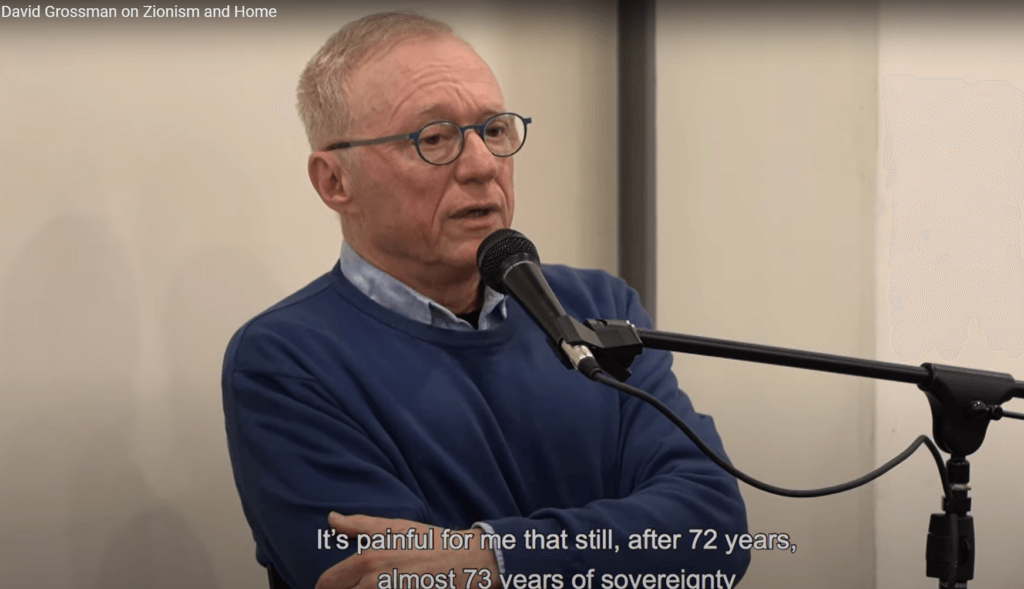
A Jerusalem school has just posted an excerpt of a talk that David Grossman, a leading figure of the Zionist left, gave there last year. Grossman’s son Uri died in the Lebanon war in 2006 at age 20, and a student asked the novelist to reflect on the fact that his son might still be alive if the Grossman family didn’t live in Israel. Grossman responded that he had thought about leaving Israel, but resolved to stay because the country holds so much meaning to him.
Grossman then took the question to Israel’s existential issues, and the importance of the Zionist mission for Jews to find a secure home in Israel, something they have failed to do in 73 years.
Here is a long excerpt, based on Shalem College’s publication of a translation of Grossman’s comments from that 2020 appearance.
I live here because for me, this is the place in which my life has meaning, the place with which I want to connect. It’s the place that’s relevant for me in a way that no other place is.
I can teach at universities throughout the world, but their pain is not my pain. And at the end of the day, their joy is different from mine too. Here, even those things that drive me crazy are relevant to me, they mean something to me. I understand… all those codes that create the behaviors that drive me crazy…. In short, I wouldn’t want to live anywhere else, but I want to live in a place that holds relevance to me. Life is too short to live it in a place that isn’t relevant, among people who are less relevant. For me, this is the place, and I want my children’s future to be here and that of my grandchildren.
And I want this place to be a home. That’s what has fueled so much of my political activity over the years. I think that the definition of a Jewish person or Jewish collective in the past has been that of someone or some group that never felt at home in the world. Even in the friendliest of places, there was always a shadow, a sense of doubt hovering just above, an awareness that it was all so fragile, that so little was holding it together. The possibility of it coming apart at the seams, the possibility of expulsion. The possibility, God forbid, of genocide.
Israel was meant to be our home. Finally, our home. It was meant to be the place in which you felt secure, in which your standing and your relations with your neighbors was never in doubt, in which there was no disagreement with anyone about whose home it was. It’s painful for me that still, after 72 years, almost 73 years of sovereignty, and of war, we still haven’t arrived at a place in which we feel that real sense of comfort, that real sense of serenity and ease you’re meant to feel at home. People talk about the price we pay on account of the ongoing conflict and the violence and the occupation.
All that is well known, but there is something that we haven’t been able to experience. I hope the day will come that we will. Most of you are still young enough that there’s a chance you will experience it. The feeling of being at home. The feeling of ease, of inner peace, and security. The knowledge that this place will be home for you and your children and their children and onwards. A feeling with which we’re simply not familiar, a feeling we’ve never had.
And because of the absence of that feeling we don’t have a sense of the solidity of our existence. In so many other countries, people can take the existence of their country as a given. But here, the ground trembles under our feet. Our anxieties shape our lives. Now I don’t dismiss those anxieties. I have the deepest respect for them. I don’t count myself among those leftists who are so quick to write those anxieties off, not at all. I think these anxieties express something true about the reality, we can’t deny that…
And sometimes the way we deal with those anxieties can affect the way those dangers appear to us…
I’m sure of just one thing. If we don’t do something to change the situation, fast, our situation will really be dire. And as someone who cares deeply about this place and wants this place to be a home, I can’t allow myself the luxury of despairing that change won’t come.
I quote Grossman at such length because he is so eloquent and insightful on the one hand, and yet his frame is so Jewish. His concern in these remarks is for Jewish national self-determination and security from violence and expulsion. He observes that Israel has not been able to take its existence for granted for 73 years. There’s an obvious reason for that, settler colonialism. Half the population is not afforded any of this same concern by the government, Palestinians are expelled and killed almost routinely in the effort to give Jews security. I know that Grossman has worked against the oppression of Palestinians, but his historical frame in these remarks is the Jewish Question.
But Palestinians will continue to resist Zionism for the same spiritual reason Grossman decided to stay in Israel: “This is the place in which my life has meaning.”
Grossman has a high status in the U.S. (I have his books because my father had them.) He spoke at Shalem under the sponsorship of a Jewish Canadian foundation. I can only hope young North American Jews read these remarks, and offer their own political visions.
In fairness, I’d note that these comments were a small part of a much longer presentation that has not apparently been translated.


“The possibility of it coming apart at the seams, the possibility of expulsion. The possibility, God forbid, of genocide.” The possibility of Jews being expelled and killed, not the reality of it happening to Palestinians.
“People talk about the price we pay on account of the ongoing conflict and the violence and the occupation.” The price Jews pay, of course.
And remember, he supported the Lebanon war in which his son was killed.
As we say in Brooklyn, es tut mir leid.
How could any normal human being, raised with morals and a basic understanding of right and wrong feel at home in a home they know was stolen from someone else.
How could so many Jews allow themselves be brainwashed into believing that God (whoever that is) gave them the right to expel the legimate owners and in many cases murder the victims of their vile crimes.
What comfort should such people expect.Let them find themselves a legitimate home in a legitimate nation where they have to treat their fellow citizens as equals.
Then , perhaps they can heal themselves.
Grossman is far more eloquent than any Northern Ireland Unionist I have ever come across, but the sentiment is the same: they are settlers on someone else’s land who, rather than amalgamating with the people of that land, still seek to dominate them, despite many years of failure and bitterness. No wonder they feel insecure.
Possibly because I am religious and raised in the tradition, Grossman’s attitudes and beliefs seem to me profoundly un-Jewish.
Grossman has probably held a Passover seder in his home, but he seems never to have paid attention to the words of the haggadah.
וְהִיא שֶׁעָמְדָה לַאֲבוֹתֵינוּ וְלָנוּ. שֶׁלֹּא אֶחָד בִּלְבָד עָמַד עָלֵינוּ לְכַלּוֹתֵנוּ, אֶלָּא שֶׁבְּכָל דּוֹר וָדוֹר עוֹמְדִים עָלֵינוּ לְכַלוֹתֵנוּ,וְהַקָּדוֹשׁ בָּרוּךְ הוּא מַצִּילֵנוּ מִיָּדָם
And it is this that has stood for our ancestors and for us, since it is not [only] one [person or nation] that has stood [against] us to destroy us, but rather in each generation, they stand [against] us to destroy us, but the Holy One, blessed be He, rescues us from their hand.
A Jew, who lives his life in sacred time, sacred space, and sacred study does not live with the doubt that Grossman describes. We know “the Holy One, blessed be He, rescues us from their hand”.
As the Rabbinic tradition lost meaning for Jews and as Jews lost access to the sources of Jewishness, doubt crept in. I studied history and other religions at Harvard. The problem of doubt and uncertainty did not arise solely among Jews. Doubt and uncertainty is concomitant with modernization. Grossman is practicing some weird form of omphaloskepsis.
My homeland and the homeland of every religious Jew is the Torah. Grossman is delusional and shameless to believe that he can feel at home in the country that Zionists stole from its native population in atrocious genocide that continues before our eyes.
Grossman seems completely lost. He fails to realize that Palestinians did not deserve what Zionists (all not just the right-wing) did and continue to do to them.
No wonder David Grossman and other Jewish immigrants “never felt at home in Israel.” It was/is not their homeland. It was/is however, the homeland of the native Palestinians,
For the record re the Nakba:
John H. Davis, who served as Commission General of UNRWA: “An exhaustive examination of the minutes, resolutions, and press releases of the Arab League, of the files of leading Arabic newspapers, of day-to-day monitoring of broadcasts from Arab capitals and secret Arab radio stations, failed to reveal a single reference, direct or indirect, to an order given to the Arabs of Palestine to leave. All the evidence is to the contrary; that the Arab authorities continuously exhorted the Palestinian Arabs not to leave the country…. Panic and bewilderment played decisive parts in the flight. But the extent to which the refugees were savagely driven out by the Israelis as part of a deliberate master-plan has been insufficiently recognized.” (John H. Davis, The Evasive Peace, London: Murray, 1968)
What happened in Palestine in 1947 and 1948 was aptly described by eye-witness Nathan Chofshi, a Jewish immigrant from Russia who arrived in Palestine in 1908 in the same group as Polish born David Ben-Gurion (real name, David Gruen): “…[W]e old Jewish settlers in Palestine who witnessed the flight know how and in what manner we, Jews, forced the Arabs to leave cities and villages…some of them were driven out by force of arms; others were made to leave by deceit, lying and false promises. It is enough to cite the cities of Jaffa, Lydda, Ramle, Beersheba, Acre from among numberless others.” (Jewish Newsletter, February 9, 1959).
Chofshi was deeply ashamed of what his fellow Jews did to the Palestinians: “We came and turned the native Arabs into tragic refugees. And still we dare to slander and malign them, to besmirch their name. Instead of being deeply ashamed of what we did and of trying to undo some of the evil we committed…we justify our terrible acts and even attempt to glorify them.” (ibid)