
The signs are clear that the United States and Israeli governments are trying to reestablish the “special relationship” between the countries as an intimate partnership with no public differences and squabbles, everything ironed out in private. Israeli President Reuven Rivlin comes to Washington today. Israeli Foreign Minister Yair Lapid met with Secretary of State Tony Blinken in Rome and vowed to restore bipartisan support for Israel in Washington. Israeli media are reporting that Prime Minister Naftali Bennett may come to Washington in July for a group hug at the White House.
And whatever could come between them? The good news here is that progressive groups are pushing Palestinian human rights in Washington at a time when the Biden administration clearly wants the Palestinian issue to disappear.
More than a dozen leftwing groups showed up today to lobby for the Palestinians of East Jerusalem, specifically the Silwan neighborhood, being ethnically cleansed so as to further the Judaization of the city. You can see the list below. The US Campaign for Palestinian Rights writes:
As you read this message right now, about 1,500 Palestinian people in the al-Bustan neighborhood of Silwan, Jerusalem are fighting to stay in their native homeland, resisting Israeli bulldozers coming to destroy their homes and push them out. For some families, those bulldozers could arrive as soon as today.
Their resistance is part of a global uprising for justice for the Palestinian people. Today we’re showing up on the phones and in the streets in solidarity, alongside thousands, for a Day of Action to stop Israel’s ethnic cleansing. We demand that Democratic leadership quit giving Israel the green light to continue ethnic cleansing in Silwan, Jerusalem, and all of Palestine.

Here is the petition from Jewish Voice for Peace aimed at the Democratic leadership: “Nancy and Chuck are complicit in ethnic cleansing.”

I have seen no positive response from House Democrats.
Though 73 House Democrats have signed a letter supported by J Street, calling on the Biden administration to reverse the moves of the Trump administration– including the green light for evictions.
Strongly oppose the forced expulsion via eviction of Palestinian families from their homes in East Jerusalem and throughout Palestinian territory.
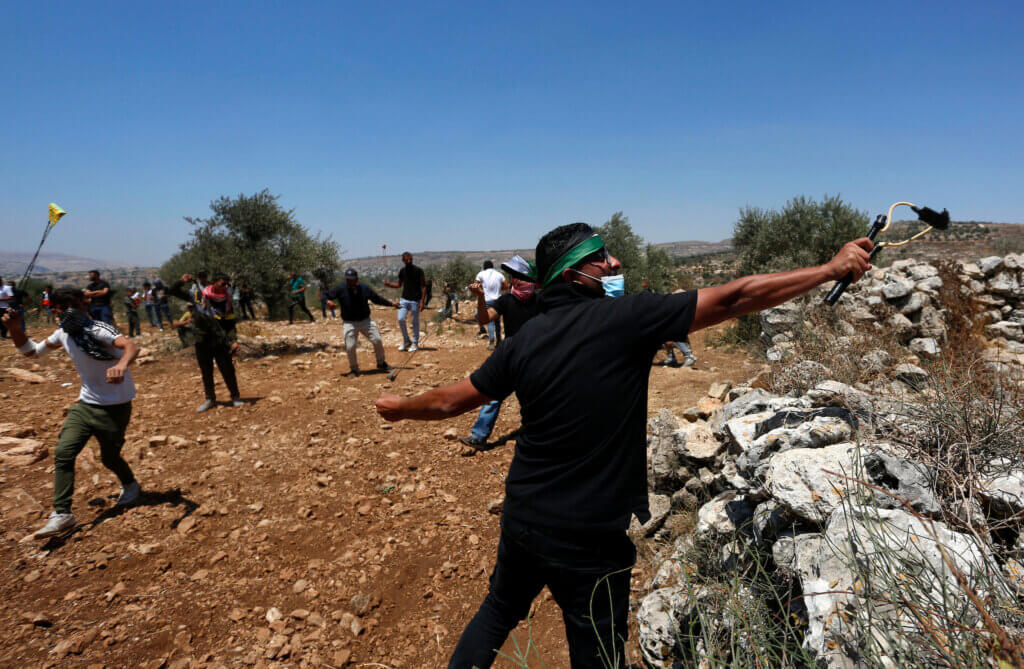
Meantime, today, the Israeli government was able to defuse another political crisis. The government reached a deal with religious settlers to evacuate the illegal outpost of Evyatar although they can maintain a yeshiva on the occupied lands of Beita village.
The deal removes a source of division inside the government. Defense Minister Benny Gantz has been pushing to evacuate the outpost, despite resistance from the rightwing members of the coalition, notably Bennett and Gideon Saar. Yossi Alpher at Americans for Peace Now:
Evyatar’s overnight construction [in May] was unauthorized even by the Netanyahu government back in May. Gantz and the IDF insist on dismantling it lest its survival provoke new West Bank tensions (four Palestinians have already died in the violent protests engendered by Evyatar) and complicate Israel’s relations with the Arab world, the US and the EU. The outpost’s removal is almost certain to provoke settler violence aimed at IDF soldiers, with political ramifications for a coalition that comprises a number of rightist sympathizers with the settlers.
Americans for Peace Now had called on the Biden administration to demand the removal of the Evyatar outpost settlement. Americans for Peace Now posted a statement by Avner Gvaryahu of Breaking the Silence saying that the outpost is a clear sign of “apartheid.”
The deal cannot be satisfying to Palestinian neighbors — the houses in the settlement are to be reoccupied by yeshiva students in coming weeks. I imagine protests in Palestine will continue.
Bear in mind that at least four Palestinians have been killed by the Israeli military as they protested this outpost on their land.
h/t Michael Arria and Yumna Patel.
” Americans for Peace Now posted a statement by Avner Gvaryahu of Breaking the Silence saying that the outpost is a clear sign of “apartheid.”
Gvaryahu’s explanation why ‘apartheid’ is an accurate description is worth reading:
https://peacenow.org/entry.php?id=38446#.YNokFruSnIV
I understand that a lot of people are bothered by the talk of apartheid. The link between our policies in the territories and the historical crime that took place in South Africa infuriates them. No matter that apartheid is a term in international law, the comparison is still there, they are hard to digest. So let’s put the term aside for a moment. For a moment. It is in Afrikaans anyway. Let’s talk about separation, or hafrada in Hebrew. Try it for a moment. It rolls on the tongue, doesn’t it?
Does anyone not think that there is a separation-based regime in the territories? Does anyone know that Israel maintains a complex and sophisticated system for creating a separation between Israelis and Palestinians? We have been there for 54 years. Does anyone really need more proof that there are laws for Palestinians and laws for Israelis? Does anyone need statistics on how many building permits Palestinians receive and how many demolition orders? On the number of outposts that flourish like poisonous mushrooms after the rain, with the enthusiastic encouragement of MKs from the coalition and the opposition, with the security of the army, with the help of regional councils, with the financing of my tax money?
1 of 2
https://www.aljazeera.com/opinions/2021/6/26/there-is-no-good-reason-why-israel-should-not-be-under-sanctions
“There is no good reason why Israel should not be under sanctions”
“Sanctions are used to respond to violations of international law. Israel has violated it many times, so why is it not sanctioned yet?” by Yara Hawari, Al Jazeera, June 26/21.
EXCERPTS:
“Last month a parliamentary petition was launched in the United Kingdom, calling for sanctions against the Israeli regime, blocking all trade, especially the export of arms. The petition received more than 386,000 signatures, forcing the UK parliament to debate the topic. The response from the British Government was clear: it stated it firmly opposed sanctions and boycotts against Israel, citing their ‘close relationship’.
“In Ireland, the issue of sanctions against Israel was also brought up in an amendment to a motion condemning the ‘de facto annexation’ of Palestinian land. While the amendment did not pass, the topic of sanctions was brought front and centre.
“The momentum for both the petition and the amendment came from the sharp public reaction against the intensified violence the Israeli regime has been inflicting on Palestinians over the last few months, including the most recent Israeli regime bombardment of Gaza in which more than 256 Palestinians were killed including 66 children.
“Yet, the call for sanctioning Israel has long been a focal point of the Palestinian struggle. Indeed, it is a core pillar of the Boycott, Divestment, Sanctions (BDS) movement – launched in 2005 which calls on people to pressure governments into fulfilling their obligations under international law to end Israeli apartheid by imposing sanctions. These can include banning business with illegal Israeli settlements, ending free-trade agreements, curbing military trade, and suspending Israel’s membership in international forums such as United Nations agencies, sports federations, international cultural organizations, and others.
“International sanctions were mandated in the League of Nations more than a century ago as a way to deter aggression and war. Since then, they have been enshrined under the international legal regime as an appropriate and effective way for third countries to punish those who violate international law. (cont’d)
2 of 2
“For example, sanctions including an arms embargo were used against South Africa’s apartheid regime to help end its racist rule over the country. More recently, in 2014, the European Union adopted sanctions against Russia following its illegal annexation of Ukraine’s Crimean Peninsula.”
“As Joseph Borrell, the EU High Representative for Foreign Affairs, recently told the UN Security Council: ‘[Sanctions] are a key instrument at our disposal to counter breaches of international law, proliferation of weapons, staunch the flow of arms into war zones … to combat human rights abuses and target those individuals who seek to undermine peace processes … They are designed to bring about change in policy or activity.”
“By Borrell’s logic, there is no reason why sanctions should not be imposed on the Israeli regime to hold it accountable for its many violations of international law. Yet the Israeli regime, which has been described as an apartheid one by human rights organizations and is currently under investigation by the International Criminal Court for committing war crimes against the Palestinian people, has faced no such sanctions.”
“The good news here is that progressive groups are pushing Palestinian human rights in Washington at a time when the Biden administration clearly wants the Palestinian issue to disappear”._______________It should come as no surprise to observers of American politics that both political parties see no benefit from a contentious relationship with Israel. They see no political upside of being accused of being “unfriendly” to Israel. When Presidents look for opportunities to challenge or stand against an action or policy, they do a lot of kissing up to empower them to try. The political graveyard speaks for itself. SFRC Chair, Chuck Percy, Jimmy Carter, GHWB, as examples. Politicians got it. Imagine the storm if a politician said, “I support the BDS call and propose these sanctions.” Safe political ground does not exist to seriously challenge Israel. At least now there is some room to nibble around the edges .Biden pointed the political path forward suggesting an emphasis on dignity and equality then retreated while that fermented to protect his time in the sun. BDS activists can end Apartheid along side a civil rights campaign against Jewish supremacy under the law when the Palestinian people come to a consensus toward that objective.
A yeshiva, eh? There’s a building in Hebron that used to be a Palestinian school. Jewish settlers went in, at night when no one was there, and refused to leave. And the cops and soldiers didn’t kick them out. Now it’s a yeshiva. What do you think is going to happen in Evyatar?