
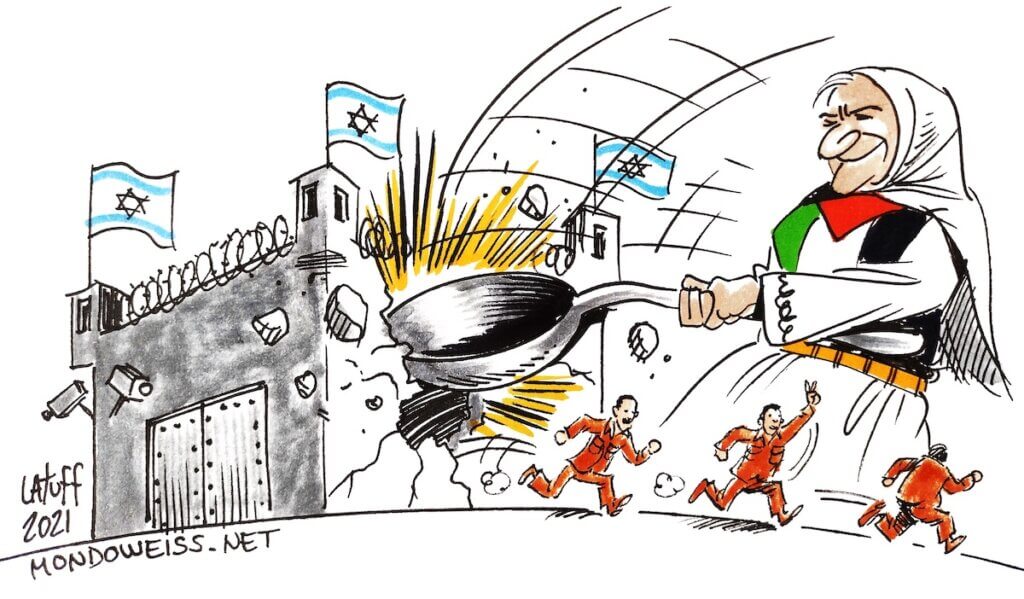
What are the lessons we, Palestinians, have learned from the successful prison break carried out by six political prisoners earlier this month? This prison break brought Israel’s “mythical” security system to its knees. All Palestinians, whether those living in the 1967 occupied areas, or Israel’s third-class citizens, or refugees living in miserable refugee camps and in exile, spent two weeks of an “imagined freedom” created by the prisoners. They felt they were more fully human, and that they could transform this (unjust) world.
The heroic act itself managed to destroy a myth and create a new reality: the first is that Israel’s security is unbreachable, and the latter is that Palestinians have a resolute will to freedom. Our Justice League managed to humiliate the whole Zionist project and what it stands for, namely, settler-colonialism and apartheid. Hence, the euphoria amongst Palestinians and Arabs and the outpouring of support from previously colonized nations and other freedom lovers.
They made us live in an “as if” state that opens pathways to new worlds beyond the walls erected by apartheid Israel and its barbaric, inhumane policies. Paulo Freire would have called it “untested feasibility,” an elaborate philosophy of hope that called for marginalized groups to move beyond their “limit situations” — i.e., the constraints placed on our humanity by Zionism— and, more importantly, how to transform those hostile conditions into a space for creative experimentation of freedom, equality and justice. In sum, to emancipate! We also know from Freire that any action taken on the world necessarily transforms the world as we know it, and this transformation of the world affects the manner in which we act on it after. To enter into this process is how individuals learn to become subjects who act upon a dynamic, open world rather than remaining passive objects that are merely acted upon in closed, unchanging systems such as apartheid Israel, White South Africa, and Jim Crow’s America before it, wants us to believe. This is the six prisoners’ vision of how we, colonized Palestinians, can overcome subjugation to Jewish supremacy.
What we have learned from these heroes is that ideas of liberation are not about static worldviews but also about world-changing, that apartheid and settler-colonialism can be defeated even with the smallest tool available: a spoon!
Forget about The Shawshank Redemption, Prison Break, and The Great Escape . . . it is doubtful that the six heroes have even heard about these films. They don’t have white skin, blond hair, nor do they have an inferiority complex (Black skin, white masks.) Rather, they are Palestinian prisoners, refugees, that the world decided to turn its back on and force to pay the price for a pogrom committed more than 75 years ago in Europe! They were born to non-Jewish mothers! What we have learned from these heroes is that ideas of liberation are not about static worldviews but also about world-changing, that apartheid and settler-colonialism can be defeated even with the smallest tool available: a spoon!
The shock, and even horror, expressed in almost all Israeli media is a reflection of the deep-rooted racism of Zionist ideology and its impact on ordinary Israelis’ minds because they are indoctrinated into believing that they are entitled to certain privileges that must be denied to the “goyim,” who are totally dehumanized and demonized. One Israeli writer warned that: “the escape caused a transition [among Palestinians] from depression to euphoria — and every psychologist knows that this creates an unstable situation!” In fact, like the inhumane apartheid system before it, apartheid Israel is unable to understand Palestinian suffering and the nature of its oppression of those living in historic Palestine. Zakaria Zubeidi, one of the six recaptured prisoners, has this to say to them:
What do you expect from a person whose father you starved by preventing him from practicing his profession as a teacher, whom you then killed his mother in front of him, shot dead by a sniper; who you killed his brother and his best friends along with 370 sons and daughters of a refugee camp crowded into one square kilometer?!
What do you expect from a person whose family you displaced alongside his people and whom you suppressed their rights in the most severe way—while you arrested him twenty times and each time tortured his body and made him physically disabled while in the prime of his youth?
In the above-mentioned movies, the escapees manage to get their freedom because the world outside the walls of their prisons is a welcoming one, whereas, in the Palestinian case, it is the same racist world of settler-colonialism. Now wonder then that the late Palestinian Mahmoud Darwish asks, in one of his painful poems: “Where should birds fly after the last sky?”


2 of 2
“I feel the poem of our Galilean, Mahmoud Darwish who prays, writes, that I am an Arab. It will be written that Mahmoud Abbas was an Arab traitor. Your criminal betrayal of humanity, contributing not only to colonialism but to the zionist project to end, to make disappear, to exterminate our people, endangering also the existence and continuity of the Arab, Persian and Kurdish peoples and cultures. Greater Israel.
“The liberation of Palestine against the colonial yoke and anachronism, that desperately just and tormenting human cause, is the outcome and contribution to contemporary and universal history of advancing against inhuman colonial barbarism, imperial atrophy and against the most effective fascist movement of our time, zionism.”
1 of 2
Jesus was a Palestinian, but so was Judas – Orinoco Tribune – News and opinion pieces about Venezuela and beyond
“Jesus was a Palestinian, so was Judas” Orinoco Tribune, Sept. 13/21, by Susana Khalil.
EXCERPT:
“Solitary letter to the de facto President of the Palestinian Authority, Mahmoud Abbas”
“I have made a pact with life that, in my rudimentary and messy struggle from the Diaspora for the liberation of my Palestinian homeland against Israeli colonial anachronism, it will intrinsically be my path and encounter with humanity itself, with all that is noble, sane, just, honest and generous. I do not speak of the beautiful, because all this is painful and I stoically protect it with the mud and honey of dignity.
“When you die, I will not celebrate your death. I say this because there is a tendency to celebrate the death of traitors. Perhaps I will die before you. And I will not celebrate your death precisely so that I do not degrade myself in the human misery that causes suffering, so that injustice does not dehumanize me. I take refuge in the human condition, that is my temple. When a just or unjust human creature dies, it is the same human self. When Rulilahla Mandela died, it was the same human self and I rejoiced in his fruitful humanity. When the genocidal genius Ariel Sharon died, it was the same human self that scared me with shame and horror. The death of tyrants, bloodthirsty, genocidal and treacherous people is not a victory of the people in struggle. I will not celebrate the death of Henry Kissinger, George Bush, José María Aznar, Tony Blair, Bin Salman, Madeline Albright, Tzipi Livni, Zayed bin Sultan Al Nahyan, Hamad Bin Isa Al Khalifa, among many others.
“Out of respect and love for humanity and life, I will not celebrate your death, but I will make it clear, out of outrage, that a traitor of my people has died. The greatest traitor of the Arab world is a Palestinian.” (cont’d)