Editor’s Note: The article is part of our series Gaza Diaries which shares firsthand accounts of Palestinians who lived through the 11-day Israeli attack on Gaza in May 2021, and are now dealing with its aftermath. You can read the entire series here.
The act of writing about Palestine is symbolic of Palestine itself; my prose is fragmented and stems from a shattered recollection of every experience I’ve ever had. After two and a half years of being away from my home, I decided it was time to return. Preparing for the journey to Gaza through Egypt last spring, I printed every single official document I had, I got vaccinated, and I left all my valuable belongings from my rental in Doha with a friend, in case I didn’t return.
“I won’t be sad, nor will I blame you, if you don’t come. The journey is arduous, and you might be unable to leave Gaza,” my wife Taj said on the phone when I first told her about my decision to return home after living apart for thirty months for reasons too complicated—but entirely Palestinian—to explain here.
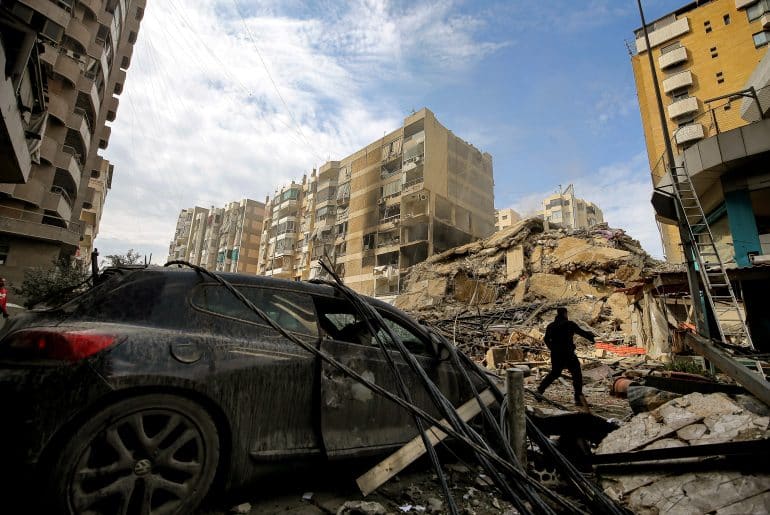
“I lied,” she later confessed on the sixth night of last May’s Israeli attack on Gaza. In those early morning hours, Israeli aircraft bombed the usually bustling al-Wehda St., killing 49 people, including two extended families.

I was in high school when I first acquired the habit of staying awake until 3:00 a.m. Back then in the mid-2000s, the Israeli military used to penetrate Gaza’s eastern fence overnight and occupy strategic houses in operations to clear the way for the tanks and bulldozers. This was a traumatizing military tactic for those of us who lived nearby the fence, especially for families like mine. It took years to readjust my circadian rhythm. Yet after finally breaking the insomniac sleep pattern, I quickly picked up the old habit again a few months ago as the nights were a living hell for Palestinians in Gaza.
When I returned to Gaza the terror was inconceivable. May 14, the first night of a series of its kind for Gaza, was the worst. At exactly 12:00 am, 160 Israeli planes dropped fire while tanks shelled, hitting 150 “targets” with 450 missiles and artillery fire.
The heavy bombardment lasted for 40 minutes. Terrified, Taj and I cornered ourselves in what we thought was the safest place in our fifth-floor apartment and waited for our turn. I held Taj under my right arm and my mobile in the left. I received a notification, Benjamin Netanyahu tweeted and the density of attacks started to decline. He was watching.
I was 10 years old when I was taught how to run for cover from Israeli warplanes. “Zigzag,” my father told me while my grandfather showed me how to cover my head as he did once in the 1950s. Shielding him with her body, my mother told us the story of how her pregnant mother protected her brother from an Israeli tank in the first hours of the Six-Day War in 1967, and then she wishfully insisted the soldiers will not target children of my age.
A week later, an Israeli shell killed 4-month-old Iman Hijo in Khan Younis. While I have many stories of survival to tell, I still don’t think these “survival tactics” would be helpful in surviving an Israeli airstrike, especially now that they are bombing high-rises.
The way I ended up back in Gaza was because of a holiday. Excitedly, I had planned to spend the springtime Eid holiday with my family. It was a chance to see everyone and everything after being abroad for a long time. I crossed the Rafah border for the first time two weeks before Gaza’s COVID-19 nighttime lockdown was lifted, on May 6 (it was a Thursday). With pandemic closures lifted, people rushed to the sea. Taj took me to a nice place, a seaside cafe called Maldive Gaza. Although the place was crowded, we managed to find a spot overlooking the Mediterranean. On the horizon, you could see white dots stitching the sky and the sea together. These were the Israeli warships, effectively Gaza’s fourth wall.
On May 18, what was the seventh day of what the Israeli army dubbed Operation Guardian of the Walls, my mother called me. The name of the operation was meant to reference Jerusalem’s walls, of course, yet I was thinking of different Israeli walls. One stretches over 712 kilometers in the West Bank. Another, the Philadelphi wall, separates Gaza and Egypt. In January 2008, the Palestinians tore down a piece of the latter wall and crossed into Egypt looking for food and supplies. This was one year into a blockade that continues to this day and was my first time outside of Gaza. The second was a decade later. But for many who crossed with me in 2008, this was the last time they ever left this place.
“I saw your name on Rafah crossing’s travel list,” my mother said anxiously on the phone. “Why are you still here? Leave,” she continued. Two weeks prior, I had registered to travel back to Egypt so I happened to have already been approved to leave by the time the escalation began. She complained earlier that I only visited them twice since my return while now she was insisting that I leave immediately. For two and a half years I hadn’t seen my family and now they wanted me to leave. I didn’t.
Our apartment is located in the heart of Gaza City, in al-Naser neighborhood overlooking al-Shati refugee camp next to the shore and is one of the world’s most densely populated areas. A dead silence falls upon everything as soon as the night falls and the glittering lights of the warships appear on the horizon, nothing to be heard; no children playing, and no mothers calling them back home. Being inevitable, a terror-stricken burden of waiting for the next massacre looms over every house in Gaza and an insane feeling of wishing it will be far away from you and from anyone you know.
On May 21, I saw my grandfather crying for the first time the day a ceasefire was declared. As the paramedics were pulling dead bodies from under the rubble and tunnels, tears gathered in his eyes as he shook his head saying: “Young people, like flowers, are dying for us.” Seventy-three years earlier, during the Nakba, my then 18-year-old grandfather dug a small tunnel next to his old house on the outskirts of the old Gaza governorate, which is now under Israeli control. He wanted to protect himself from the Zionist militias that were attacking Palestinian villages. He almost died in that tunnel when the entrance was accidentally blocked, that experience left him scarred forever. Everyone in my family knew the story but no one seemed to remember it when he cried.
In the first minutes of the ceasefire, people took to the streets in Gaza celebrating their victory, their new life, or their resilience! Does it really matter? Faced with the total denial of, and the ongoing war on your mere existence (and resistance), survival is something to be celebrated. By all means, no one can convince Palestinians otherwise.
Taj and I remained home and checked on everyone we knew over the phone. Then we decided to again visit our new favorite cafe.
Two weeks later, I packed my clothes, my wife’s love, my mother’s blessings, my father’s advice, my friends’ gifts, and finally my people’s cries and resilience, and headed to the border. After one day at the Rafah crossing, where we slept the night on the street and another on the road across from the Sinai Peninsula, I reached the Cairo Airport and, three hours later, my final destination.
I think back to when Taj and I revisited the partially-destroyed Maldive Gaza cafe and sat feet away from where a missile exploded, as I tried to make sense of my whole journey back home. Alas, I couldn’t think of better words than what Mahmoud Darwish once said to Rita: “Come, let’s belong to the massacre.”
Abdelrahman Abuabed
Abdelrahman Abuabed is an Arabic writer and a comparative literature researcher.