

It’s hard to believe that the same streets in Haifa that are now filled with lights, decorations, and a lively Christmas atmosphere, with Jewish and Palestinian residents alike taking in the holiday spirit, were the site of shattered windows, smashed cars, vandalized shops, and the blood of those very same Palestinian residents after Jewish-supremacist mobs rampaged through the city’s mixed neighborhoods in May.
A year that began with an existential threat to the lives of Haifa residents ends in a festive atmosphere as tens of thousands visited the Palestinian neighborhoods of Haifa to bask in the holiday cheer if the bloodshed and violence of Black May this year never occurred.
The violence we saw earlier this year was a direct attempt by then Prime Minister Benjamin Netanyahu to blow up life in mixed cities such as Haifa, Jaffa, Lod, and Ramla to salvage his premiership. He did this by empowering and legitimizing the most radical and extreme forces in the Jewish and settler spheres. This is nothing new, however – mixed cities have been the target of a relentless onslaught by extremist settler organizations for almost two decades now.
Ever since Israel’s unilateral 2005 withdrawal from Gaza, these settler organizations have turned their attention to Judaizing the few remaining mixed cities in Israel, particularly in cities with a large Palestinian minority like Acre. They have done this by making the lives of the cities’ Palestinian residents as miserable as possible. Just three years after the withdrawal, riots broke out in the mixed city of Acre between radical, Jewish settler groups and the city native Palestinian inhabitants. Over the span of a week, over 30 homes were damaged, with three Palestinian homes being burned beyond recognition. 100 cars and 80 shops, both Jewish and Palestinian owned, were ravaged. In the end, however, it was the Palestinian community that bore the brunt of police indictments.
Violent, Jewish supremacist organizations such as Lehava and Kahana Chai sought to repeat the explosion of violence seen in Acre in 2008 this past May. As Palestinians took to the streets in peaceful demonstrations throughout Israel’s Palestinian and mixed cities, they were met with an overblown police response. In Haifa, the police – in line with the former Minister of Public Security Amir Ohana’s orders – blew up the demonstrations with excessive force.
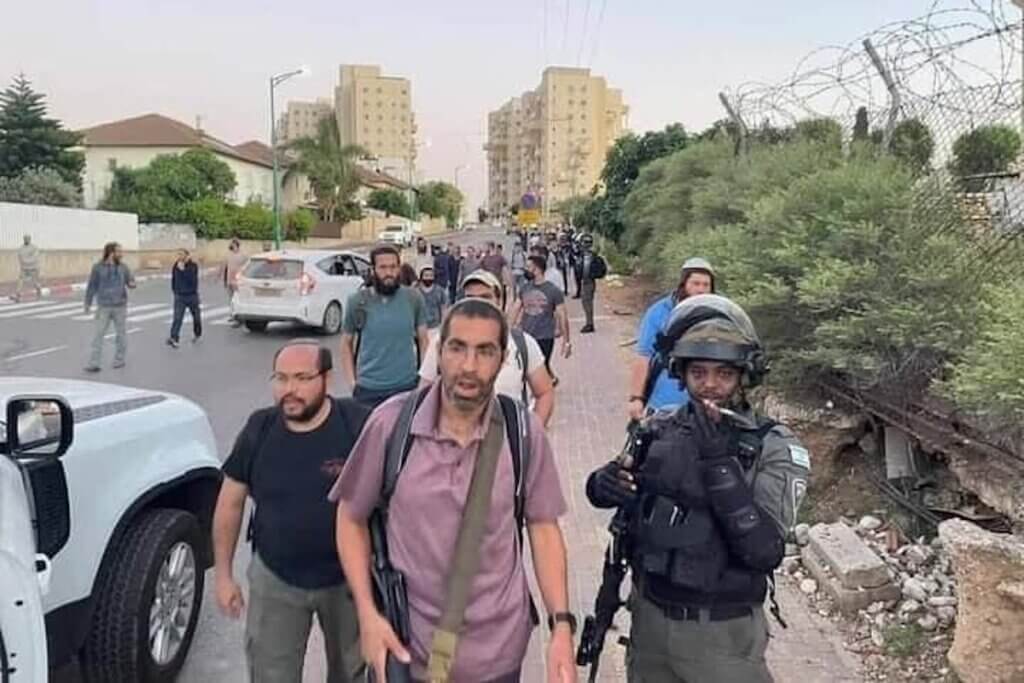
Meanwhile, buses of Lehava and Kahane Chai supporters were on their way to Haifa. That same afternoon, Jewish and Palestinian leaders met at the city council with Haifa Mayor Einat Kalisch-Rotem, warning her of a “black night” should the racist mobs be unleashed into the city’s Palestinian and mixed neighborhoods. The police department did not attend the meeting. That same evening, as the buses arrived at the outskirts of the Palestinian neighborhoods, carrying dozens of rioters, the Palestinian residents organized in their neighborhoods of Wadi Nisnas and Halisa.
The police closed off the mixed neighborhoods, including the German Colony and Wadi Jamal, and marched with the Jewish mobs who attacked and rioted with full force throughout the neighborhoods’ streets, some armed with guns. They attacked Palestinian residents, houses, cars, property, and businesses.
In one neighborhood, racist rioters attempting to break into Palestinian homes were met with Palestinians ready to protect their homes. Only then did the police intervene to prevent a civil war from starting. In other words, only when the Palestinian resident defending their homes began to show force in their resistance did the Israeli police stop the radical racist rioters.
These scenes of radical supremacist mobs rioting in the streets of mixed cities as Palestinian residents were hiding in their homes fearing for their life was repeated in Jaffa, Lod, Ramla, and other mixed cities. In addition to drawing many strong parallels to the violence in Acre over a decade prior, the events in May were also a significant escalation; fueled by relentless incitement by Israeli officials and politicians and the empowering and legitimization of radical supremacism at the hands of Prime Minister Netanyahu over the years.
A common theme during the violence in 2008 and 2021 was the perception among the Jewish-Israeli public to those events. Since the inception of the State of Israel in 1948, Jews have always viewed themselves as detached from the Middle East; that is, they are disengaged from the Middle East, the various peoples that live in, its rich cultures, languages, and history. They treat Israel as though it is a part of Europe, not the Middle East.
When their Palestinian neighbors (quite literally) were under attack, Israelis viewed the violence as something happening to distant Palestinians in the West Bank in Gaza. There is little solidarity from the general Israeli public towards their Palestinian neighbors in Haifa, Lod, and Ramla. This apathy and indifference were also seen in Haifa Mayor Kalisch-Rotem’s lack of response to the violence ravaging her own city’s streets, terrorizing her very own constituents.
Interestingly, however, cities such as Nof Hagalil (formerly Nazareth Elite) which sits right next to Nazareth, the largest Palestinian city in Israel, and is normally the site of such anti-Palestinian violence was quiet during May. Despite a third of its residents being Palestinian, Nof Hagalil remained surprisingly quiet and did not experience the rioting seen in Haifa.
Like in Haifa, Nof Hagalil Mayor Ronen Plot met with Palestinian city council members who voiced their concerns over attempts by settlers and racist mobs to incite violence against the city’s Palestinian residents. However, unlike Kalisch-Rotem, who comes from the Askhenazi elites of Israel, Plot comes from the Russian-speaking community comprised of Soviet migrants which, like Palestinian citizens of Israel, is marginalized in Israel. Thus, Plot was much more susceptible to the potentially explosive events that could take place in his city and acted in cooperation with the Palestinian council members to prevent the outbreak of violence.
The indifference shown by Haifa’s Jewish residents reflect an overt consensus among the Israeli public regarding its relationship to the Middle East. They came to the Middle East yet pretend not to be a part of it.
This pattern was repeated all over Israel. In cities led by mayors who were indifferent to the concerns of their Palestinian resident or outright incited against them – as in the case of the mayor of Lod which saw particularly fierce violence against Palestinians – we saw violent, racist mobs roam the streets freely, often under police protection. This occurred despite the countless warnings of Palestinian public officials and community leaders.
The indifference shown by Kalisch-Rotem and Haifa’s Jewish residents reflect an overt consensus among the Israeli public regarding its relationship to the Middle East. They came to the Middle East yet pretend not to be a part of it. A common phrase, used by former Prime Minister Netanyahu himself in the past, which reflects the Israeli public’s core view of itself in the Middle East is that Israel is a “villa in the jungle.”
However, this perception appeared to shatter recently. Due to global lockdowns, Israelis suddenly found themselves forced to spend the holiday season at home, only to discover that Christmas has been celebrated for decades in their very own backyard. Tens of thousands of Israelis flooded Palestinian cities such as Nazareth and the Palestinian neighborhoods of Haifa to celebrate the holiday season. Many Palestinians recount hearing their Jewish neighbors say “it’s like going abroad” as they walked through the ornamented streets of Nazareth and Haifa, took pictures with the Christmas tree, and dined in Palestinian restaurants. In Haifa, Israelis suddenly discovered the German Colony that was burning just a few months ago.
It is time for Israel and the Israeli public to face the fact that it is in the Middle East. The Palestinian communities in Haifa, Acre, Jaffa, Lod, Ramla, and Nazareth are the face of the Middle East. The Jewish residents of these cities must not deny that. Nor should they erect barriers – physical or mental – to uphold the false curtain they have surrounded themselves with.


One of the most important elements of Zionist ideology is that Jews have an historical and ancestral link to Palestine. Now we read that Jewish Israelis seem to feel most at home in places like Tel Aviv, which are the ones most similar to Europe, and that they feel themselves to be traveling abroad when they visit large Palestinian population centers, which are more authentically Middle Eastern. Go figure.
1 of 2
Briefly, for the record re the Zionist conquest of Haifa:
The Arab defenders were poorly “…armed with British and French rifles, mostly of World War 1 vintage, & chronically short of ammunition. The entire garrison possessed only fifteen sub-machine guns, an essential weapon in urban warfare. In contrast, Haifa was the home & recruiting base of the 2,000 strong [Zionist] Carmeli or Second Brigade … [which had] armoured cars, two-inch & three inch mortars, machine guns, Sten & Thompson sub-machine guns, rifles & grenades – all in plentiful quantities & with virtually unlimited supplies of mortar shells & ammunition.” (Professor Whalid Khalidi, Harvard, “Selected Documents…” JPS Vol. XXVll, No. 3, Spring 1998, p. 87)
As well as Davidka mortars with sixty-pound shells, the Carmeli Brigade used Barrel bombs (nicknamed Barak Bullets) which were ‘converted oil barrels & spherical sea mines filled with explosives [that were] rolled down onto the Arab quarters from the higher Jewish areas.’ (Khalidi, ibid, pp.87 & 89)
The Carmeli Brigade was ordered to be ruthless against the Arabs, to ‘kill every [adult] male encountered’ & to attack with firebombs ‘all objectives that can be set alight.’ (Benny Morris, The Birth of the Palestinian Refugee Problem, 1947- 1949, New York: Cambridge University Press, 1988, pp. 76-77) Arthur Koestler described what came after the Davidka mortars & barrel bombs: ‘ruthless dynamiting of block after block of bazaars & blind alleys until the panic had reached sufficient dimensions to end all resistance.’ (Palumbo, The Palestinian Catastrophe, p. 64)
Gunfire continued throughout the night of April 21 as the volunteers fought bravely against impossible odds. Inevitably, they were overwhelmed which left the Arab civilians undefended. A blood bath followed: ‘When the Haganah Command learned that the Arab authorities were calling upon the civilians to gather for shelter in the old market place, three inch mortars, according to the official history of the Carmeli Brigade, were ordered to shell the market place. When the shelling began and shells fell inside the market a great panic ensued. The crowd broke into the port & pushing aside the police who guarded the gate it stormed the boats & began to flee the city’.” (Khalidi, p. 89) (cont’d)
.
2 of 2
British officials who were in Haifa at the time, later testified that as Palestinians fled down the narrow alleys towards the docks the Haganah opened fire on them with “indiscriminate & revolting machine gun fire on women & children [which] led to considerable congestion [of] hysterical & terrified Arab women & children & old people on whom the Jews opened up mercilessly with fire.” (Professor John Quigley, Palestine & Israel…, p. 60)
Haganah commander Ben Zion Inbar recalled firing on the Arabs as they gathered in the market: ‘We manned the biggest mortar which our forces had at that time – a three-inch mortar – & when all the Arabs gathered in this area we started firing on them. When the shells started falling on them, they rushed down to the boats & set off by sea for Acre [across the bay from & north of Haifa].” (Quigley, p. 60)
Haganah commander Ben Zion Inbar recalled firing on the Arabs as they gathered in the market: ‘We manned the biggest mortar which our forces had at that time – a three-inch mortar – & when all the Arabs gathered in this area we started firing on them. When the shells started falling on them, they rushed down to the boats & set off by sea for Acre [across the bay from & north of Haifa].’ (ibid)
“The 3-inch mortars ‘opened up on the market square [where there was] a great crowd…panic took hold. The multitude burst into the port, pushed aside the policemen, charged the boats & began fleeing the town.’ British observers noted that ‘during the morning they [the Haganah] were continually shooting down on all Arabs who moved both in Wadi Nisnas & the Old City. This included completely indiscriminate & revolting machinegun fire & sniping on women & children attempting to get out of Haifa through the gates into the docks….There was considerable congestion outside the East Gate [of the port] of hysterical & terrified Arab women & children & old people on whom the Jews opened up mercilessly with fire.’” (Benny Morris, The Birth of the Palestinian Problem, 1947-1949, New York) .
It will never be know how many hundreds or thousands were slain in the streets, but less than 24 hours after the attack began nearly 60,000 of Haifa’s Arabs had been forced to flee for their lives by sea to nearby Acre with many continuing on to Lebanon.