THE OTHER END OF THE SEA
by Alison Glick
260 pp. Interlink Books $20
Alison Glick’s first novel, The Other End of the Sea, draws heavily from her experiences, especially the six years she lived in Israel, Palestine, and Syria. The story starts with her main character, Becky Klein, a naïve young woman from the Midwest, who travels to Israel in search of her Jewish roots. But Becky’s search takes her down a path that forever changes her life in ways she could never have imagined.

Glick’s book spans the period from Becky’s first visit to Israel in the summer of 1981 to the present. As a Palestinian-American who lived the first three decades of my life in the Middle East—mostly in my hometown of Jerusalem, I am astounded by the depth of understanding that this book demonstrates of the Palestinian experience over the last four decades.
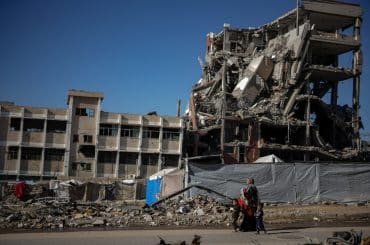
The tale describes how Becky, though naïve, nonetheless begins to see the “separate and unequal” treatment by Israelis of Palestinians, even those who are citizens of Israel. We see what unfolds when a person witnesses wrongs and cannot look away. Becky relates her increasing sense of the injustices she sees to her own family’s legacy. Realizing she needs a deeper background to understand what she has seen, the protagonist returns to the U.S. to study Middle East History. Afterwards, Becky takes a teaching job in Ramallah, and then moves to Gaza, where she begins working as a human rights researcher. There Rebecca falls in love with and marries a Palestinian from Shati Camp, Zayn Majdalawi, who had spent 15 years in an Israeli prison for resisting the occupation. In his family she finds unexpected warmth and welcoming arms.
A particularly touching example of the relationship forged between Zayn’s family and Rebecca is the scene in Shati camp where her brother-in-law Lutfi takes her to meet, for the first time, his mother, Asma, and his father, Omar, who is a sheikh:
…She called to her husband, Sheikh Omar, who was finishing his afternoon prayers in one of the three rooms off the courtyard.
He emerged clad in a white Nehru shirt, drawstring pants cinched loosely at the waist, and a skull cap perched atop his smooth head. Blind since boyhood, he began guiding himself toward us along the courtyard wall; with a few strides Lutfi was at his father’s side. I could see my father-in-law’s once statuesque physique, now bowed with age and the labors of blind perambulation, reflected in Lutfi’s.
“There is someone I want you to meet,” Lutfi said loudly. He took his father’s hand and led him toward me, past the lone fig tree that grew defiantly in an old olive oil tin.
As they approached, a moist circle sprouted under my arms.
“Ya ba, hathee marat Zayn. Baba, this is Zayn’s wife, Rebecca.”
Sheikh Omar had begun extending his hand in greeting, but when the sentence ended his arm froze. The words marat Zayn bounced off the cinder block walls, playing with the dead silence that echoed even louder. Omar’s mouth twitched and he cocked his head.
“Zayn tjawaz? Zayn married?” His voice soft in a wave of confusion edged with another growing emotion.
“Hathee marat Zayn?!” Asma croaked.
She struggled to her feet and steadied herself by throwing her arms around my shoulders and planting innumerable moist kisses on my cheeks.
I turned back to the sheikh, who still seemed to be taking in the news. I could hear the distant sound of the sea pounding itself along the camp’s beaches.
“Marat Zayn,” he repeated.
A smile formed from the center of his lips and spread itself across his face, lifting the corners of his salt-and-pepper beard. His mouth opened into a toothless grin. He released Lutfi’s grip and reached out to me, taking my face in his hands so he could find my cheeks and kiss them.
My father-in-law led me into the room in which he had just prayed. We sat on floor cushions arranged against the wall. Lutfi brought us tea.
“Keefik? How are you?” he asked.
He offered me a cigarette and while we smoked and drank tea I told him about myself: my family, my work, where I was living.
“What do you need? Money? Food? Aya hajee, bas eselee! Anything, just ask!” he commanded.
Between questions about my siblings and where I had gone to college, he suddenly had me repeat the shahada, testifying: la elah illa allah wa Mohammed rasul allah. There is no God but God and Mohammed is his prophet. I did so and went back to telling him about the Friends School in Ramallah. Lutfi grinned and shook his head. It was then that I realized the reason for Sheikh Omar’s request: repeating the shahada was how one converted to Islam.
I helped his fingers find the cup so he could pour me more tea. Then he took my hand in his and turned my palm upward. With his other hand he began gently rubbing the tips of my fingers with a smooth, circular motion, slowly moving from finger to finger.
“Ya binti. Ahlan wa sahlan. Welcome, my daughter.”
The couple keep a beautiful garden in their yard, overlooking the Mediterranean Sea. The garden, the sea, and Gaza itself become characters in the story, evoking the drama, beauty, and tenderness at the heart of the novel.
But constant Israeli violence against Palestinians, and the threat of more imprisonment and torture for Zayn, force the two of them out of Palestine. What follows is a story of precarious existence in Egypt, Libya, and Syria. Glick’s account also touches on the experience of Zayn and Rebecca’s daughter, raised first in Syria, then the U.S., but proud of her Palestinian identity.
This book will strike a chord among Palestinians especially, and other people across the world who have experienced severe oppression in their countries. For example, Palestinians will recognize in the narrative the fear of arrest and torture; the threat of long prison sentences, sometimes under indefinite “administrative detention” (without trial or charges;) and the deprivation and suffering that these injustices inflict on the families of detainees. According to the respected Palestinian prisoners’ rights group, Addameer, “approximately 20 percent of the total Palestinian population in the [occupied Palestinian Territories] and as many as 40 percent of the total male Palestinian population” have been held in military detention.
Palestinians and many others will also identify with the pain of exile that people feel when the conditions they face at home drive them to seek life elsewhere. Rebecca follows Zayn, who is forced to flee Gaza, as they move from one country to another—places where he is really unwelcome and subject to more persecution. The crucible of exile changes Zayn inwardly and outwardly; his most distinguishing features, his beaming smile and deep green eyes, begin to fade with the emotional toll. As the protagonist Rebecca observes:
Now he was in exile. This changed everything. Indeed, it seemed to unmoor him, and he had begun to float away. What I didn’t know was how far would he go? Or what, if anything, would bring him back?
The love that grew so beautifully between him and Rebecca is now battered by the uncertainties and hardships of their precarious existence.
Above all, The Other End of the Sea is a gripping story of a difficult love between two people, and also of their love for dignity and freedom, under unbearable conditions. It also includes humor that will be familiar to people who are continuously fighting for their dignity.
The author, perhaps also a naïve young American in 1981, is a person of amazing courage. She bravely allowed her conscience to face challenges that most people would avoid. And her aesthetic showed her a grace that many people would never see. In another act of courage, she shares both the beauty and the pain of the story on the printed page. Read her book and tell your friends about it.