
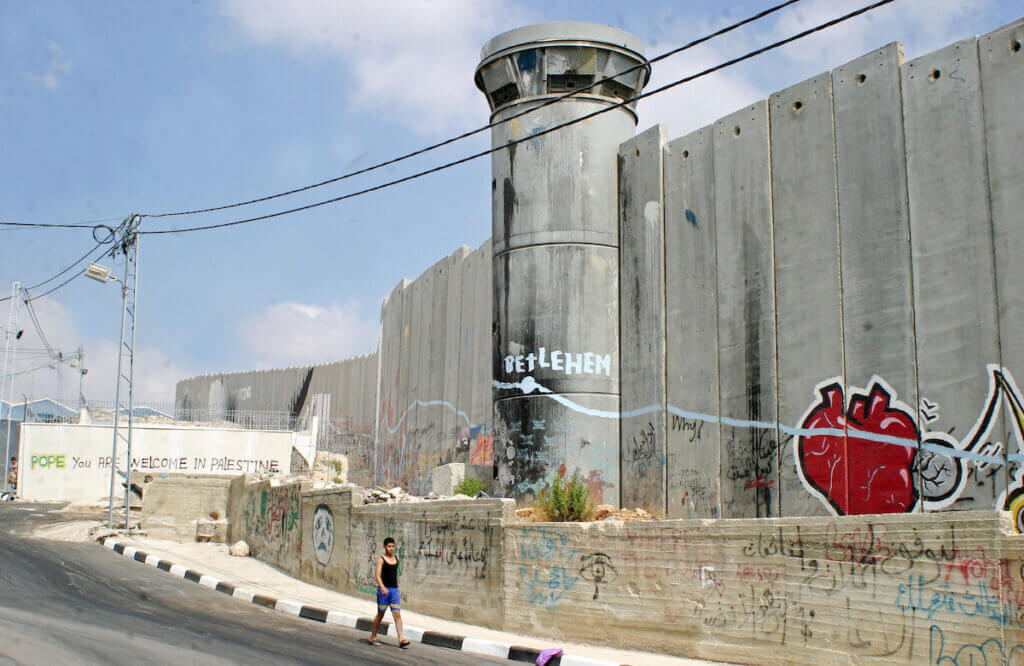
In a statement released last week, the most extensive Palestinian Christian ecumenical nonviolent movement, Kairos Palestine (KP), expressed gratitude for Amnesty International’s courage in documenting that “Israel’s laws, policies and practices constitute an apartheid state.”
“Since its establishment in 1948,” Amnesty’s report charges, “Israel has pursued an explicit policy of establishing and maintaining a Jewish demographic hegemony and maximizing its control over land to benefit Jewish Israelis while minimizing the number of Palestinians and restricting their rights and obstructing their ability to challenge this dispossession.”
“Amnesty’s report is a stark affirmation of the gloomy reality of subjection, oppression, racism and discrimination that the Palestinian people are passing through day and night,” says Lucy Geries Talgeih, a KP board member and post-graduate student doing coursework at NYC’s Columbia University.
KP’s statement reads, “We are particularly grateful that Amnesty International begins its report by pointing to the roots of the May 2021 Unity Uprising that brought Palestinians together across ’48 Palestine, Gaza and the West Bank (including East Jerusalem). Israel’s brutal response not only put the world on notice regarding Israel’s over fifty-year occupation, it also served to strengthen our cry for justice and our sense of unity.”
Rifat Kassis, Kairos Palestine’s General Coordinator, recalls that at the 2001 NGO Forum held concurrently with the Durban Conference Against Racism in South Africa, Palestinians raised the slogan, “Zionism is racism and Israel apartheid.” “The statement,” Kassis says, “was adopted by the majority of participants but some human rights organizations, including Amnesty International and Human Rights Watch, had reservations about it.”
“We’re grateful for Amnesty International’s report. It is a tool in the hands of Palestinians on their path to freedom.”
Rifat Kassis, Kairos Palestine’s General Coordinator
Twenty years on now, both globally respected human right organizations have issued reports accusing Israel of being an apartheid state. “These profound changes in the international environment,” Kassis says “especially on the popular and civil society levels regarding Israel, mean that sooner or later Israel will be held accountable. We’re grateful for Amnesty International’s report. It is a tool in the hands of Palestinians on their path to freedom.”
Talgeih cautions, “Questions remain. Can this report disturb the still water that marks our reality for more than 68 years? Can it trigger much-awaited change? Who can hold Israel accountable for its violations of basic human rights?” She adds, “These are questions that all humanity should answer.”
Looking ahead, Kassis says, “We in Kairos Palestine hope that global churches, especially the Vatican and the World Council of Churches meeting this year in Germany will adopt these reports and respond accordingly to Palestinians’ pleas for justice and an end to Israel’s brutal occupation.”
Kairos Palestine’s statement indirectly addresses those who accuse Amnesty International and supporters of its report of antisemitism. Quoting from its 2009 document, Kairos Palestine: A Moment of Truth, Palestinian Christians reaffirmed their hope for justice and reconciliation:
Our message to the Jews tells them: Even though we have fought one another in the recent past and still struggle today, we are able to love and live together. We can organize our political life, with all its complexity, according to the logic of this love and its power, after ending the occupation and establishing justice. (KP 5.4.2)
We believe in God, good and just. We believe that God’s goodness will finally triumph over the evil of hate and of death that still persist in our land. We will see here “a new land” and “a new human being”, capable of rising up in the spirit to love each one of his or her brothers and sisters. (KP 10)

A brief look at Zionism and apartheid in action:
“When Jewish troops occupied the village of Safsaf in the Upper Galilee, on 29 October 1948, they encountered no resistance whatsoever, only white flags of surrender. The residents were ordered to assemble in the central square and according to one of them, Um Shaladah al-Saliah, while they were lining up “…the soldiers ordered four girls to accompany them to the well to fetch water for the villagers. But the young women never got to the well. ‘Instead, they took them to our empty houses and raped them. [Then,] about seventy of our young men were blind-folded and shot to death, one after the other, in front of us’.” (Professor Michael Palumbo, The Palestinian Catastrophe, p. 167-68)
Um Shaladah al-Saliah ‘s account was confirmed by Yosef Nahmani, then director of the Jewish National Fund office in Eastern Galilee, whose diary record for 6 November 1948 reads: “In Safsaf, after…the inhabitants had raised a white flag, the [soldiers] collected and separated the men and women, tied the hands of fifty-sixty fellahin [farmers] and shot and killed them and buried them in a pit. Also, they raped several women….” (Benny Morris, “Falsifying the Record,” Journal of Palestine Studies, Vol. XXIV, Number 3, Spring 1995, p.55)
“Notes taken by Aharon Cohen during a November 11, 1948 meeting of the Political Committee of Mapam (United Workers Party) provide further proof of the atrocities committed by Israeli soldiers in Safsaf: “…52 [Arab] men [were] tied together with a rope, pushed down a well and shot. 10 killed. Women pleaded for mercy, cases of rape…. A girl of 14 raped. Another four killed. Rings [cut off?] with knives.” (Benny Morris, “Falsifying the Record,” Journal of Palestine Studies, Vol. XXIV, No. 3, Spring 1995, p. 60)
“we can organize our political life…… after ending the occupation and establishing justice.”
Debate and discussion of plans for co-existence by either party, ideas for a political path, would bring peaceful co-existence more into focus.
Jonathan Kuttab recently published Beyond the Two-State Solution to stir the conversation Brent is suggesting: https://www.amazon.com/Beyond-Two-State-Solution-Jonathan-Kuttab/dp/B08T5WGFZ6.