
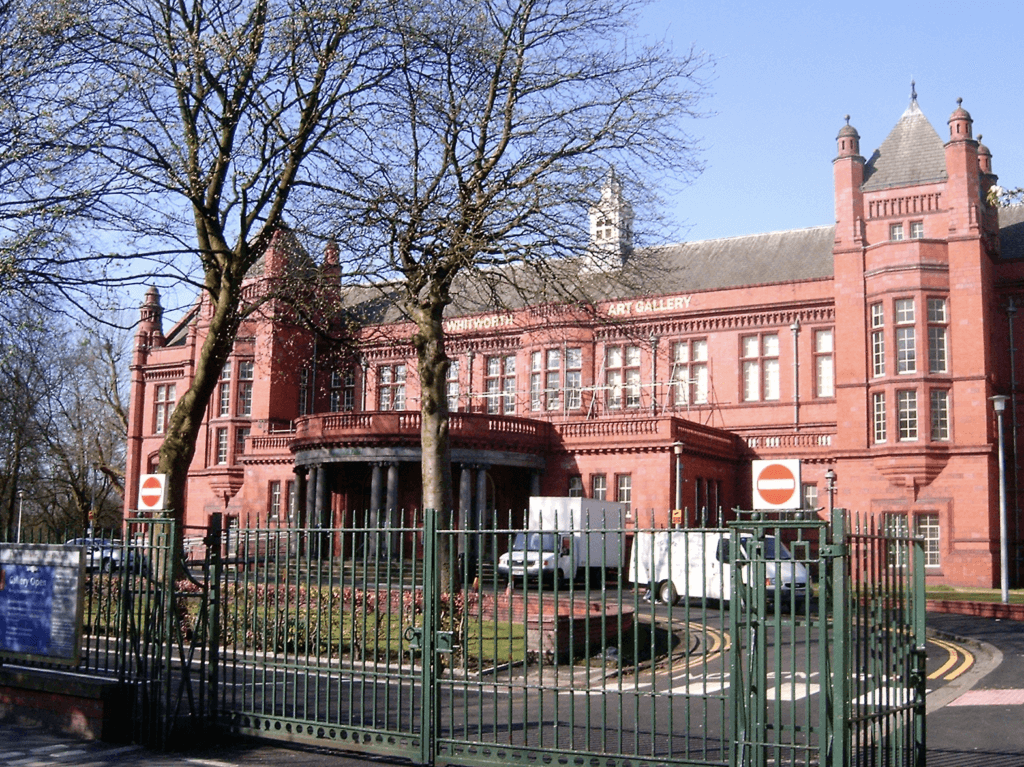
Whitworth Art Gallery director Alistair Hudson has been asked to step down from his position after being targeted by a pro-Israel legal group, The Guardian reports. The campaign to remove him was sparked by a 2021 art exhibition that contained a statement expressing solidarity with Palestinians. The gallery is run by the University of Manchester. Art Forum reports that Hudson was “ousted.”
Last August the investigative art group Forensic Architecture pulled its Cloud Studies exhibition from the Whitworth after a statement they included on Palestine was removed. “Forensic Architecture stands with Palestine,” it read. “We believe this liberation struggle is inseparable from other global struggles against racism, white supremacy, antisemitism, and settler-colonial violence and we acknowledge its particularly close entanglement with the Black liberation struggle around the world.”
The gallery removed the statement in response to a series of complaints from a Zionist legal organization called UK Lawyers For Israel (UKLFI), which claimed the note was “incendiary.”
“The level of nastiness is really outrageous,” Forensic Architecture founding director Eyal Weizman told Mondoweiss at the time. “And we understood that we have to confront this group, because we are in a relatively stronger position than other cultural institutions and artists that are targeted by pro-Israel lobbyists in the UK. And that we are going to fight that one. It takes some mobilization, organizing. It also takes good lawyers.”
The gallery eventually allowed the statement to stay in the exhibition, after Palestine activists began protesting in front of the Whitworth and thousands of letters opposing the move poured in.
Hudson said the statement would be displayed prominently. “The university, as a non-political organization, has tried to balance extremely complex issues raised by the exhibition, but we believe that the worst outcome for all parties concerned would have been to close this exhibition for an extended period of time,” he explained.
The gallery’s reversal prompted a series of complaints against Hudson from the UKLFI. Jonathan Turner, chief executive of UKLFI, told The Guardian that the group had “pointed out to the university that the director of the Whitworth Art Gallery had falsely assured the vice-chancellor that they had established the accuracy and legalities of the work presented in the Forensic Architecture exhibition…we suggested that the university should take appropriate disciplinary action.”
A University of Manchester spokesperson told the British newspaper that “staffing matters are strictly internal to the university and we never comment on questions of this nature.”
According to the group Artists for Palestine UK many artists have pulled their work from the gallery in response to Hudson’s dismissal. “The withdrawal is an act of foremost solidarity with Palestine and Palestinian people and ensuring that artists, academics and the public can continue to freely express their views as well as with Alistair Hudson and the workers and employees of The Whitworth,” tweeted the artist Tai Shani.
In 2019 the London-based writer Hilary Aked called UKLFI “one of the quietest yet most influential Israel lobby actors currently operating in Britain.” She detailed numerous links between the organization and the Israeli government.
Forensic Architecture responded to Hudson’s forced departure on Twitter: “All members of FA are shocked & enraged at this blatant punishment and vengeful attempt to suppress solidarity with Palestinians who continue to face violent human rights abuses and apartheid by Israel in Palestine and beyond.”
“Alistair turned the Whitworth into an art space where the important questions of our time could be asked,” Eyal Weizman told The Guardian. “His sacking is the last in series of bullying actions by the University of Manchester, which initially aimed at silencing our solidarity with Palestinians, then at stifling open debate and taming political art more generally. This move will shrink the space for art and artists.”

As in the article about this controversy that was published on Mondoweiss last September, we are again not told what kind of art was being exhibited (the title “Cloud Studies” is not explanatory), nor how Palestine was related, if at all, to the art being exhibited. The ousted director is quoted here as saying, “The university, as a non-political organization, has tried to balance extremely complex issues raised by the exhibition“, but we are not told what any of these extremely complex issues are.
1 of 2
Europe Needs to Ban trade with Israeli Squatter Settlements in Occupied Palestinian Territories (juancole.com)
“Europe Needs to Ban trade with Israeli Squatter Settlements in ‘Occupied Palestinian Territories’ Human Rights Watch”
EXCERPT: “(Brussels, February 21, 2022) – “The European Commission should prohibit EU trade with settlements in occupied territories globally, Human Rights Watch said today as it signed onto a European Citizen’s Initiative (ECI). The citizen-led initiative, registered with the European Commission in September 2021 & initiated on February 20, 2022, calls for adopting legislation to prohibit products originating from unlawful settlements from entering the EU market & to ban EU exports to settlements.
“The transfer of an occupying power’s civilian population to a militarily occupied territory violates the Fourth Geneva Convention & under the Rome Statute of the International Criminal Court, is a war crime. Trading in products produced in settlements in occupied territory or with them helps to sustain these violations of international humanitarian law. It also entrenches the human rights abuses that often stem from settlements, including land confiscation, natural resource exploitation, & displacement of & discrimination against the local population.
“’Settlements unlawfully rob local populations of their land, resources, & livelihoods,’ said Bruno Stagno, chief advocacy officer at Human Rights Watch. ‘No country should be enabling the trade in goods produced as a result of land theft, displacement, & discrimination.’
“The EU should also ban trade that contributes to unlawful resource extraction in occupied territories, which is also a violation of international humanitarian law, Human Rights Watch said.
“Human Rights Watch joins more than 100 civil society organizations, grassroots movements, trade unions & politicians in backing the Initiative. It utilizes a provision designed to enable European citizens to direct the European Commission to consider proposed legislative action. If it amasses a million signatures, the Commission will be legally obliged to consider a ban on the trade of settlement goods.” (cont’d)
2 of 2
“The initiators of the ECI originally filed for registration in July 2019, but the Commission initially refused to register it, on the grounds that the initiative sought a sanction. The European Court of Justice nullified this decision in May 2021, finding that the Commission had failed to consider the initiative as a general commercial measure. This decision prompted the Commission to reverse course, register the Initiative, & recognize its own authority to regulate trade with settlements.
“The EU & member states should prohibit settlement trade to comply with its obligation under the Geneva Conventions to ensure respect for international humanitarian law, Human Rights Watch said. The illegality of settlements under international humanitarian law is well established & stems in part from their close link with discrimination & economic harm to the local population, as set out in the International Committee of the Red Cross’s 1958 commentary on the Geneva Convention.
“Human Rights Watch has documented this phenomenon in the Occupied Palestinian Territory (OPT), where Israeli authorities have for decades imposed harsh military rule over millions of Palestinians while governing hundreds of thousands of Jewish Israeli settlers under Israeli civil law. To establish & maintain the settlement enterprise, Israeli authorities have confiscated more than two million dunams (2,000 square kilometers) of Palestinian land. Israeli authorities have confined Palestinians to living in dozens of disconnected enclaves, demolished thousands of Palestinian homes, & imposed sweeping restrictions on the freedom of movement & basic civil rights of millions, among other grave abuses.
“Such systematic repression lies at the heart of Israel’s crimes against humanity of apartheid & persecution, as Human Rights Watch & many other Palestinian, Israeli, & international human rights organizations have documented.
“Countries have a duty under international humanitarian law not to legitimatize, even if inadvertently, the transfer of civilians into settlements in the occupied territory. Nor should they deny the reality of ongoing military occupations & therefore, the application of international humanitarian law, whatever the claims of the occupying power.”
If it comes that Palestinian citizens in Israel seriously engage politically for equal rights, the dynamics will shift. Two states may get new life and battles like this one will become history.