

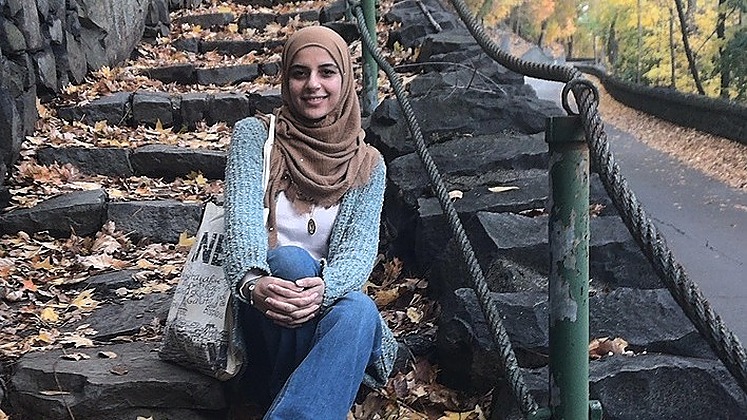
One year ago, on March 13, 2025, Palestinian Columbia protester Leqaa Kordia was arrested and detained after turning herself into the Department of Homeland Security (DHS) in New Jersey.
Today, Friday, March 13, 2026, an immigration judge just ordered her release for the third time.
In her third bond hearing, Kordia’s lawyer Sarah Sherman-Stokes once again presented ample evidence that, despite arguments from DHS, her client is not a flight risk and should be eligible for bond.
Kordia is the last remaining Columbia protester in detention and was arrested shortly after fellow protester Mahmoud Khalil. While detained, Kordia’s health has taken a drastic downturn amidst harsh conditions inside Prairieland Detention Center, which has received numerous complaints related to overcrowding, lack of medical resources, unsanitary facilities, and more.
During Friday’s hearing, Immigration Judge Tara Naselow-Nahas was receptive to Kordia’s team, at several points expressing frustration with DHS’ lack of preparedness and inconsistency. Pointing out, despite DHS’ lawyer Anastasia Norcross’s argument that no bond should be set, that DHS’ appeal stated that the current bond of $20,000 is “insufficient,” only implying that the current bond is not high enough.
“I tried to get an answer from higher ups on the case,” Norcross explained regarding dissonance between the appeal and arguments presented at the hearing.
Judge Naselow-Nahas also stated that, despite seeing “thousands of pages of evidence from the respondent,” she’s seen nothing consequential from DHS. The judge also states that, in her estimation, Kordia poses “no risk.”
“My hands are kind of tied here. Obviously I agree with you that the $20,000 bond was sufficient,” Judge Naselow-Nahas said before explaining that DHS will almost certainly impose another stay.
Before granting release upon payment of $100,000, in hopes of satisfying DHS’ previous argument of insufficient bond, the judge also pointed out that Kordia’s ongoing visa petition would be a viable avenue of release in 60 days in the event of another DHS appeal. Sherman-Stokes also noted that the habeas filing is due for a response on March 16.
As Judge Naselow-Nahas promised the bond would be uploaded before 1pm CT, supporters now wait in anticipation for either Kordia’s release or another DHS filing keeping her confined.
Several family and community members, including the mayor of her hometown of Paterson, New Jersey, have signed sworn declarations that they would ensure Kordia attend subsequent hearings once she’s freed. Sherman-Stokes also stressed the importance of Kordia’s release, citing “neurological and cardiac abnormalities” that could result in Leqaa’s immediate death following her diagnosis of malnutrition and sleep deprivation.
Kordia’s arrest was related to the expiration of her student visa, as she mistakenly thought a pending family green card nullified the expiration in the interim between the two – a disruptive but normally inconsequential misconception that could be remedied through cooperation with DHS.
Under any other administration’s DHS, Kordia’s team argues she would have been likely to legally manage her mistake from the comfort of her home in New Jersey. But under Donald Trump, DHS has targeted Kordia for both her Palestinian identity and her activism, keeping her detained thousands of miles from her family at Prairieland Detention Center in Alvarado, Texas.
As her health has deteriorated, Kordia’s story has gained significant traction in the fight for her release, with public support bolstered by the likes of New York City Mayor Zohran Mamdani, fellow Columbia protester Mahmoud Khalil, and now U.S. Representative and the only Palestinian-American in Congress, Rep. Rashida Tlaib.
Last Friday, Rep. Tlaib scheduled to visit Kordia after reading news reports of her seizure. Despite her team scheduling the visit through proper channels with DHS, detention center staff were not expecting Tlaib.
“I came to see Leqaa, but when I walked in – and the way they handled me coming in to see and do a visitation – I was like, ‘No, I want to do a tour.’ And that’s why I ended up spending over four hours in there,” Rep. Tlaib told Mondoweiss.
Rep. Tlaib provided an exclusive interview to Mondoweiss regarding her visit, explaining that she fears for Kordia’s life in detention as she suffers through malnutrition.
“I’m afraid she’s going to die in there. I’m very upset that she [has to] keep filing grievances, and she’s obviously become an advocate inside that chamber, inside the ICE warehouse,“ Rep. Tlaib said. “She’s worried about everybody else. But I’m really worried. She didn’t look good. She looked very pale.”
Meanwhile, the campus where she was arrested for protesting genocide almost two years ago has not forgotten Kordia. In the wake of her seizure and in anticipation of her first year anniversary, Barnard and Columbia students and faculty started a relay hunger strike on March 9. The strike was, in-part, launched by faculty already organizing a weekly vigil in honor of detained community members, including Kordia.
“The idea is really solidarity fasting for her observing Ramadan, or trying to observe as best as she can,” Shayoni Mitra, a Barnard faculty member helping organize the strike said. “Also we have the option of fasting in the evening. I think the idea really is to have some form of embodied solidarity with Leqaa.”
Protesters have been posted at 116th and Broadway while tabling and raising awareness of Kordia’s case 24 hours a day. Around 25 people total have participated in the strike thus far according to Hunger Strike for Leqaa, and more people from across backgrounds learn about her case every day. At the time of publishing, the strike was in its 95th hour.

Mahmoud Khalil, the first Columbia protester to be detained, came out to support both the 45th consecutive week of the vigil and the launch of the hunger strike, as covered by campus publication, The Columbia Inspector.
“I think that this has really galvanized folks,” Shayoni Mitra said. “There was already a lot of talk about doing something to mark Mahmoud Khalil’s one year of kidnapping. And from that sprung this idea of, ‘Hey, this is the perfect time to talk about the one person who is already still in detention, and sort of accelerate the momentum to demand her release.’”
Lauren, a student protester and junior in the philosophy department, spoke about how the most recent protest movement for Palestine at the end of 2023 – and the institutional response – has shaped that class’ experience at Columbia.
“[The encampment protest] was my freshman spring. And the thing about Columbia freshmen is they live on campus, so they were right in the middle of everything that was happening,” Lauren said. “And so I think that really shaped my experience. Because that was the first year, then there was the second year, all this repression and backlash, and now we’re in the third year of it, trying to undo that repression.”
As protesters are tabling to inform the public of Kordia’s year of detention, photos of her with additional materials are laid out, as well as supplies and signage encouraging members of the public to write letters. One photo displayed that is often shared online, Kordia holding a Palestinian flag at the front gates of Columbia, was taken less than 30 yards from the location of the hunger strike. One called the stretch from Amsterdam to 116th street “a palace of memories, many of them nightmarish,” for protesters.

Community members from all walks of life have stopped to write letters for Kordia. And while protesters are often passed by onlookers, many have taken time to learn about Kordia’s case and show support.
“We’re going to write a letter,” a resident of the area visiting the installation with his daughter said after observing the table for a few moments. He took a pencil and paper and began writing. His daughter, around 12 years old, watched quietly before he invited her to write one as well.
“I don’t know what to write,” his daughter said.
“Just tell her we’re praying for her, to stay strong, and she’s got this,” the resident answered.
In the wake of the judge’s decision, Kordia’s supporters still await her potential release, with an answer not expected until Monday. In a public statement following the hearing, Leqaa Kordia said:
“I’m deeply grateful for all the people who attended today’s bond hearing on the one year mark of my detention. I’m very, very proud of my community, family, and friends who have been speaking out for my freedom since day one. To see so many people during the hearing today made me feel loved and supported, and it made me confident that freedom is near. All I want is for the government to finally release me now so I can go home to my family. Until then, l’ll continue speaking up for the basic rights and freedom of all people, from Texas to Palestine.”
UGLY America’s lawlessness is getting harder and harder to overlook.