

Last Wednesday an Israeli sniper shot journalist Shireen Abu Akleh in the head, in the space between her press helmet and jacket, as she covered their military raid on Jenin. Jenin, a refugee camp in the West Bank known for its resistance to Israeli occupation, where in 2002 Israeli forces committed a massacre, uprooted trees, leveled the entire camp. Watch Mohammed Bakri’s Jenin, Jenin. Read Susan Abulhawa’s novel Mornings in Jenin. Google the camp and its history. I can’t articulate the horror. Abu Akleh spent her life working to, in occupied Jenin and in the rest of Palestine. She insisted on contextualizing violence. We grew up with and through watching her coverage of a land we could not visit, of intifadas and Israeli bombing campaigns and the time in between. I recognize her voice, how it shaped mine.
The scene: a younger journalist named Shatha Hanaysha, also marked ‘press’ and crouched next to her, a wall behind and a tree between them, is met with Israeli bullets as she extends an arm, tries to move toward Abu Akleh’s stilled body. She asks in an interview later that day, if the Israelis hadn’t intended to target journalists, why didn’t they stop shooting, let others get to Shireen? Her question hangs, and you can hear echoes of guilt, her considering whether there was a time after the bullet fractured Abu Akleh’s skull and before it was too late.
A man jumps the wall and lifts Shireen Abu Akleh. Her limbs do not resist gravity. Someone in the background worries ‘she is dead’ somewhere between question and statement. The man still carrying her hesitates as he hears more gunfire. The journalist still alive with a tree between herself and Abu Akleh begs the man to help her, to help Shireen, to risk his life for Shireen’s. At the hospital Abu Akleh does not respond to pleas to wake up. She is pronounced dead as a press-jacketed man, another coworker of hers, sobs.
Later, the journalist who could not save Shireen Abu Akleh receives condolences from another well-known journalist, Givara Budeiri, of Abu Akleh’s generation. “No one could have saved her,” Budeiri tells the younger journalist, recognizing the guilt her eyes carry, a feeling she, having herself borne witness to Palestinian life and its erasure, viscerally knows too. “And your testimony showed the world the truth.” I wonder how many times the older journalist has had to repeat these same words to herself, and which elders first helped her through this too-familiar aftermath.
The younger journalist, with red eyes and a puffy face, faces the camera hours after witnessing life leave a person dear to her, someone after whom, she shares, she modeled her career. I’m not sure whether the younger journalist transiently puts this fresh trauma aside or if she feels propelled by it. If occupation’s aim is to overwhelm us with a collective sense of grief, it becomes an act of resistance to will ourselves against that grief’s individuating paralysis. This happens in community. “We will not stop,” she says. “What just happened—we won’t stop.” She notes how at Abu Akleh’s services on Wednesday she watched her colleagues cry and film concurrently, how these acts actually inform each other. “Shireen madraseh,” literally ‘a school,’ something closer to ‘an institution,’ a force whose reach and roots outsize and outlast her.
Israeli officials try to tell a different story: first, as usual, the Palestinians probably killed Shireen Abu Akleh. Then, she was ‘armed with a camera.’ Incredible, how they always say the quiet part out loud, armed with guns and impunity.
At Shireen Abu Akleh’s funeral on Friday, Israeli forces beat pallbearers with batons such that they almost drop her coffin. This violence, like arguably all violence, isn’t at all senseless. Rather, it’s perfectly logical within the framework of settler-colonialism. As Palestinian scholar Steven Salaita recently wrote, indiscriminate violence under occupation serves to “negate the native’s existence” so the settler might justify his. How else to live atop graves except in denial? Total erasure of the native, via their ceaseless dehumanization in life and in death, is settler-colonialism’s necessary precondition.
In characteristic stenographic fashion, the BBC reports “her coffin was jostled as Israeli police and Palestinians clashed as it left hospital.” “Violence” simply “broke out.” Israeli forces storm the hospital too, unclear for what reason except to confirm she hasn’t risen from the place they’d sent her. They raid Abu Akleh’s grieving family’s home on Wednesday, then attack her hearse on Friday, to confiscate more Palestinian flags. The New York Times calls all of these “spasms of tension,” as though aggression against mourners or deliberate erasure were something uncontrollable, like neurons misfiring, muscles cramping.
At Abu Akleh’s church services in Jerusalem on Friday, Israeli soldiers ask Palestinians whether they are Christian or Muslim, deny the latter entry. Shireen Abu Akleh is Christian, Shatha Hanaysha Muslim, and I only know to notice this difference looking through eyes that aren’t mine.
It’s the other side that tries to reduce and even transmute settler-colonialism into something ahistorical, like an abstract, timeless hatred between Muslims and Jews. One glaring problem with this formulation, often invoked too by well-meaning allies, is that it erases Palestinian Christians. Occupiers consistently replace material grievances with identity. It is Divide & Conquer 101: raise borders, impose and ingrain difference to obstruct unity and obvious common orientation.
Shireen Abu Akleh was a threat because she understood the Palestinian struggle as one concerning all Palestinians, about settler-colonialism and the lands out of which her people continue to face forced displacement (read: ethnic cleansing), the histories of how refugee camps like the one now marked with her blood came to be.
What became her final report shows Shireen Abu Akleh walking alongside a Palestinian elder through the ruins of his village, ethnically cleansed in 1948, as he excavates the village map from somewhere in his memory, points to specific stones on the ground and recalls family names and homes. Abu Akleh asks him questions and allows for silence when his jaw trembles, eyes struggle to hold back tears. In other parts of the report she narrates—via voiceover and walking through these ruins alone—the broader history of the Nakba, from its start in 1948 into present day, situates the specificity offered earlier by the individual witness. The report was released post-mortem, on May 15, Nakba day, its material gathered just before Abu Akleh left for Jenin.
Shireen Abu Akleh was killed because she spoke and lived against the occupation of her country, because she was a Palestinian who knew her worth, knew her people could articulate themselves and resist on their own terms, had nothing—especially not their humanity—to prove to a desensitized world. That she was an American citizen is irrelevant, as is her religion, except that these details might accrue sympathy from an audience otherwise disinclined to view Palestinians as human. What does that sort of sympathy do for us?
A Palestinian flag and red kuffiyeh drape Shireen Abu Akleh’s coffin, more flags and flowered crosses populating the procession, held up by people present to express gratitude for Abu Akleh’s commitment to the self-evidence of her people’s humanity, as Jerusalem church bells ring farewells. She is buried in the land to which she sustained witness.
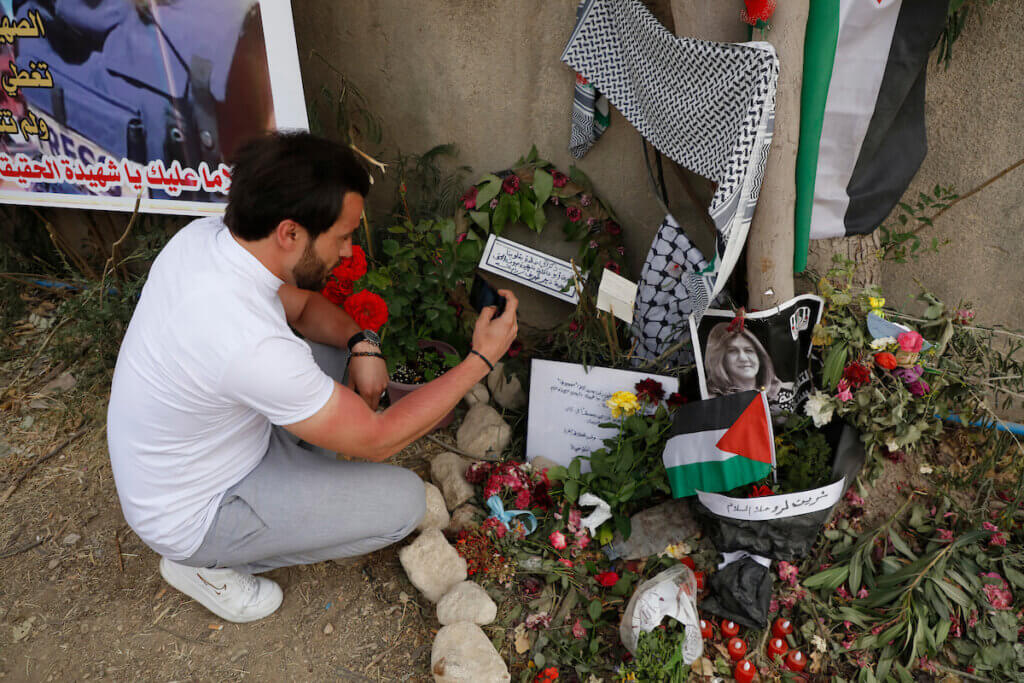
At Jenin’s entrance, the place where Shireen Abu Akleh was killed, people have raised a memorial. Pictures of her, along with flags and kuffiyehs, are fixed to that same tree that saw her die. People lay flowers on the ground, bow their heads in different versions of the same prayer.
In another world Abu Akleh might have covered this latest Israeli aggression against Palestinians. She might’ve compared Wednesday’s scene of the two journalists in Jenin—one crouching, a hand cupping her mouth in total shock, the other with her face interred, body silenced—to that of Muhammad al-Durrah and his father from decades ago in Gaza, so inscribed into our collective memory it might as well be genetically encoded. The overlays, the inextricable tangling of witness and attempted erasure—of martyrdom in the wholest sense—in occupied Palestine.
Shireen Abu Akleh spent her life memory-making on Palestine’s behalf, showing us ourselves through familiar eyes, resisting occupation’s insistent dehumanization of the occupied. She laid bare the absurd breadth of its hatred for Palestinian life, no expression of Palestinian existence—not even a flag on a coffin of a life they’d already stolen—too small to license terror.
Mary Turfah
Mary Turfah was born and raised in Dearborn, MI, to a Palestinian and Lebanese family. She has an MA in Middle Eastern South Asian and African Studies from Columbia University, where her research focused on oral history, memory, and the Nakba. She is a medical student at the University of Michigan.


In the Israelis’ version of history did the Palestinians also bulldoze their own homes and slaughter the villagers in Deir Yassin?
How does Israel have that immunity from the truth that enables its arrogant impunity? How have such ostensible carriers of the truth as the BBC and the New York Times become such agents of deception?
1 of 2
RGB Media – Responsive Email Template (972mag.com)
“A Funeral Brutalized,” The Landline, by Oren Ziv,, May 15/22
MUST READ!!
“I’ve documented my fair share of political funerals, but never have I witnessed what occurred as Shireen Abu Akleh’s body was laid to rest on Friday in Jerusalem. Despite the visible grief of Abu Akleh’s colleagues, who worked with her in the occupied West Bank & Jerusalem, & the other Palestinians in attendance who had regularly tuned in to her reporting over the years, the Israeli police’s behavior during the funeral procession was brutal, even by their very low standards.
“Despite the documentation, which clearly shows the police attacking the pallbearers & mourners, the Israeli media, as well as a number of prominent international media outlets, continue to refer to what took place as ‘clashes.’ Perhaps, then, it would be useful to set the record straight.
“On Friday morning, hundreds of people — Abu Akleh’s family members, friends, journalists, & others — gathered in the courtyard of St. Joseph’s Hospital in the Jerusalem neighborhood of Sheikh Jarrah. The police immediately put up barriers around the perimeter of the neighborhood, preventing many from entering.
“At noon, mourners held an Islamic prayer followed by a Christian one. After the prayers, dozens of people waved Palestinian flags & chanted as Abu Akleh’s body was brought out for the funeral procession, an act the police deemed ‘incitement.’ The officers warned that should the chants continue, they would disperse the crowd.
“At around 1 p.m., when a hearse arrived to take Abu Akleh’s body to its burial place, some of the Palestinians in the procession announced that they wanted to carry her on foot — as is customary during Palestinian political funerals — to the Old City, & from there to be buried in Mount Zion Cemetery. Police tried to force the family to arrange for the body to be transported in advance, but from the public’s point of view, the funeral should have taken place according to the family’s desires, not those of the police.(cont’d)
2 of 2
“By now, the images of what happened next have spread far & wide, shocking the world. As the coffin was removed from the morgue, hundreds began marching toward the exit gate of the hospital, where dozens of riot police officers armed with batons were waiting for them. The police began brutally beating the mourners as they carried the coffin, almost causing it to fall. Contrary to police claims, no stones had been thrown. Only after the officers tried to disperse the crowd with batons & stun grenades were several objects, mostly bottles, thrown at them.
“The attacks continued. Soldiers fired sponge-tipped bullets & threw stun grenades until, 15 minutes later, the body was whisked away in a vehicle. Even after that, the police did not allow Abu Akleh’s colleagues — who were not only there to report, but also to mourn — to leave the hospital yard, beating them once again with batons. As the vehicle made its way from the hospital yard, a police officer was seen removing the Palestinian flags that were draped on it. Only an hour later was everyone allowed to leave.
“The conduct of the police was not surprising; it was merely a blatant demonstration of the racism, brutality, & humiliation that Palestinians routinely face in East Jerusalem & beyond.
“At an event of this magnitude, though, one could have expected Public Security Minister Omer Bar-Lev or Prime Minister Naftali Bennett to ensure that the procession be allowed to take place undisturbed. Yet it seems that both the police &, likely, the political echelon decided to clamp down on the funeral & its unabashed expressions of Palestinian identity in a city where even waving a Palestinian flag is beyond the pale.
“In an attempt to justify the police’s conduct, Police Spokesman Eli Levi released a partial video, taken from the police drone camera, showing the events in the hospital yard. Levi claimed that objects were thrown before the dispersal began. Yet the video begins only after the police force had already stormed into the hospital compound & started attacking people.
“Unsurprisingly, the parts where the police storm with batons were entirely cut out. Synchronizing the drone footage with video footage from the ground shows, for example, that one of the people alleged to have thrown stones was in fact waving a Palestinian flag.(cont’d)
.