
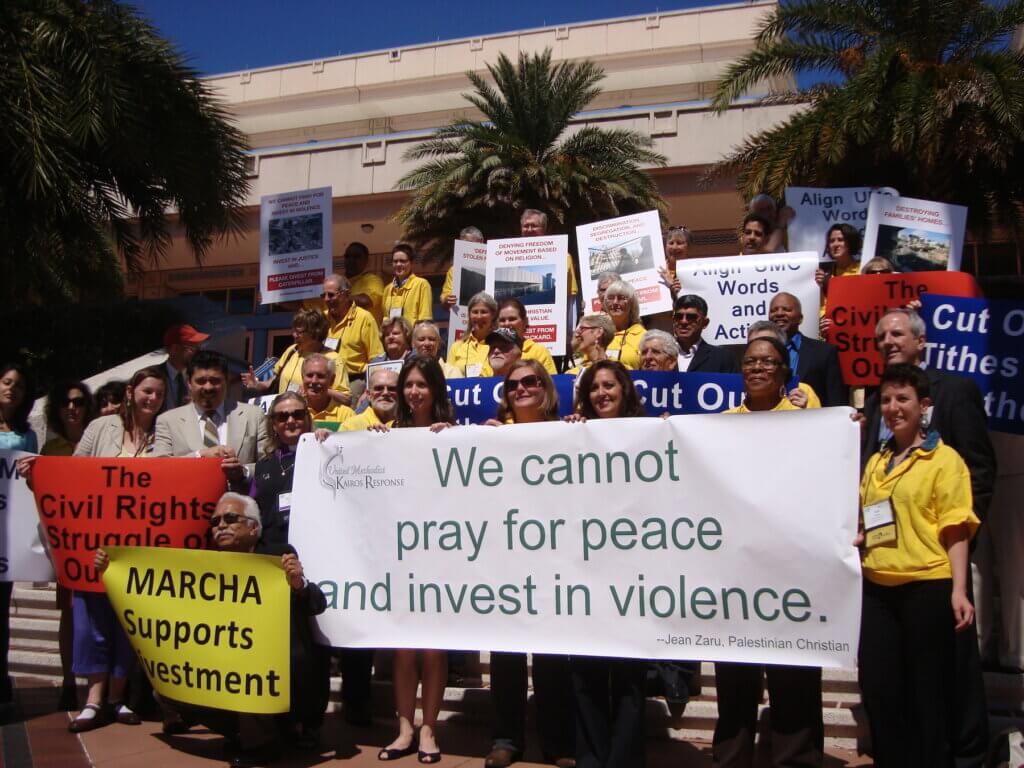
In their 2016 book This is an Uprising, activists and organizers Mark and Paul Engler argue that authoritarian regimes maintain power through the preservation of seemingly immutable beliefs and assumptions as well as through the actual political structures of injustice. Political scientist Gene Sharp called these “pillars of support.” Racist regimes in particular function in this way: colonial powers on the belief in the inferiority of the colonized; tyrannous governments on the divine or natural right to wield supreme power over subject groups. “Movements succeed,” write the Englers, “when they win over ever-greater levels of public support for their cause and undermine the pillars of support.”
There are turning points in every liberation struggle. Support for Israel’s ongoing dispossession and oppression of the Palestinian people has always relied on the maintenance of unchallenged beliefs and assumptions: the Palestinians were never a nation or a people; God promised the land to the Jewish people; the world owes the Jews a national haven to compensate for millennia of persecution; criticizing Israel is antisemitic.
Today, a single word now serves to topple these pillars of support for Israel’s ongoing project of dispossession and colonization–apartheid.
“The biblical answer is clear. The theological answer is clear. Neutrality is not a faithful response.”
Dossier on Apartheid: A Pressing Call to Churches Around the World
On July 1, Kairos Palestine and the Global Kairos for Justice Coalition released a document that changes the game: “A Dossier on Apartheid: A Pressing Call to Churches Around the World” sets out how Israel’s laws, policies and practices meet the internationally accepted definition of apartheid, presents a theological and biblical perspective on the sin of apartheid, and issues a stirring call to the churches of the world to respond to the call of the Palestinian people: “How will your church, council, conference, region or synod respond?” the authors of the Dossier ask. “The biblical answer is clear. The theological answer is clear. Neutrality is not a faithful response.”
“Words matter,” write the authors of the Dossier, confronting the institutional churches as well as individual Christians on their reluctance to use the word in reference to Israel.
Churches are called to use the word apartheid…[which] points—in both its definition in international law and its description of realities on the ground—to a truth. As churches recognize but hesitate to use the word, we fail to name a fundamental motivation for our taking up the ministry of Jesus “to bring good news to the poor, to proclaim release to captives, to let the oppressed go free” (Luke 4:16ff).”
Dossier on Apartheid: A Pressing Call to Churches Around the World
The argument extends beyond the case of Palestine. To denounce apartheid affirms Palestinian experience and motivates the international community to explore, embrace and strengthen the framework of international law in a time when it is being eroded though systems of racism, authoritarianism, and other oppressions based on economic, patriarchal, political, and military power—including antisemitism.
At the July 1 launch, Patriarch Emeritus of the Latin Patriarchate of Jerusalem Michel Sabbah called out not only to Christians but to the world at large to hold Israel to account for its violation of internationally recognized crimes against humanity.
The world community has done a poor job of that. The denial of the fundamental rights and indeed of the very peoplehood of the Palestinians from early in the twentieth century to the present day has been recently documented by legal scholar Noura Erakat (Justice for Some: Law and the Question of Palestine) and historian Rashid Khalidi (The Hundred Years’ War on Palestine: A History of Settler Colonialism and Resistance, 1917–2017). Perhaps the most telling example was what took place in Durban, South Africa in 2001 at the United Nations-sponsored World Conference against Racism, Racial Discrimination, Xenophobia and Related Intolerance (WCAR). Language equating Zionism with racism was proposed for the conference declaration. Considered “inflammatory” and vigorously opposed by a number of member countries, including Israel and the United States (who ultimately walked out of the conference in protest), the language was not included in the final WCAR declaration.
“We have an apartheid reality in what is supposed to be a post-apartheid world.”
Akshaya Kumar, Human Rights Watch
Effectively, action regarding Israel has been kept off the international stage, blocked in the UN by the U.S. Security Council veto, pushed aside by the neoliberal democracies of the West in favor of promoting Israel as a bulwark of democracy during the Cold War and more recently in defense of western civilization in the War Against Terror. Throughout the twentieth century, action in support of Palestinian rights has been sidelined theologically by mainline churches in the rush to atone for antisemitism and to preserve the post-WWII Christian-Jewish interfaith détente. Calling Israel’s policies by its name now brings to a head the question of what to do about Israel’s crimes. Speaking at the Dossier launch, Akshaya Kumar, Director of Crisis Advocacy at Human Rights Watch made the point with striking simplicity: “we have an apartheid reality in what is supposed to be a post-apartheid world.”
The call to the churches
Twenty-one years after Durban, the world is again called upon to acknowledge the crimes of dispossession and the abrogation of human rights resulting from the Zionist project. But it is not from a United Nations forum or international tribunal that this call originates today. It is not the growing awareness of Israel’s relentless pursuit of its program of colonization and erasure of the Palestinian people that is bringing this pressure to bear, even though the question of Israel and apartheid is now being debated in the United States Congress and in the mainstream media.
The church was born in resistance to Empire–and from this stems its fierce opposition to economic inequality and to divisions based on class, race, and group identity. In times of social and political crisis, the commitment to social justice arises from the grassroots of the churches.
Two decades on from Durban, it is the call issuing from Palestinian civil society that has brought the world to this point of reckoning with apartheid in our time. The 2005 Palestinian civil society Call for Boycott Divestment and Sanctions (BDS) was a thunderclap, echoing the call for sanctions against South Africa that began in the 1970s and that played a key role in bringing down that regime. The “Moment of Truth” Kairos document of the Palestinian churches followed in 2009, articulating the heart of Palestinian liberation theology. In this call from the churches of the oppressed, the importance of the South African churches in the anti-apartheid struggle resonated strongly. Their role in bringing the global church and then the governments of the world to an awareness of apartheid is still relatively unknown outside of the figure of Desmond Tutu. That story provides a powerful lesson for today’s struggle against Israeli apartheid.
Throughout the twentieth century, the church proved itself as an organizing force for social change. Examples include its formative role in the Black Liberation movement in the United States and the anti-apartheid struggle in South Africa, in the birth of liberation theology in Latin America, and in anti-colonial movements in Korea and the Philippines. The church was born in resistance to Empire–and from this stems its fierce opposition to economic inequality and to divisions based on class, race, and group identity. In times of social and political crisis, the commitment to social justice arises from the grassroots of the churches.
Together with the BDS call, the Kairos call of the Palestinian churches awakened the global church to the urgency of the Palestinian plight and to the theological imperative to act. The Presbyterian Church (USA) led the charge in 2004, voting to begin a process of “phased selective divestment” from multinational corporations profiting from Israeli human rights abuses. Owing to the efforts of the Presbyterian Israel Palestine Mission Network, in coalition with human rights groups such as the U.S. Campaign for Palestinian Rights and Jewish Voice for Peace, Presbyterians spent the next 8 years bringing divestment resolutions to their biennial General Assembly, including actions for sanctions and boycotts which they passed in 2010 and 2012, finally passing a resolution at the 2014 General Assembly to divest from companies complicit in the colonization of Palestine.

Other mainline Protestant denominations in the U.S. followed, adopting divestment policies and challenging the theological validity of Christian Zionism. In 2021 the United Church of Christ (UCC) overwhelmingly approved “A Declaration for a Just Peace between Palestine and Israel.” Based on the 2020 “Cry for Hope: A Call to Decisive Action” of Kairos Palestine and Global Kairos for Justice, the UCC declaration called for specific actions on the part of the church, rejecting categorically Israel’s “apartheid system of laws and legal procedures.” And on July 8 of this year, one week following the release of the Dossier, the Presbyterian Church USA adopted a resolution titled “On Recognition That Israel’s Laws, Policies, and Practices Constitute Apartheid Against the Palestinian People.” Like the Dossier, the resolution exhaustively details Israel’s systematic denial of Palestinian rights, as well as making the case, based on gospel principles and church precedent, for “why Presbyterians must act.”
The Presbyterian resolution, a tour de force of legal, historical, political and theological argument, follows the UCC declaration from 2021, as well as resolutions from regional divisions of the other denominations that specifically name Israeli apartheid and are now in the pipeline for voting by those denominations. Most recently, two regional conferences of the United Methodist Church, New England and Oregon-Idaho, approved resolutions on Israeli apartheid, to be brought before the denomination’s General Assembly in 2024.
Today we are witness to what can only be described as the unstoppable momentum of church opposition to Israel’s program of discrimination, dispossession, and ethnic cleansing. Naming Israeli apartheid sweeps away objections and arguments that distract, confuse, and obfuscate. This is what happened when, in response to denominational actions to divest and in support of boycotts, the cry went out from defenders of Israel and the Zionist program that these actions were anti-Israel and therefore anti-Jewish. The good news was that the battle was then joined on a field determined by the grassroots activism of the Palestinians and those who supported their call for direct action.
“Why boycott Israel or divest from the occupation?” became the questions, rather than “how can we protect Israel against Arab aggression and the eternal, implacable forces of antisemitism?” Read David Wildman’s seminal 2006 article “Why Divestment? Why Now?” Now, with the hitherto unacceptable naming of Israel as an apartheid regime, we are again engaging with the defenders of the status quo on an issue of our choosing.
What will be be your response?
Following the July 1 launch, I sent a congratulatory email to my colleague, a Palestinian who serves on the Global Kairos for Justice committee responsible for the Dossier. “We have turned a corner” I wrote, mentioning the recent moves by U.S. denominations on Israeli apartheid. “The question,” I added, “is what is around that corner.”
We are faced with (at least) two questions.
First: now that the churches have confessed their obligation to not remain silent in the face of an international outrage, what actions will follow? Most U.S. Protestant denominations have already taken action in the form of divestment from companies implicated in the colonization of Palestine. Many have issued official statements challenging U.S. military aid to Israel. Now that these same churches are calling it apartheid, is there more that needs to happen?
Here is where the South Africa example becomes even more relevant. In that case, once apartheid was named, direct measures were taken within the church polity which ultimately had a significant impact on the actions of governments to sanction and isolate South Africa. In 1982, the World Alliance of Reformed Churches (now the World Communion of Reformed Churches) declared a status confessionis and duly suspended the South African member churches practicing racial separation.
In the present case, there are no churches directly implicated in Israeli apartheid–but the question has been asked whether Israeli apartheid constitutes a status confessionis. The case for that is made in Part 3 of “A Dossier on Israeli Apartheid.” Whether or not churches at denominational or ecumenical levels declare that such a theological imperative exists, now that apartheid has been named are further measures now required to keep the church faithful to gospel principles and to established church policy with respect to human rights?
The case of South Africa leads to the second question. The 1985 South Africa Kairos document “Challenge to the Church” stated clearly that “the apartheid minority regime is irreformable… It can only be replaced by another government.” In other words, as long as the ideology of apartheid continued to drive the laws and policies of South Africa, the systemic, racially-based inequality maintained by the state could never be done away with. Cannot the same be said in the case of Israeli apartheid, which is the logical and inevitable outcome of Zionism?
This leads us to the other corner that has been turned, notably with the publication of “Cry for Hope” in 2020: the identification of Christian Zionism as antithetical to the gospel and incompatible with Christian faith. Does the growing realization on the part of church leaders and theologians of the (their words) heretical nature of Christian Zionism follow inevitably from the naming of Israeli apartheid? Indeed, now that the issue of Israel as an apartheid regime is on the table, Zionism itself become the issue. We have circled back to Durban. Can apartheid be brought to an end without Zionism, as theology and political ideology, also being delegitimized?
In the case of South Africa, domestic and then international pressure resulted in the replacement of the government; the ruling party stepped down, to be replaced with a true democracy and the end of the system of racist laws and the brutal mechanisms of their enforcement. To cite another example in the US, the grassroots Black liberation movement–which originated in the churches and was organized along gospel principles of resistance to tyranny–resulted in the dismantling of racist laws and the enactment of laws dedicated to racial equality. We know that in both cases the work to establish economic and social equality is very far from complete. But the legal and political changes that came about created the opportunity to build something new.
Now that the truth is being told–the prohibited word spoken, the veils of mythology, and denial fallen away–what now? How are these pronouncements to be turned into action?
The PC(USA) overture is a tour de force of political and theological argument. It allows for no equivocation or dodging, no delay for further study or engagement in “dialogue” with interfaith partners. The UCC and Methodist resolutions specify direct actions, including conditioning U.S. military aid to Israel and challenging Christian Zionism.
What remains to be done is to develop strategies to bring the resolutions to congregations and clergy. I have no doubt that the activists who have brought their churches to this point are not missing a beat in getting to work on that.
The Englers write about the power of “trigger events”–in contrast to the slow, steady efforts of movement building–to move things ahead in game-changing leaps. Examples include the Sharpsburg massacre and the Soweto student uprising in South Africa and the bus boycott, attack dogs and the fire hoses used against Black people in the civil rights movement. The public awareness resulting from these events, combined with coalitions with labor and student groups and the emergence of leaders that inspired and roused the committed at the moments of deepest despair and exhaustion, helped create the critical mass to produce meaningful change. Are the appearance of the “Dossier on Israeli Apartheid” and the calls to action from church denominations, coupled with the recent releases from Human Rights Watch, Amnesty International, and the Israeli human rights group B’Tselem, serve as trigger events that can bring decades of grassroots work to fruition? Can we seize the moment to end apartheid in our time, liberating both Jew and Palestinian from the evil poisoning their present and darkening their future?
The “Dossier on Israeli Apartheid” closes with a desperate plea from the heart of Palestinian suffering: “How will you respond? Are you able to help us get our freedom back?…we are talking about people’s lives and livelihood. We are talking about our very existence on the land of our ancestors.” We have the congregational study materials. We have the direct action campaigns, and more will come. We have the charge from the Palestinians. The pillars of support are tumbling down. What now?
Mark Braverman
Mark Braverman is Executive Director of Kairos USA. He is the author of “Theology in the Shadow of the Holocaust: Revisiting Bonhoeffer and the Jews” appearing in the current issue of Theology Today.

“The church was born in resistance to Empire” …….. hmmm. Yes, but it soon became imperial itself.
I’m thinking of Le Chambon, the French village that resisted the Nazi takeover of France and sheltered Jews. (The story is told in Lest Innocent Blood Be Shed, by Philip Hallie.) It was a Protestant village in a Catholic country, with memories of Catholic persecutions of Protestants, and so its people were accustomed to thinking that the government could not be trusted. But “the powers that be are ordained of God” is still a majority viewpoint. Not only Christian, of course. If it weren’t, tyrants couldn’t do what they do.