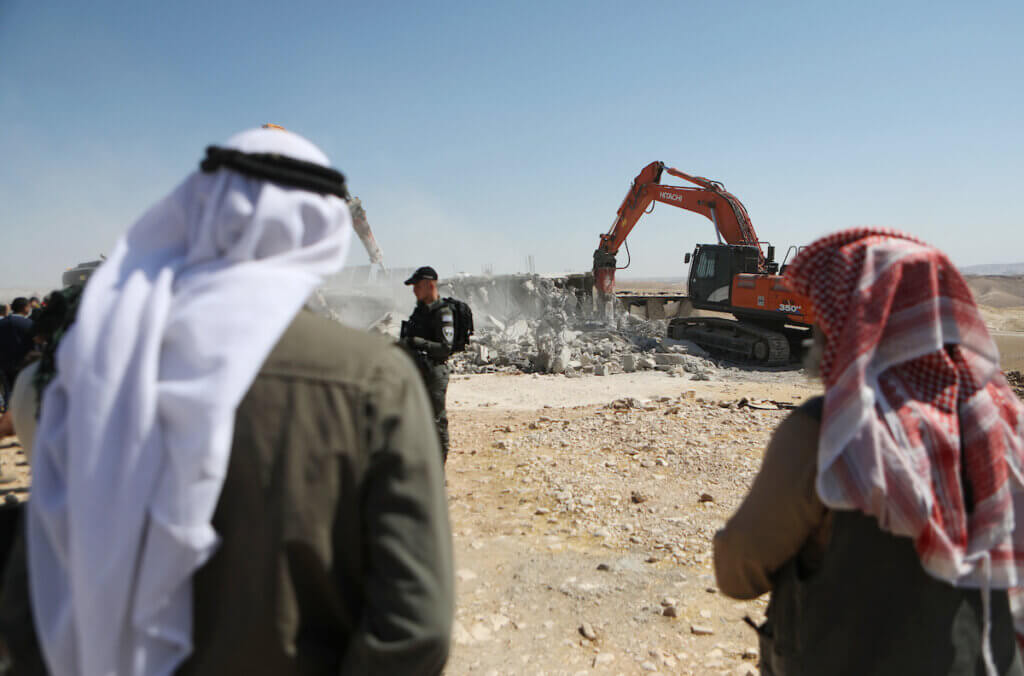
Earlier this month I traveled with my video crew to Masafer Yatta, or the South Hebron Hills, of the occupied West Bank.
We were going to film a new report about Israel’s plans to forcibly expel more than 1,300 Palestinians in the area. What’s happening in Masafer Yatta is a war crime playing out in real time, and we wanted to document it.
After 12 grueling hours in the heat, documenting the testimonies of Palestinians under threat of forced expulsion, we were wrapping up our shoot. Our final shots were set on the mountaintop of the village of Umm al-Kheir, overlooking the Israeli settlement of Carmel.
It was then that an Israeli army jeep pulled up next to our vehicle, and two armed soldiers came out and approached us. And so ensued a two-hour long detention, and a frustrating, humiliating reminder of the occupation Palestinians are living under.
After refusing to hand over our phones and our camera footage, the soldiers told us we weren’t allowed to film the settlement and threatened us with arrest. Those threats dragged on for two hours, as they waited for an answer from their captain on what they should do with us.
The sun had gone down by this point, the wind had picked up and we were getting cold, tired, and hungry. We wanted to go home, and told the soldiers that if they were going to arrest us to do it then and there.
But the arrest never materialized, and that oh-so important answer from their captain never came. What did come was a group of Israeli activists who confronted the soldiers, and told them they had no right to hold us – something we had been saying for two hours.
Within five minutes of the Israeli activists’ arrival, the soldiers were gone, and we were free to go. On the way home, all we could say was “who knows how long we would’ve been there if those activists hadn’t shown up.”
We were acutely aware of the fact that all the logic and reason we presented meant nothing, simply because our crew was Palestinian.
What we experienced is just a drop in the bucket of all the violations that journalists, primarily Palestinian journalists, face while working under occupation. Arbitrary detention and arrest seem mild when compared to the execution of our colleagues like Shireen Abu Akleh and Yaser Murtaja.
What happened to our crew was also a small snippet of the daily reality that all Palestinians, in Masafer Yatta and across occupied Palestine, live under every single day.
Just a few days before we went to Masafer Yatta, Israeli forces pulled a similar move, detaining a group of local residents and Palestinian activists for more than eight hours in the hot afternoon sun.
They were told they were illegally inside an Israeli military firing zone. The thing is, the borders of the firing zone were drawn around huge swaths of inhabited land, plainly meaning there are always Palestinians in the firing zone, because they live there.
But that didn’t matter. The soldiers decided that day that they had the time, and they were going to use it to detain the activists on arbitrary charges. After eight hours, they let them go, but confiscated the car of Sami Hureini, a local activist with the group Youth of Sumud, and one of the subjects of our new report.
Sami’s car is used not only by him and his family, but by other activists in Youth of Sumud, who rely on it to transport them deep into the firing zone to participate in solidarity activities with the communities in the firing zone.
After more than three weeks, Sami’s car was finally released, only after he was forced to pay thousands of shekels in fines. His car was released under the condition that it is not allowed to be in the borders of the firing zone for 24 months.
The arbitrary nature of his detention, the seizure of his car, and the conditional release of his vehicle paint the perfect, and most absurd picture, of what it means to be Palestinian under occupation.
Sami said it perfectly in a Facebook post a few days ago, following the release of his car.
“With this condition and targeted violence, Israeli forces are trying to stop my work and limit my activism. They think that they will prevent me from standing in solidarity and resisting with my people in Masafer Yatta. The same people that are facing the immediate threat of displacement.
This is just more encouragement for me to continue with the struggle.
I, my people and our communities will continue to resist the occupation and apartheid, as well as all of the racist policies that aim to to evict us from our land.
This won’t stop me.
Without the use of my car to reach the Firing Zone, we will use donkeys to reach the area and stand with our villages and our people. We must support each other and resist this effort to displace and ethnically cleanse the people of Masafer Yatta.
The occupation will end.
Free Palestine.”