

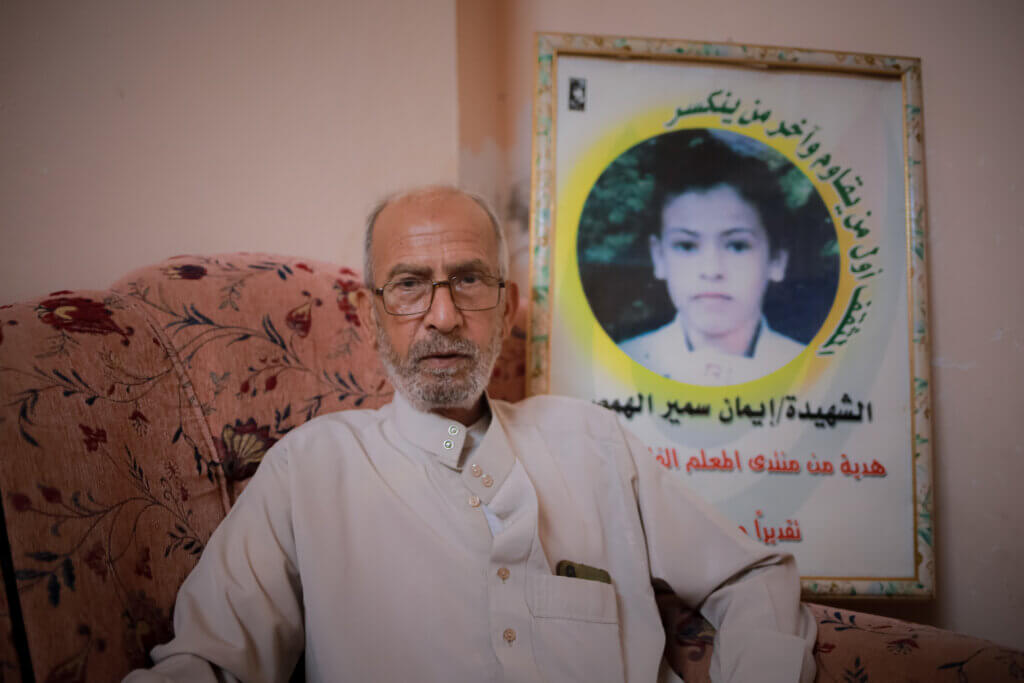
After 18 years of seeking justice for their murdered 13-year-old daughter, who was killed during the Second Intifada by an Israeli soldier, the Israeli Supreme Court dismissed the Al-Homs family’s case against their daughter’s murderer in July.
Eman Al-Homs was brutally killed in 2004 by Israeli forces in the Tel Al-Sultan refugee camp in Rafah, in the southern Gaza Strip. On that day, the hospital told the family that their daughter’s body had been riddled with over 23 bullets — fired into her body after her death.
The Al-Homs family sued the Israeli army in 2004, citing the testimony of eyewitnesses as well as the testimony of the soldiers themselves, who were members of the brigade that carried out the murder and testified against the officer that, according to them, made the “confirming kill.” 18 years later, the Israeli court ruled to dismiss the case.
Eman Al-Homs’ family petitioned the Israeli court, looking for justice, yet all they found out was that “the Israeli judiciary offers no justice at all,” Eman’s father, 68-year-old Sameer Al-Homs, tells Mondoweiss.
The day of the killing
When Eman and her sister Heba,16, prepared themselves to leave home to go to school at 6 a.m. on October 5, 2004, neither them nor their family knew that this would be the last time they walked together. Since their schools were in opposite directions, Eman and Heba separated at some point through their journey. Eman’s school was near an Israeli military tower known as Zo’rob, which confiscated a wide area in Rafah. The fence separating the school from the Israeli-controlled area was dilapidated, in some places had collapsed altogether, through which Eman wandered, unaware of her impending fate.
When the girl walked through the area, clearly wearing a school backpack and dressed in a school uniform, the Israelis shot her on sight.
According to the eyewitness who informed the family of what happened, when Eman heard the sound of the guns, she panicked from fright and disorientation, and appeared not to know where to go.
The family was first made aware that something wasn’t right when the school called, asking whether Eman had gone to school or not. Only 10 minutes before, he had heard on a local radio station that a school girl was murdered at Zo’rob. Now worried, he called the station to ask about the name of the girl, only to hear the name of his own daughter.
The family told Mondoweiss that the Israeli forces first gunned her down from a distance, and when the vehicle reached her, the officer walked over towards her body and filled her with several more bullets.
“I was so shocked when I heard it — she was an innocent girl who just left home early for school in pursuit of her dreams, and she came back home a corpse, riddled with bullets,” her father says. “It is very hard for any father to see his daughter like that. Now add to that the feeling when you are told that it is now impossible to seek justice for her soul.”
“Israeli forces threw down her body from a high hill of sand. I went to her and held her body. It was full of thorns and sand from the fall, mixed up with her blood.”
Sarhan Al-Homs, Eman’s brother
Al-Homes could barely contain his rage and indignation. “For 18 years, we have waited for justice for our child, killed in the worst conditions one can imagine, and we got nothing from the Israeli courts. But my daughter’s killer was rewarded and offered compensation. This system only protects killers,” he said bitterly.
When the family went to collect her from the Zo’rob military tower, “Israeli forces threw down her body from a high hill of sand,” her brother Sarhan says. “I went to her and held her body. It was full of thorns and sand from the fall, mixed up with her blood.”
At the hospital, a doctor who was also a relative of the family confirmed that over 23 bullets were fired into her body after her death. “The bullets left burns where they entered her body,” Sarhan says, explaining that the doctor told them a bullet shot into a live person’s body leaves a different mark than if they were dead — the latter appearing as a burn mark at the entry site. He holds up a photo of Eman’s body, wearing her school uniform clearly marked by the bullets and displaying the tell-tale burn marks. Her family keeps the photo as evidence to this day.

No justice in a colonial court
Eman’s story received widespread international media attention in 2004 when her father first started the legal case, suing the Israeli captain responsible for the killing — referred to as “R” by the court. Israeli attorney Leah Tsemel was representing the family, and assured them that they had a strong case.
The family’s only knowledge of the case came from their lawyer, as they could not travel from Gaza to Israel to stand in court.
Be’er Sheva District Court Judge Shlomo Friedlander said that the shooting was in violation of international law. However, he accepted the Israeli government’s position that the killing was carried out as part of a “wartime action.”
By this ruling, the Israeli government was not liable in the case, and could not be required to pay compensation, according to Haaretz.
He was also charged with the illegal use of his weapon, while also being accused of obstruction of justice after asking his soldiers to alter their testimonies to the military investigators that were probing the incident, according to Haaretz.
The family’s case was based on the testimonies of other soldiers serving alongside captain R. They said at the court that they had seen their commander make a “confirming kill,” only to change their testimonies later.
R’s father told Haaretz that the military court’s ruling reinforced his faith in the IDF and the judicial system, adding that he expected a full apology.
As for Eman’s father in Gaza, the whole world won’t be able to give him closure for the murder of his daughter now, he told Mondoweiss.
“This is the Israeli justice that we got. After all these years of waiting, they prove that my daughter’s blood is not worth anything to them — and now they’ve rewarded her killer,” he says.
This is clearly stated in the ruling of the Israeli judge presiding over the case:
“There is no expression of ulterior motives, including revenge. The remarks reflect the danger entailed in the deceased’s infiltration near the post, from the point of view of the soldiers, and their combat response to this threat until it was completely neutralized.”
Israeli attorney Leah Tsemel, who represented the Homs family, says she wasn’t surprised by the court’s ruling. “It has been proven once again that the blood of a Palestinian, even if she was young and small, doesn’t count for much.”
The Palestinian courts have no power to prosecute Israeli criminals, so Palestinians go to the Israeli Supreme Court to demand justice for their loved ones — but there is no justice to be had in a colonial court system.
“All cases Palestinians submit to the Israeli courts in order to get justice are failing, because the Israeli judiciary system is politicized. When it comes to the Palestinians, this system only works to cover and protect Israeli crimes committed against Palestinians. We can see that clearly by looking into the Israeli court decisions,” Tahseen Elayyan, a legal researcher at Palestinian human rights organization Al-Haq, told Mondoweiss.
“Sometimes the sentence for the deliberate murder of Palestinians is a few months in jail, a sentence that is also decreased by the pressure that Israeli officials put on the court — in the rare case when an Israeli is found guilty,” Elayyan continued. “This justice system is not neutral and offers no justice to Palestinians”
Taking it global
But if there is no court in all of Palestine that can bring Israelis to account for their crimes against Palestinians, where should Palestinians seek justice?
Palestinian organizations have attempted to sue Israeli criminals in European courts, under the principle of “extraterritorial jurisdiction,” which forces these countries to investigate the crimes that are presented to them regardless of where they were committed and who committed them.
“Unfortunately, all such cases have been rebuffed by the governments of these countries, because they will not confront Israel — countries like Britain, Spain, and Belgium,” Elayyan says. “These countries changed their laws to escape having to prosecute Israelis.”
After finding no justice in Palestinian courts, Israeli courts, or European courts, the last recourse available to Palestinians is the International Criminal Court (ICC).
“The ICC is a last resort for Palestinians,” says Elayyan. “But so far there have been no actual steps on the ground by the ICC, despite the fact that it announced a year ago that it will investigate war crimes committed in the Palestinian territories.”
“If the ICC fails to bring justice for Palestinians, this will send a very negative message — that international law cannot bring justice for you. We don’t want that to happen, and the ICC investigation is still ongoing.”
The Israeli human rights group B’Tselem issued a report in May 2016 about the response of the Israeli courts to crimes committed by Israeli soldiers. “B’Tselem has demanded an investigation in 739 cases in which soldiers killed, injured, or beat Palestinians, used them as human shields, or damaged Palestinian property,” the report reads.
But an analysis of the responses B’Tselem received as to how the military law enforcement system handled these 739 cases are telling. In a quarter of cases (182), no investigation was ever launched, and in nearly half of the cases (343), the investigation was closed with no further action; actual charges brought against the implicated soldiers in only 25 cases. Another 13 cases saw soldiers referred for disciplinary action, while 132 cases remain at various stages of processing, and the Military Advocate General’s Corps was unable to locate 44 others.
Family disappointed
Eman Al-Homs’s family seek a just closure to their case, and want to see their daughter’s killer behind bars. Yet after all these years, all they got from the Israeli courts was a slap in the face.
“She was killed in a horrific way, and her soul deserves justice. I wanted to go to her grave and tell her that I did that for her, but I don’t think that will happen in this world,” her father says.
It is no question in Sameer’s mind what would happen had the roles been reversed. “What if the murdered girl were Israeli, and her killer were Palestinian? Do you think the case would have dragged on for so long?” he asks in indignation. “Do you think that the Israeli court will have dealt with him like the way it dealt with our daughter’s killer?”
Sameer Al-Homs plans on taking his daughter’s case to the ICC.
Tareq S. Hajjaj
Tareq S. Hajjaj is a journalist and a member of the Palestinian Writers Union. Follow him on Twitter at @Tareqshajjaj.


1 of 2
Why Israel hates the Palestinians so much | Israel-Palestine conflict | Al Jazeera
“Why Israel hates the Palestinians so much”
“Israel’s hatred of the Palestinians is shaped & driven by three basic sentiments. Al Jazeera, August 8/22, by Marwan Bishara.
EXCERPT:
“The Palestinians have every reason to hate Israel; it is a settler-colonial apartheid state erected on the ruins of their homeland. But why does Israel hate the Palestinians so much? It has sadistically & systematically terrorised, blockaded & imprisoned them after taking control of their lives & livelihoods, denying them fundamental rights & freedoms.
“The obvious answer may not be the right answer. Yes, Israel abhors Palestinian violence & terrorism that has touched more than a few Israelis but it is nothing compared with the wholesale violence & state-terror exacted by Israel on the Palestinians, launching vengeful & preemptive wars, as it has this past weekend.
“To my mind, Israel’s hatred of the Palestinians is shaped & driven by three basic sentiments: fear, envy & anger.
“Fear is a major factor – it can be irrational but also instrumental.
“It should come as no surprise that Israel has continued to fear the Palestinians well after it occupied all their lands & became a mighty regional & nuclear power. Because its fear of the Palestinians is not merely physical or material, it is existential.
“Under the apt title: Why all Israelis are cowards, an Israeli columnist wondered in 2014 what kind of a society produces cowardly soldiers who shoot unarmed Palestinian youth from a long distance. Some four years later, in 2018, it was indeed surreal to watch Israeli soldiers hide behind fortified defences as they shot hundreds of unarmed protesters for days on end.
“Israel basically fled Gaza in fear back in 2005, imposing an inhumane blockade on the two million, mostly refugees, living there.
“Israel fears all that is Palestinian steadfastness, Palestinian unity, Palestinian democracy, Palestinian poetry, & all Palestinian national symbols, including language, which it downgraded, & the flag, which it is trying to ban. Israel especially fears Palestinian mothers bearing new babies, which it calls a ‘demographic threat’. (cont’d)
2 of 2
Echoing this national Israeli obsession with Palestinian procreation, a historian warned 12 years ago that demography is a threat to the survival of the Jewish state much like a nuclear Iran, for example, because in his view, Palestinians could become a majority by 2040-2050.
“Fear is also instrumental for a garrison state like Israel, known as ‘an army with a country attached’. In a book summarising his decades-long experience in Israel, an American journalist noted that: ‘Today’s government stirs up fears, most of them imaginary or at least wildly exaggerated, painting Israel as an isolated, lonely, threatened, little country, always on the defensive, always on the lookout for the next sign of hate somewhere, eager to overreact.”
“In sum, fear generates hatred because, in the words of another Israeli observer, a state that is always afraid cannot be free; a state that is shaped by militant messianism & ugly racism, against the indigenous people of the land, cannot be truly independent either.
“Israel is also angry, always angry at the Palestinians for refusing to give up or give in, for not going away; far away. Israel, for all intents & purposes, has won all its wars since 1948, & become a regional superpower, forcing Arab regimes to bow in humiliation. And yet the Palestinians continue to deny the Israelis victory, they will not submit; they will not surrender, rather they continue to resist come what may.
“Israel has the world powers on its side, with the United States in its pocket, Europe behind it and the Arab regimes sucking up to it. But the isolated – & even forgotten – Palestinians still refuse to cede their basic rights, let alone concede defeat. It must be infuriating for Israel to have so much innocent blood on its hands, to no avail. It kills, tortures, exploits & robs the Palestinians of all that is dear, but they will not acquiesce. It has imprisoned more than a million of them over the years but the Palestinians refuse to capitulate. They continue to yearn & struggle for freedom & independence, with many insisting on Israel’s own demise as a colonial state. Israel is also envious of Palestinian inner power & outward pride. .”
They REWARDED the killer?