
“I wanted to liberate the image of Palestine held hostage by the Israeli media machine, creating new meanings and connotations,” says Palestinian artist Steve Sabella about his new book, Palestine Unsettled. The photo book includes 130 unique images taken in Palestine during the Second Intifada and won the prestigious Arab Fund for Arts and Culture – AFAC grant. Sabella defines his premise like this: “”At one point in my life, as someone who lived under Israeli occupation, I realized that Israel colonizes not only the land but the people’s imagination too. This led me to speak about the colonization of the imagination and how in reality and practice, the quest should become to free the mind first, cleansing the images we hold of ourselves, liberating and setting them free.”
On a bright but cold day in the third week of September, I visited Sabella’s studio in the colorful Berlin neighborhood of Prenzlauer Berg to discuss his new book. But somehow, we first talked about our ambitions, as diasporic middle easterners, to get German citizenship and how to escape the coming German winter.
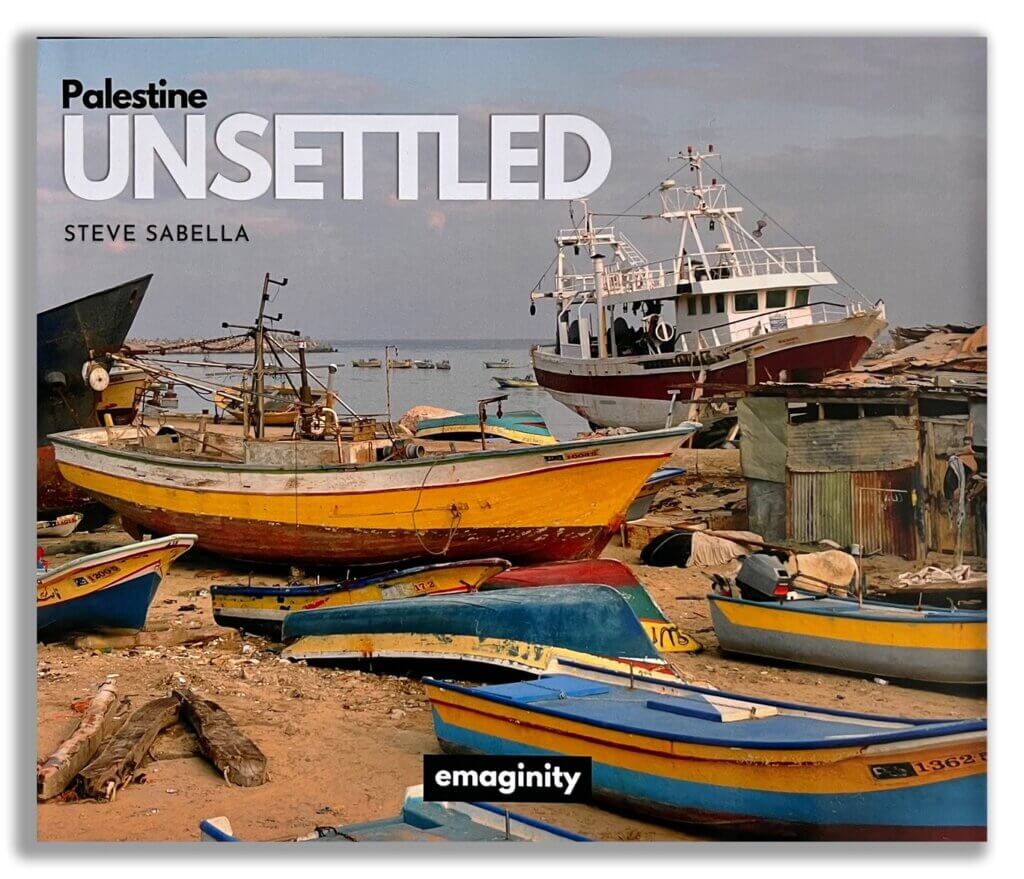
Sabella, with his long black hair, and his black clothes, then hands me a copy of Palestine Unsettled. I see that the book hasn’t any opening words or an epilogue. On the cover of the book, is a photo of the port of Gaza, some of the fishing boats grounded, some in the water. The photograph is like a painting, dynamically drawing blue and orange lines. “It’s a photo journey without text, word, caption, or date except for one dedication in Arabic. The images float in time and space, one after the other, from one dimension to another,” he explains.
However, he dedicated the book to one person and one novel – –The Children of the Dew by the late exiled Palestinian writer Mohammed Al-Asaad. And he elaborates, “My first encounter with Mohammed Al-Asaad was through my memoir The Parachute Paradox, which he started to translate to Arabic voluntarily. By chance, I discovered his masterpiece Children of the Dew, and without his permission, feeling it was a duty, I started translating it into English. Children of the Dew is about that fateful night when Palestine became Israel in the blink of an eye. In many ways, my book sheds light on what happened afterward.” The stories blend.
Sabella has a special way of absorbing/re-creating beauty, even in a tragic reality where there is an active siege on Gaza. Sabella explains, “Palestine is the land of beauty and imagination.” However, people who see the book won’t have any information about each photo. What will they think?
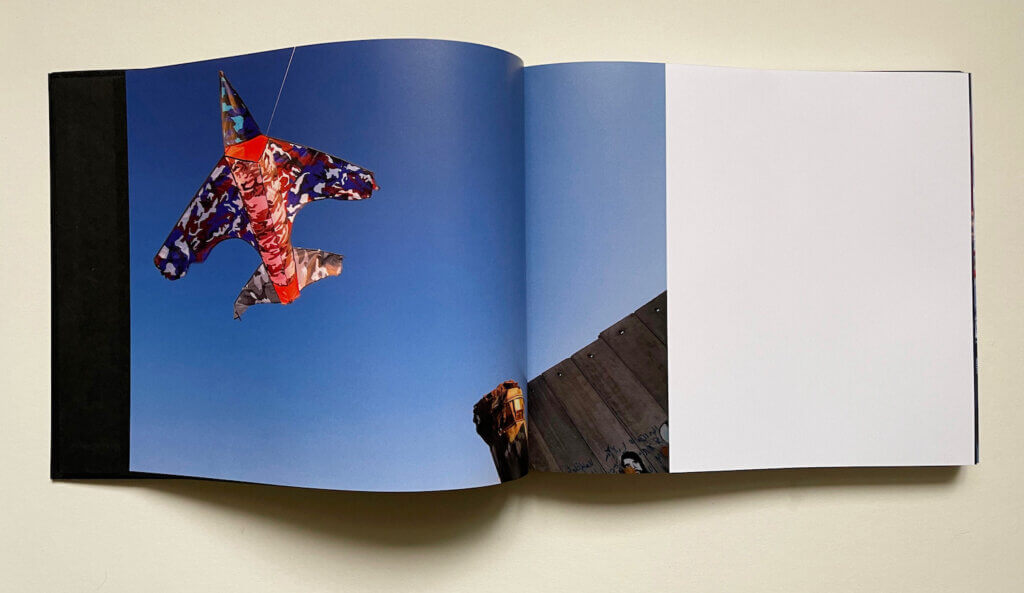
The book has many photos of children. It seems as if Sabella wants to protect the Palestinian child, as in a photograph where you see a father holding his son, at the checkpoint in Qalandia. Right above them is the rifle of an Israeli soldier pointing at them. In another photo, the Israeli F16 that usually bombing Palestine seemingly turns into a colorful kite that cuts through the apartheid wall and gives a different future to the Palestinian children. And yet another photo shows young actors from the Ramallah theater standing on the stage in front of an artistic separation-wall made of a mesh fabric like an invisible wall.

Sabella captures how Israelis painted the separation wall in brown to blend with the land and hide its existence for the settlers who drive next to it. He comments: “Many people came and conquered Palestine, what will the Israelis, when their empire will collapse, be remembered for? For building on the land, the ugliest structure on earth?”


While shooting for this book, Sabella moved freely between Israel, Gaza, and the West Bank. “I’m one of the only Palestinians during this period that had access to the whole of Palestine since, as you know, Palestinians from Gaza are entrapped, and People from the West Bank have many restrictions, not even allowed to step foot in Jerusalem. Because I worked with the UN and had the press card, I could enter Gaza and elsewhere. I know Gaza very well. I was even kidnapped over there. I was lucky to get a perspective not many people had access to, and I always feel it’s a duty to share knowledge and vision.”
In one of the photos, I recognize Jaffa Harbor where I lived before emigrating to Berlin. Sabella explains: “There is a shot from Jaffa’s harbor to remind people of all Palestine.”

I ask him about the Ferris wheel that appeared in one of the photos, and he tells me that it was show in Gaza and then bombed and destroyed by Israeli bombing during the second Intifada by Israeli’s F16 fighter jets. The Ferris wheel in my opinion captures the way in which the political and theological order can rotate, and there is another opportunity to rise for those who are now below. Sabella explains, “The Palestinian quest was always to embrace life, something I felt while roaming the streets of Palestine and entering many destroyed homes. Palestinians, like everyone else, want to live. These photos are a celebration of life.” Sabella’s idea is to escape from the pool of images we know from the Israeli and international media regarding Palestine.
Now sitting in central Berlin, with the weather getting even colder, I sadly look at some photos that show the Palestinians at the Mediterranean Sea. Sabella explains, “Until recently, Palestinians were not allowed to reach the seashore. I have a friend born in Rafah, not far from the sea, who never saw the sea because the Israeli settlements were blocking the shore. For me, this is absurd.”

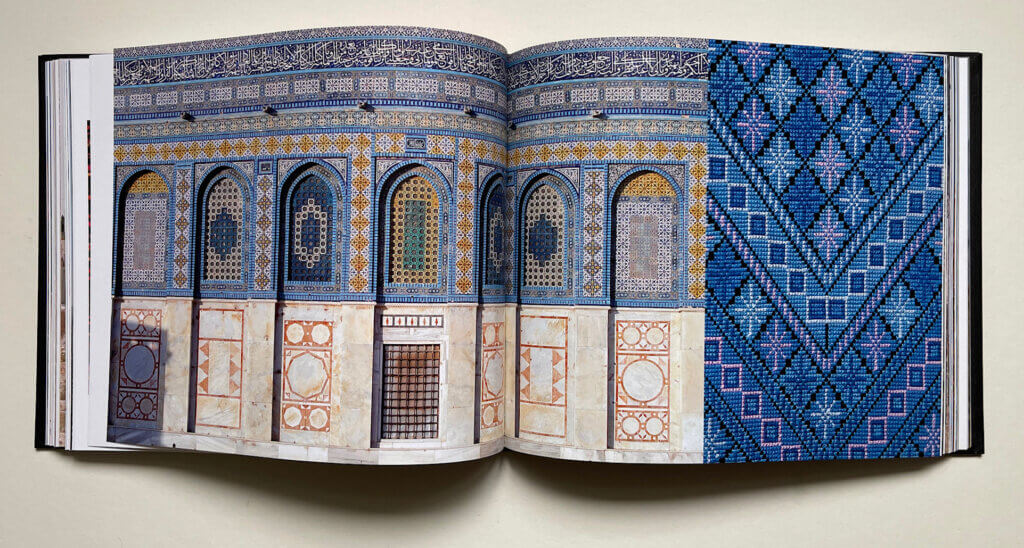
After looking at more than two thirds of the book, I feel that uplift of the soul especially from photos of the Palestinian women works of traditionally embroidery, standing next to the photos of the arabesque of the Dome of the rock – the lines almost converge. Sabella continues that line of thoughts, “I wanted to invite or lead audiences on a journey through Palestine that defies and revises their expectations, creating captivating connections.”

Mati Shemoelof
Mati Shemoelof is a writer and poet. His website is mati-s.com.
If one listens or reads the Israeli take on life then Palestinians do not exist or if they do they are all terrorists bent on Israel’s destruction. What a wonderful take on Palestinian life and art. They are a thriving community who has every right to exist in their own homeland. Too bad the world does not recognize their gifts to humanity.
Just viewed “My Tree” ($5 on Amazon) – it’s like 10 years of Mondoweiss condensed down to an hour and forty five minute film.
Jamie Sherman is a Canadian Jew who had a tree planted in his name when he was 13 by the JNF, so he goes to Israel to find ‘his’ tree in Canada Park – must see. Sherman interviews many interesting people but I think the most interesting was Seth Morrison, a JNF board member who quit – his story can be found here:
https://forward.com/opinion/147766/jnf-board-member-quits-over-evictions/
Some of my earliest Jewish memories involve dropping spare change in the Jewish National Fund’s iconic little blue boxes. I was proud that my money would help plant trees in Israel. The JNF, I knew, was making the desert bloom….As an adult, I became a member of the organization’s Washington, D.C., board and moved from donating extra nickels to raising thousands of dollars for JNF…Now, I regret to announce that this week I have resigned my board position and am severing all ties with the organization.
And yet it’s still important to realize how much Palestine has been colonized:
https://www.timesofisrael.com/in-search-of-his-tree-in-israel-a-canadian-filmmaker-unearths-unsettling-issues/
“In search of ‘his’ tree in Israel, a Canadian filmmaker unearths unsettling issues…After learning a sapling planted through JNF for his bar mitzvah is in a forest where once stood a Palestinian village, Jason Sherman asks himself if he is complicit in a cover-up..”
You can watch “My Tree” on Amazon.