

On October 18, Israeli forces in civilian clothing raided a home in the Jerusalem neighborhood of Beit Hanina, arresting 16-year-old Shadi Khoury.
At the same time, a local cultural center in Ramallah was distributing posters about an upcoming show for a prominent Palestinian cultural artist and composer, Suheil Khoury. The event hosted by the Arabic Orchestra was set to take place on November 17. Suheil Khoury is Shadi’s father and the general director of the Edward Said National Conservatory of Music. Now, rather than preparing for the upcoming event, Suheil is consumed with chasing a rigged legal system to free his 16-year-old boy.
“I was in Arabic class when I got a message from my friend saying Shadi was arrested,” Noor, Shadi’s classmate, told Mondoweiss from a classroom of the Quaker Ramallah Friends School, a week after the arrest. “I couldn’t process that. None of us could.”
“I met Shadi just last year,” Walid Sabi, 16, tells Mondoweiss. Posters of Shadi are now plastered across the walls of the school. “We became closer as we played football together,” he said with a smile.
“Everyone loved him,” Ilena, 16, said. “Usually we don’t like people we just meet, but the more we got to know him, the more we loved him.” In a similar sentiment, many of Shadi’s classmates spoke of the ways in which Shadi drew affinity from his peers.
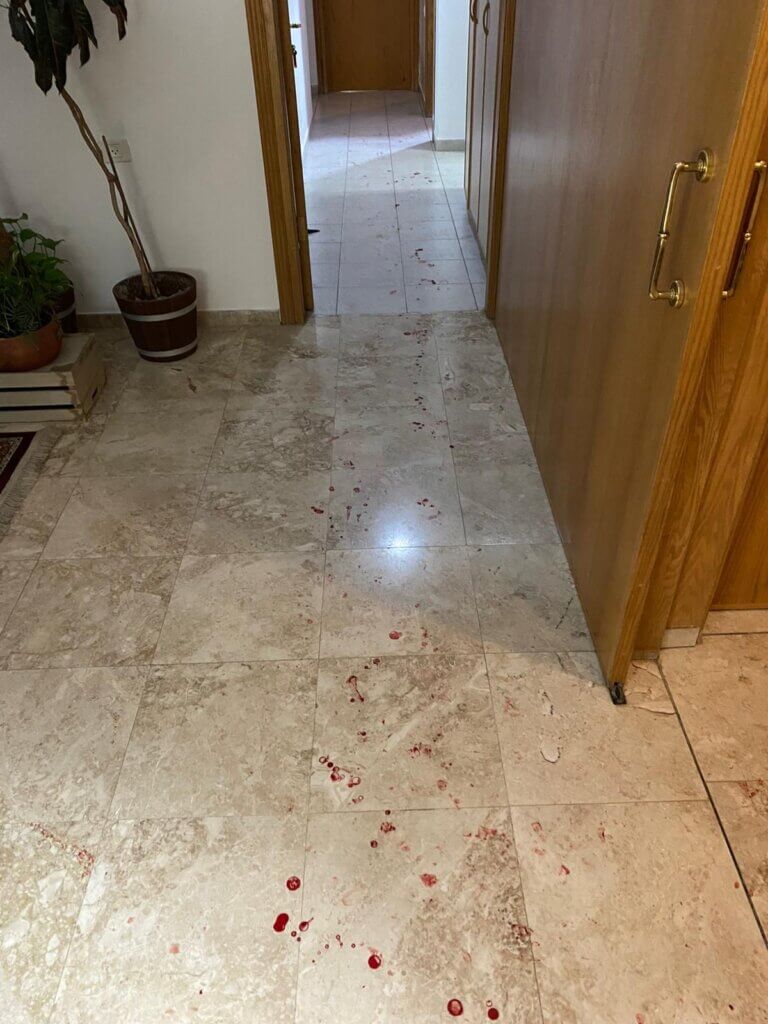
Shadi was arrested and brutally dragged out of his home by four Israeli officers and into an Israeli police car. The trail of blood from the beating stained his home’s tile floor. When Shadi’s parents attempted to intervene to protect their young son they were pushed away and Shadi’s father was tazed, according to the family.
At the time of writing (two weeks after the violent raid) Shadi is still being held in the Maskubiya Detention Center or “Russian compound” in Jerusalem, known as a “slaughterhouse” among Palestinian detainees, due to the harsh conditions to which they are subjected there — especially the notorious cell no. 4.
“They came in and raided his room at around 5:30 a.m.,” Zeina Khoury, 31, told Mondoweiss a week after the brutal arrest of her younger sibling, trying to remain composed.
Zeina says the officers “demanded to take Shadi’s phone.” Yet the 16-year-old showed defiance when he chose to uphold his rights and ask, “where’s your warrant for that?” Holding her two-month newborn, Zeina recounted the officers’ response: “they said ‘we have a warrant for everything.’”
Not even allowed to change out of his pajamas, Shadi was beaten as he was taken from his home. Shadi was later denied access to a lawyer or an adult guardian, violating his basic rights as a child prisoner.
Yet as a Palestinian and a Jerusalemite, the assault on Khoury may appear as if it were inevitable. Since the beginning of the year, more than 5,300 Palestinians have been detained by the Israeli military, including 630 children, most of whom were from Jerusalem. Another classmate of Khoury’s, who is from the Jerusalem neighborhood of Sheikh Jarrah, shared that he had also been arrested by Israeli forces last year, when he was only 15.
“Last year, a boy from my village in Abu Qash was arrested by the Israeli army,” another classmate, also 16, shared. “He was taken for more than two weeks, as if that’s normal.”
Globally, Israel is the only country to automatically prosecute children in military courts. “The context is a state that is very violent and criminal,” forensic psychologist, Dr. Nadera Shalhoub-Kevorkian, told Mondoweiss.
A traumatized generation
Shalhoub-Kevorkian explained to Mondoweiss that the criminalization of Palestinian children is the product of a systematic Israeli policy of what she calls “un-childing.” She warns that the frequency and intensity with which Israel targets Palestinian children and minors, especially in Jerusalem, is unprecedented.
From the neighborhood of Beit Hanina in occupied Jerusalem, Shadi, like most youth in Jerusalem, is at increased risk of harassment and targeting by Israeli forces. This became further exacerbated after last year’s Unity Intifada that was sparked by the attempt to displace Palestinian families in Sheikh Jarrah.
“Shadi is a case among so many Palestinian children that are being harassed, tortured, and imprisoned,” Shadi’s grandmother, 89-year-old Samia Khoury, wrote in a statement. She continued to explain the intention behind the systemic assault of Palestinian children, “for no reason other than being a Palestinian seeking to live in dignity and freedom in their own country.”
As of September, Israel had 132 Palestinian children between the ages of 12 and 17 in military detention. Detention of children should be a last resort according to the International Convention on the Rights of a Child (CRC), which Israel ratified as of 1991. However, Israel has not ratified the 2011 Optional Protocol of the CRC which affirms the rights of a child to submit complaints for the violations of their rights.
“They’re trying to pin anything and everything [on him],” Zeina Khoury told Mondoweiss. “They’re trying to make a point.”
The impact of Shadi’s imprisonment has gone beyond the beatings, or the fear that his parents, Suheil and Rania, must navigate as their son remains held captive by a regime known to abuse children. More than this, the lives that Shadi had contact with, even if briefly, were ruptured.
Shadi’s classmates made t-shirts in solidarity with their friend and classmate. Plain black shirts with a photo of the 16-year-old and a hashtag in Arabic which said, “Shadi is our pride.” The photo stood as a testament of his friends’ rejection of Israeli criminalization.
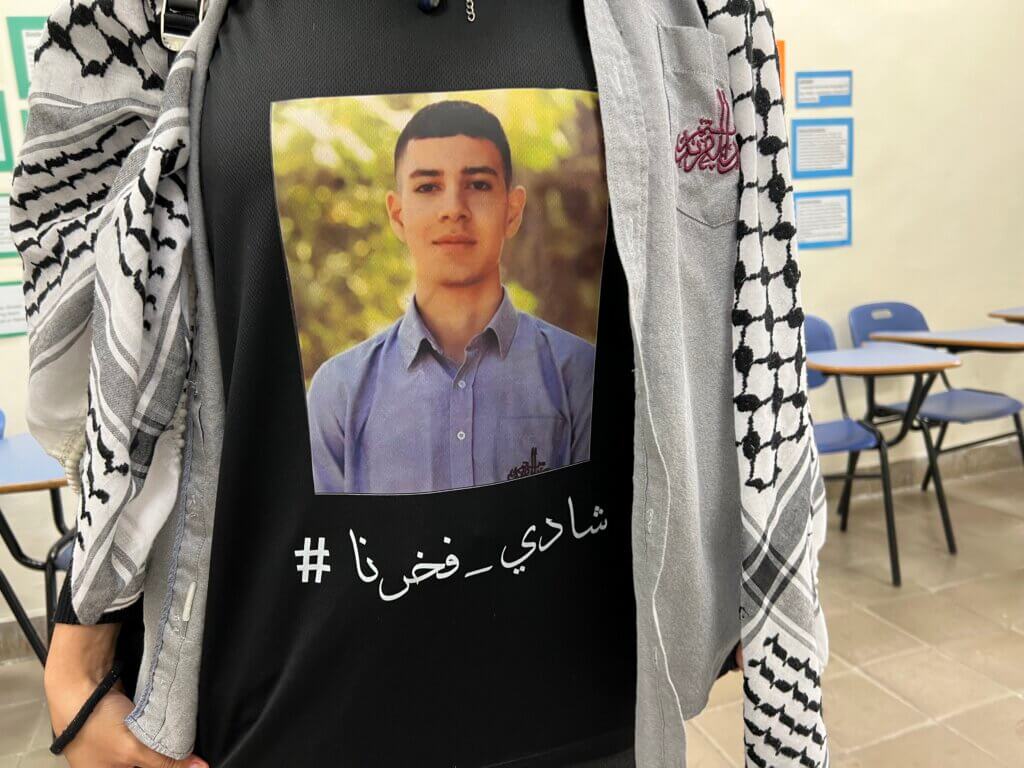
With schools in Jerusalem facing additional assaults by Israel, making them an increasingly unsafe space for Palestinian youth, Shadi moved to Ramallah’s Friends School only last year. “I became friends with him last year when he first came,” Adam, also 16 and one of Shadi’s classmates, told Mondoweiss. “We used to wait together after school until the Jerusalem buses arrived so he could go home,” he continued.
Palestinian youth are often exposed to daily Israeli brutality and illegal military occupation through the experience of checkpoints. Sometimes, Shadi would miss the bus to Jerusalem, forcing him to stay the night at one of the homes of his classmates.
Almost half of the Palestinian population, nearly 44 percent, is comprised of children under the age of 18. Last year, at least 86 Palestinian children were killed, making it the deadliest year for Palestinian children since 2014. More than half of those killed were under the age of 12.
Since the start of this year, in a mere ten months, 41 Palestinian children and minors were killed. More than half of those killed, 28 children, were killed in the West Bank and Jerusalem, while 13 were killed in Gaza during the August onslaught dubbed Operation Breaking Dawn.
In addition to the continued killing of Palestinian children, through increasing and intensifying the military detention and arrest of children and minors, and the persistent exposure to violence on checkpoints, Israel is slowly killing Palestinian childhoods by way of psychosocial engineering. A good portion of Palestinian teens share the experience of either being detained by Israel or knowing someone that was.
“I feel like Shadi’s situation is an eye-opener for me, who knows who could be next?” Shadi’s peer and friend, Ilena, 16, said. “It could be me, it could be my sister, my brother,” she said.

The illegal detention often includes ill-treatment, denial of legal rights, and at times torture, where they are likely to face various forms of abuse by soldiers, according to reports by human rights monitoring groups.
In a room of almost ten students, when Mondoweiss asked if they were aware of their rights in military detention — such as a lawyer, a parent, or the right to remain silent — only four of them said they vaguely knew of their rights. This type of engineered ignorance on rights is also how Israeli forces recruit and infiltrate Palestinian spaces, even online.
More recently, Israel has also employed social media posts and de-contextualized statements on personal pages or in private messages to detain and intimidate Palestinians, including children and minors. This is often done to coerce a confession or information about others.
As though latching on to some sort of hope, Shadi’s friends shared their stories, then asked me “will we get him in trouble if we share our stories?” This type of anxiety stems from the recognition that Israel has a 99.8 percent conviction rate, with more than 53,000 Palestinian children arrested since 1967.
“Even if we make noise, I don’t think it will help,” Walid, another classmate said. “They [Israeli forces] will do what they want, without a care about anything or anyone else,” he said, as his head dropped towards his chest.
“We don’t need more hashtags,” Walid said. Listening to her classmate, Noor interjected: “but hashtags and sharing his story is a bare minimum that we, young ones, can do.”
“We need to create pressure to bring our friend home,” she added.
1 of 2
The Rise of Israeli Fascism as the Swing Vote in Parliament, and the Project of Ethnic Cleansing (juancole.com)
“The Rise of Israeli Fascism as the Swing Vote in Parliament, and the Project of Ethnic Cleansing”Informed Comment, by Juan Cole, 11/02/2022
“Despite Israeli propaganda about being a democracy that shares values with the liberal West, the country has for some time gone down a much darker path. Exit polling done by the major Israeli television channels in Tuesday’s election suggests that Bezalel Smotrich’s Religious Zionist Party, in a joint slate with Otzma Yehudit (Jewish Power), will win between 13 & 15 seats in the 120-member Israeli parliament or Knesset.
“Many members of Religious Zionist Party coalition came out of the violent & racist Kahanist movement of the late Rabbi Meir Kahane. Kahanist organizations such as the Kach Party came to be outlawed as terrorists by both Israel & the United States, but former members of the younger generation such as Itamar Ben-Gvir have reinvented themselves through other extremist parties such as Otzmah Yehudit that have coalesced with the Religious Zionist Party.
“A decade ago, such figures were too toxic for mainstream Israeli politicians to have anything to do with them. Now, the far right Likud leader Binyamin Netanyahu, has formally allied with the Religious Zionist Party.
“Ben-Gvir once pulled a gun on Palestinian residents of Sheikh Jarrah. He was once convicted in Israel of incitement to racism for his anti-Palestinian threats. He advocates stripping Israeli citizenship from any of the 1.5 million Israelis of Palestinian heritage whom he perceives to be in any way disloyal to Israel, & expelling them. This is a form of ethnic cleansing. He considers Palestinian-Israeli members of parliament to be a fifth column. He even wants to set up a ministry charged with ‘encouraging’ Palestinian-Israelis to ’emigrate.’ No doubt he will do his best to find a final solution to this problem of impurities in the Israeli body politic. (cont’d)
.
2 of 2
“Ben-Gvir, however, is only a symptom of the rot that has set into Israeli politics. He wants to simply annex the West Bank, or at least the 62% of it in Area C, which would be a war crime. But that position is no longer the monopoly of the fringe far, far-right. Such an annexation was broached by Likud leader Netanyahu during his last tenure as prime minister. Avigdor Lieberman, the secular leader of the Russian bloc in Israel, who disdains religious Zionism, has also urged expulsion of Israelis of Palestinian heritage if they will not sign a loyalty oath.
“To see how monstrous these positions are, just transpose them to an American setting. American Indians are our indigenous population, as Palestinians are Israel’s. Palestinians have lived on their land for millennia, just as have American Indians.*
“Deb Haaland, our Secretary of the Interior, is an American Indian. What if a clique of politicians in the United States stood up on the floor of the House and demanded that she be fired because she belongs to a ‘fifth column’ & is disloyal to the United States?
“What if today’s politicians routinely spoke about the need to strip citizenship from & expel the Navajo from New Mexico & Arizona into Mexico & to annex the Navajo Reservation, the 27,000-square-mile area that stretches across four states in the Southwest? What if all 7 million American Indians were branded terrorists by some politicians in Washington?
“Of course, politicians in earlier centuries did all those things to American Indians here, but those actions are now widely recognized as having been injustices. If someone insisted nowadays that the Trail of Tears had been a great good thing, we would know immediately that that person is a horrible racist.
*Putting aside ancient history, most Israelis can’t trace their families’ residence in Israel back further than the early twentieth century. Ancient history doesn’t count or else France and Spain would have to surrender to Italy, the Roman successor state, and dissolve themselves.”