
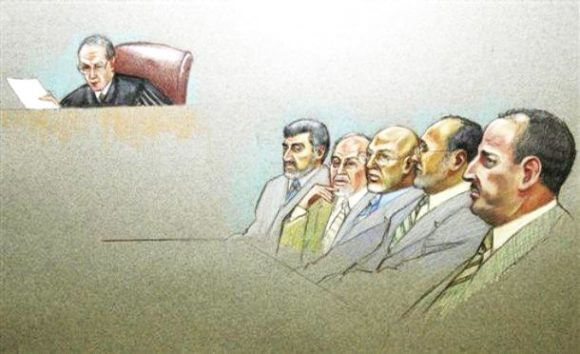
A coalition of Palestine advocacy groups has launched a renewed effort to free members of the Holy Land Five, a group of Palestinian men imprisoned fourteen years ago for allegedly funding terrorism through their charity.
The new campaign was ignited by Within Our Lifetime, the Coalition for Civil Freedoms, and the Samidoun Prisoner Network, but dozens of human rights organizations have joined the call including Palestinian Youth Movement, CUNY Law Students for Justice in Palestine, and the Canadian BDS Coalition.
“It is time to act,” said the Samidoun Prisoner Network in a statement. “These three men remain behind bars, locked away from their communities and loving families, and we demand their freedom, alongside the freedom of all Palestinian prisoners. Like the prisoners of the Black Liberation Movement, Leonard Peltier, Alex Saab and others, the Holy Land 5 are political prisoners of U.S. imperialism.”
Holy Land Five
The Texas-based Holy Land Foundation (HLF) was targeted by the George W. Bush administration following the 9/11 attacks and the government was able to shut down the charity in December 2001. According to reporting from the Washington Post, Bush was pressured to take down the HLF by late Israeli Prime Minister Ariel Sharon and the former president “speedily obliged.”
In July 2004 Mufid Abdulqader, Ghassan Elashi, Shukri Abu Baker, Abdulrahman Odeh, and Mohammed El-Mezain were arrested. Their first trial in 2007 resulted in a hung jury, but they were retried the following year and each sentenced to prison. Abu Baker and Aashi for sixty-five years, Abdulqader for twenty, and Mezain and Odeh for fifteen. Odeh was finally freed in 2020 while El-Mezain was released this year.
The prosecution argued that, through the charity’s aid work in the West Bank and Gaza, the HLF had assisted Hamas, the Palestinian national organization that was dubbed a terrorist organization by the Clinton administration. The first trial failed to produce a single guilty verdict out of 197 charges against the men, but was declared a mistrial after multiple jurors began harboring doubts about their decision. These doubts came after an unexplained four-day delay in having the verdict read in an open court.
“Except for the crazed McCarthy era and the wholesale internment of Japanese immigrants after the bombing of Pearl Harbor, I can’t think of a time in this country when our justice system was so manipulated on the basis of insinuation and unfounded suspicion rooted in prejudice,” wrote journalist Bob Ray Sanders in the Fort Worth Star-Telegram at the time. “Our country is better than that. At least it ought to be.”
“This case was flawed from the beginning, but it didn’t keep the government from going forward, because it needed some trophies in its war on terrorism. Instead of winning trophies, however, it destroyed a worthwhile organization and ruined many lives,” he continued. “..The Justice Department says it will retry the case. You see, prosecutors can’t admit when they’ve made a mistake. And, of course, they still want those trophies.”
As Miko Peled details in his 2017 book Injustice: The Story of the Holy Land Foundation Five, key evidence against the defendants in both trials relied on testimony from two anonymous Israeli sources. Peled has called the move “unprecedented in the history of the United States.” Additionally, evidence that was ruled as hearsay in the first trial.
“To spend millions of dollars in time and expenses to prosecute people who were of no real threat to anyone, under the banner of a terrorism case, is a waste of precious federal resources,” former prosecutor Tom Melsheimer told the Dallas Morning News after the convictions. I think this case proves that, with enough effort, the federal government can convict nearly anyone.”
Prison conditions
Shukri Abu Baker is currently being held in USP Beaumont, a high-security prison federal prison located in Texas. Earlier this year a deadly fight among inmates broke out at the facility and Abu Baker was seriously injured after guards shot tear gas to quell another altercation.
In an interview with Middle East Eye Abu Baker’s daughter, Nida Abu Baker, spoke about the conditions that are father has been forced to endure.
“He is now in one of the worst prisons in the USA,” she told the website. “He almost died and I do not want that to happen again. I’m not waiting for my dad to die for us to stand up and do something about this. It is my duty, not only as his daughter, but as a Palestinian-American because what is happening is unconstitutional and what is happening can happen to absolutely anybody if we don’t speak up about this.”
On November 29 organizers will be hosting a virtual town hall to help strategize and further build the movement.


I had forgotten much about these convictions. It really smells like anti-Palestinian racism. There needs to be a re-trial.