
A STRANGER IN YOUR OWN CITY
Travels in the Middle East’s Long War
by Ghaith Abdul-Ahad
409 pp. Knopf $30.00
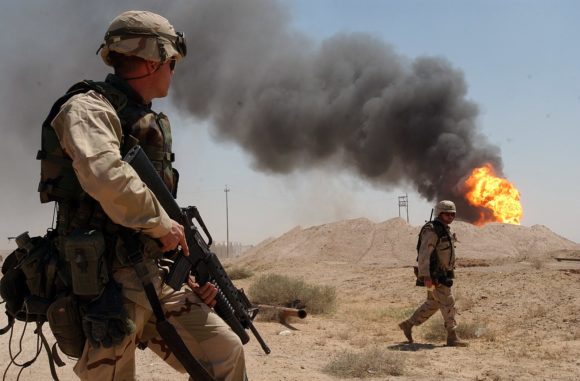
This book is a masterpiece that will surely become a classic. Ghaith Abdul-Ahad is an Iraqi journalist who spent the last 20 years reporting from his hometown of Baghdad and just about every other corner of Iraq. He was a young architect when the U.S. invaded in 2003; he quickly signed on as an interpreter/fixer for foreign journalists and then went on to write and photograph his own articles, mostly for the British Guardian. He witnessed, first-hand, the American invasion itself; the ferocious 2004 battle for Fallujah; and the rise in violent sectarianism. He was on the front lines in 2017 as the Iraqi army fought the vicious jihadi group ISIS to retake the city of Mosul, house by house.

It is impossible to over-praise this book. To start with, Abdul-Ahad’s courage is extraordinary. He came close to being killed or captured by one side or another at least a dozen times. What makes his account the more impressive is that he downplays his own bravery, or treats it matter-of-factly. Instead of his own exploits, at the heart of his book are the profiles of scores of individual Iraqis, which brings them alive; no American or European writer could have done this. This book should become the most prominent first-hand history of the awful Iraq disaster — which is still far from over 20 years later.
But A Stranger in Your Own City is more than a comprehensive journalistic account, indispensable as it is in that respect. Abdul-Ahad explains why the U.S. invasion was doomed from the outset and how it detonated the subsequent decades of violence. His analysis decisively confirms what some of us were warning in the months leading up to the American attack.

Abdul-Ahad was physically present for the most iconic moment in the 2003 U.S. invasion — when American soldiers started to pull down the statue of Saddam Hussein in Baghdad. Here’s his reaction:
Oh no, don’t do it, let the Iraqis at least topple the statue of their dictator. . . No, no, you can’t be doing this, I gasped, at least allow the facade of liberation to last for a day. But no, with all the arrogance of every occupying soldier throughout history, he [the U.S. marine] covered the face of the defeated dictator with the flag of his victorious nation; briefly, but long enough to seal the fate of the invasion in the eyes of many.
The Bush administration, and their collaborators in the Democratic Party and the mainstream U.S. media, did not understand that Americans are not the only people on earth who have strong feelings of nationalism or patriotism and who will resist foreigners, especially those of a different culture and religion who invade — even if it is to overthrow a vicious dictator who had lost most popular support. I — like others — made this point in an article that appeared two months before the U.S. invasion: “. . . Iraqis themselves may not even know until the last minute how they will react to conflicting pressures; their fear of the Saddam regime and their hatred of it, or their patriotic loyalty — in spite of Saddam — to their tribe, region or country. . .”
The situation immediately got worse once the U.S. installed a Coalition Provisional Authority to run the country, staffed by Americans. Abdul-Ahad, whose tone is normally measured, said this crew “represented the worst combination of colonial hubris, toxic racist arrogance, and criminal incompetence. Many would later write books about their heroic struggle in the land of the Arabs.”
The Americans and their local proxies set up a system of government that resulted in murderous sectarianism between Sunni Muslims, Shiite Muslims, and Kurds. Abdul-Ahad argues that the vicious conflicts were not inevitable. He explains that on the eve of the U.S. invasion, Iraq had “a common identity, imagined and constructed, solidified into belligerent nationalism after a hundred years of a centralized government, the creation of an army that dominated social and political life, the drilling of a national myth into generations of schoolchildren. . .”
He explains that in some cases, he didn’t even know which sect certain of his friends and high school classmates belonged to. But at the shock of the American intervention, sectarianism heated up. The occupation enabled “a coalition of corrupt, imbecilic, religious warlords to rule the country for the next twenty years and create one of the most corrupt nations on earth.”
Baghdad became violently segregated, as death squads “cleansed” entire neighborhoods, creating exclusively Sunni and Shiite zones into which outsiders risked their lives to enter. To continue his reporting, Abdul-Ahad had to collect various distinct false ID cards and remember which ones to produce in which areas. (The American occupiers thoughtfully contributed by building high concrete walls to maintain the new neighborhood borders.) The segregation explains why Abdul-Ahad’s title is “A Stranger in Your Own City.”
The armed groups continued to metastasize. Abdul-Ahad eventually counted 14 different militias fighting each other in the city of Ramadi alone.
The most chilling part of the book is the rise of ISIS from 2014 onward. The endless years of violence, torture, and sectarian killings in Baghdad and elsewhere is the background that helps explains how such an extremist group could actually seize power over 8 to 12 million people in northwest Iraq. Abdul-Ahad shows how ISIS rule was even worse than outsiders may have realized. He interviews a Mosul doctor who explains: “We had two systems in the hospitals. Daesh (another name for ISIS) and their families were given the best treatment and complete access to medicine, while the normal people, the ‘Awam,’ were forced to buy their own medicine on the black market.”
Abdul-Ahad accompanied the Iraqi army as it fought to retake Mosul from the jihadist group. Once again, he risked his life, and once again, he makes no special point of it. He describes, in ugly detail, how the Iraqi army routinely tortured and murdered prisoners, (exactly as ISIS was doing). The extreme violence seems inevitable, a culmination of more than two awful decades: “The heritage of torture in Iraq can be traced as a linear path, from Saddam’s Mukhabarat (secret police) to the Americans in Abu Ghraib (the U.S.-managed prison) and the sectarian forces of the Iraqi government and its militias.”
We should expect to see an assessment of Abdul-Ahad’s masterwork on page 1 of the New York Times Book Review and given similar prominence across the U.S. mainstream media. But so far, with the exception of a glowing review in the Wall Street Journal (by U.S. military veteran Phil Klay): nothing.
Most of the mainstream U.S. experts who were cheerleaders for the war, whether policymakers or journalists, did not pay professionally for their mistakes. There were a handful of half-hearted mea culpas in 2013 at the 10th anniversary of the U.S. invasion, but the 20th has been greeted with silence, from New York Times columnist Thomas Friedman and the rest of them. At the very least, they should stop hiding and use their influential media platforms to promote this outstanding and courageous book.
And every influential American expert who pushed for the war “to promote democracy across the Middle East” should be required to read — and publish — Ghaith Abdul-Ahad’s biting summary of the past 20 years:
The illegal war that was based on a lie not only destroyed Iraq, causing the deaths of nearly a quarter of a million Iraqis and a few thousand Americans and unleashing a sectarian war that would engulf the region, but it permanently crippled democracy in the Middle East. . . ‘Do you want democracy? Didn’t you see what democracy did to Iraq?’ became the repeated refrain of dictators and potentates throughout the region.
I’ve been reading the book. It is very good.
I am slightly more optimistic about a review appearing in the NYT. Occasionally there will be an opinion piece or a book review that would please the typical Mondoweiss reader. No, I don’t have an example offhand, but am sure I have seen it. There are limits. You aren’t very likely to see Western officials and media types held to the same standards they would apply to Putin and other Russians who support the Ukraine invasion or destruction of infrastructure. But mainstream liberals will admit that the Iraq War was catastrophic for Iraqis. They just won’t accept that Westerners, including liberals, are just as responsible for the suffering of Iraqis as Putin and other Russian officials are for the suffering of Ukranians.
I thought “On Point” on public radio gave an excellent interview of Abdul-Ahad: https://www.wbur.org/onpoint/2023/03/30/20-years-of-chaos-in-iraq-through-iraqi-eyes
Ghaith’s articles for the Guardian were always a must-read. I’m sure I was not alone among readers in fearing for his safety whenever there was a pause in his reporting.