Key Developments (April 20-24)

- On Monday morning, April 24, Israeli forces shot and killed Suleiman Ayesh Hussein Oweid, 20. Oweid was killed during an invasion of the Aqbat Jabr refugee camp located in the Jericho district. Since last year, Palestinian armed resistance has been spreading across the West Bank, including in Jericho, where the Aqbat Jabr brigade emerged earlier this year when Israeli forces killed five of the Brigade’s fighters, while continuing to target and detain their family members in the months to follow. Oweid is the second Palestinian killed in Jericho in the last two weeks.
- Also on Monday, hours after the killing of Oweid in Jericho, a car ramming was carried out in Jerusalem. According to Israeli police, at least five Israelis were injured, including one 57-year-old who suffered an anxiety attack. The man who carried out the attack is reported to be from Beit Safafa, the last remaining Palestinian town in West Jerusalem. Israeli forces carried out punitive collective punishment against the family of the man, including the arrest of his wife from the family home. The man was identified as Hatem Abu Nijim, who is in his thirties and reportedly has a history of mental illness.
- Last week, on Thursday, April 20, Israeli settlers and the Israeli army attacked Palestinians in the Palestinian town of Beita, injuring at least two Palestinians with live ammunition and more than 30 others from teargas asphyxiation. This attack is the most recent in an escalation of assaults on the Palestinian town of Beita, where Israeli settlers have been trying to legalize and solidify their forcible annexation of the Palestinian-owned Sbeih Mountain.The last attack on Beita at such a large scale took place a week earlier, April 14, when Israeli settlers and the army attacked Palestinians in Beita and Beit Dajan, injuring at least 58 Palestinians, including one with plastic-coated pellets, which have been documented to be used in lethal ways against Palestinians.
- Last week, Israeli policy-makers also moved forward in solidifying illegal annexation of the West Bank by allocating an unprecedented transportation budget of almost 13.7 billion dollars to the West Bank. This serves to link more settlements in the West Bank with one another at the expense of Palestinians. The budget accounts for almost 25% of the total transportation budget for settlers, who constitute close to 8% of Israelis. The move was pushed forward by the Israeli Minister of Transportation, Miri Regev, and Israel’s Finance Minister, Bezalel Smotrich. Both are known for their staunch right-wing Likud approach and anti-Palestinian policies.
In-depth
Ever since the start of the year, the Zionist forever war on Jerusalem entered a new stage. While Israeli attempts to assert control over the al-Aqsa compound are nothing new, the new Israeli government is consistently striving to erode the preexisting status quo that has preserved the rights of Palestinians to the city. Ben-Gvir’s invasions into al-Aqsa have become the governmental expression of the Temple Mount Faithful, which in turn became further empowered and emboldened by the new government’s policies. All of these tensions came to a head throughout the past month, when Muslim, Jewish, and Christian holidays coincided.
During the Muslim and Christian holidays, Palestinians assert their rights to the city, which in recent years has led to the emergence of a commons, a kind of public sphere where Palestinian religious affiliation is politicized and channeled into confrontation with the colonial authorities. This is the second part of the escalation dynamic, one where the Israeli authorities refuse to suffer the mere existence of a subversive and autonomous Palestinian presence — the Ramadan commons of previous years has already proven how threatening it can be, as with the case of the Bab al-Asbat uprising that led to the easing of restrictions on movement in the Old City.
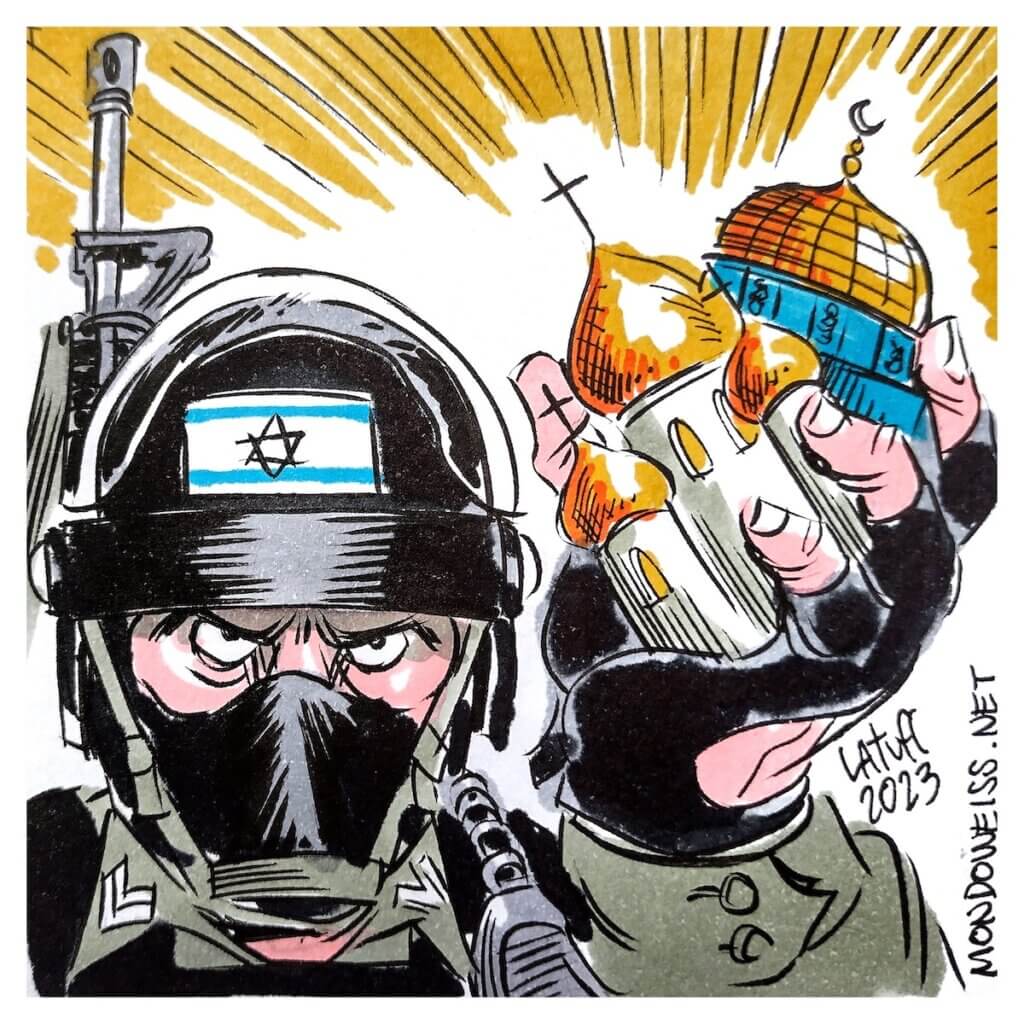
For this reason, the Israeli authorities launched two major offensives on the Palestinians of Jerusalem during the past month; the first on worshipers at al-Aqsa, which resulted in brutal beatings and the arrest of hundreds, and the second on worshipers during Easter, when the entire Old City was turned into a military zone with soldiers and checkpoints spread across it.
The twin offensives made one thing clear: the war to assert the Zionist presence over Jerusalem has entered a new phase, and its primary feature is the merging of Jewish fundamentalism with the traditional labor Zionist ethos of “maximum land with minimum Arabs.” But as the grip on Jerusalem tightens, its status as a political lightning rod for popular mobilization grows. This is not only reflected on the street, but has even threatened to engulf the region in war as rockets were fired from Gaza and southern Lebanon into Israel, a move that was met with Israeli hysteria.
While a war did not break out this time, the fact that it did not is also telling — and so is the subsequent easing of restrictions for Muslim Palestinian worshipers during the final days of Ramadan. If anything, this illustrates the Israeli fear of a wide-ranging Palestinian (and Arab) response that might emerge from its provocations in Jerusalem.
The trouble is that while these provocations will undoubtedly continue to add fuel to the fire, the colonial authorities cannot help but continue to stoke the flames. Settler interests have captured the Zionist state, and the emergence of a Palestinian Jerusalem commons is too threatening to be allowed to exist.
All this creates the social and political forces that make the continuation of the forever war on Jerusalem inevitable.
Key figures
- More than 100 Palestinians have been killed since the beginning of the year.
- At least 50 Palestinians were arrested by Israeli forces in the past week.
- There are currently 4900 Palestinian political detainees, 19 of whom are between the ages of 12 and 17. Ten of the children and minors are being held without trial or charge.