

At a time when the Palestinian freedom struggle is gaining steam and spreading internationally, Germany remains a fundamentalist supporter of Israel.
In September 2017, the German Federal Government endorsed the IHRA Working definition of antisemitism that subsequently conflates anti-Zionism with antisemitism. Then two years later, in 2019, the German Bundestag voted on an anti-BDS resolution deeming all actions that support BDS as antisemitic, and forbidding Palestinian organizations and individuals seen as supporting BDS from accessing public funding and public space. Palestinian journalists have lost their jobs, academics and artists are censured, and activists face slanderous campaigns depicting them as antisemitic by the media and politicians alike.
Now, however, Germany’s persistent intransigence against Palestinians has reached new levels. This month, as Palestinians around the world commemorate the 75th anniversary of the Nakba, Germany sent a message: advocating against Israel’s historic crimes can be a criminal offense.
Arresting anyone who looks Palestinian
Last year, May 2022 saw immense state repression against Palestinians and their supporters, when the Berlin police preemptively banned five registered events commemorating 74 years of ongoing Nakba. Over 120 people were arrested. Some who took part in a flash mob for Palestine were quickly disbanded, in addition to others who simply passed by while wearing the keffiyeh. The police admitted that they were racially profiling, arresting anyone who looked Palestinian.
This year, the Berlin police once again banned all events commemorating the 75th anniversary of the Nakba. The police disrupted a Palestinian cultural event on May 13 in the Neukolln district of Berlin. They imposed restrictions on political public speeches, exercised discretionary control over the distribution of books on Palestine, and forbade attendees from engaging in the traditional Dabka dance by deeming it a form of “political expression.”
Other protests that were scheduled for the 13th, 14th and 20th of May were also canceled. At least 11 demonstrations on the Nakba have been banned in Berlin since April 2022.
The Berlin police justified the bans stating that “public safety is directly endangered when the assembly is held” and that there is an “immediate danger that the assemblies will feature inflammatory, antisemitic exclamations, glorification of violence and acts of violence.”
In a 15 page document, the Berlin police states that the Palestinian diaspora is too emotional to participate in a demonstration:
“Even if the media treatment of the topic “Al-Nakba Day” can no longer be compared with that of the last few years, it can be said that the mood within the Palestinian diaspora, most of whose members will be affected at least indirectly, is currently affected by a considerable degree of emotionalization. Against the background of the current events in connection with East Jerusalem and the Gaza Strip, gatherings that deal critically with the fate of Palestinians in Israeli-occupied areas are suitable for mobilizing people who, in specific cases, take action or get carried away with statements that are not compatible with German legislation.”
They further justified the bans by claiming that organizations that shared the protest flyers were “antisemitic,” because they support the BDS movement.
The police also referred to Arab participants as especially violent: “The majority of the participants in the assembly will therefore be made up of young people from the Arab diaspora. Experience has shown that a clearly aggressive attitude currently prevails among this clientele and that they are not averse to violent behavior.”
The European Legal Support Center (ELSC) released a statement on Friday criticizing the continued criminalization of Palestinian existence. “The justification for the bans is informed by a systematic pattern of anti-Palestinian racism criminalizing solidarity with the Palestinian cause for freedom and return, as well as expressions of Palestinian identity.”
The ELSC argues that these measures are anti-democratic in nature and are enacted as a form of collective punishment directed at anything visibly Palestinian, extending “to any expression of collective memory and rights advocacy,” as seen through the recent bans of demonstrations that took place earlier this month. According to the ELSC, Palestinians commemorating the Nakba and more generally Arab participants are “dehumanized” and “framed in the colonial tradition as highly emotionalized men who would glorify violence.” They conclude: “these bans are an attack on all of us.”
Yet, interestingly enough, the Berlin police did allow one Nakba day demonstration to take place on Saturday May 20, organized by anti-Zionist Jewish group, Judische Stimme. The protest, however, was followed along with immense police presence and brutality.
Although there were many organizers trying to keep the peace, the police were consistently aggressive, making an escalation more likely. Disturbing images surfaced of police attacking Palestinian Muslim and Jewish participants and throwing them on the ground and kneeling on their backs — a chant of “from the river to the sea, Palestine will be free!” was apparently enough for the Berlin police to quickly disband the demonstrations.
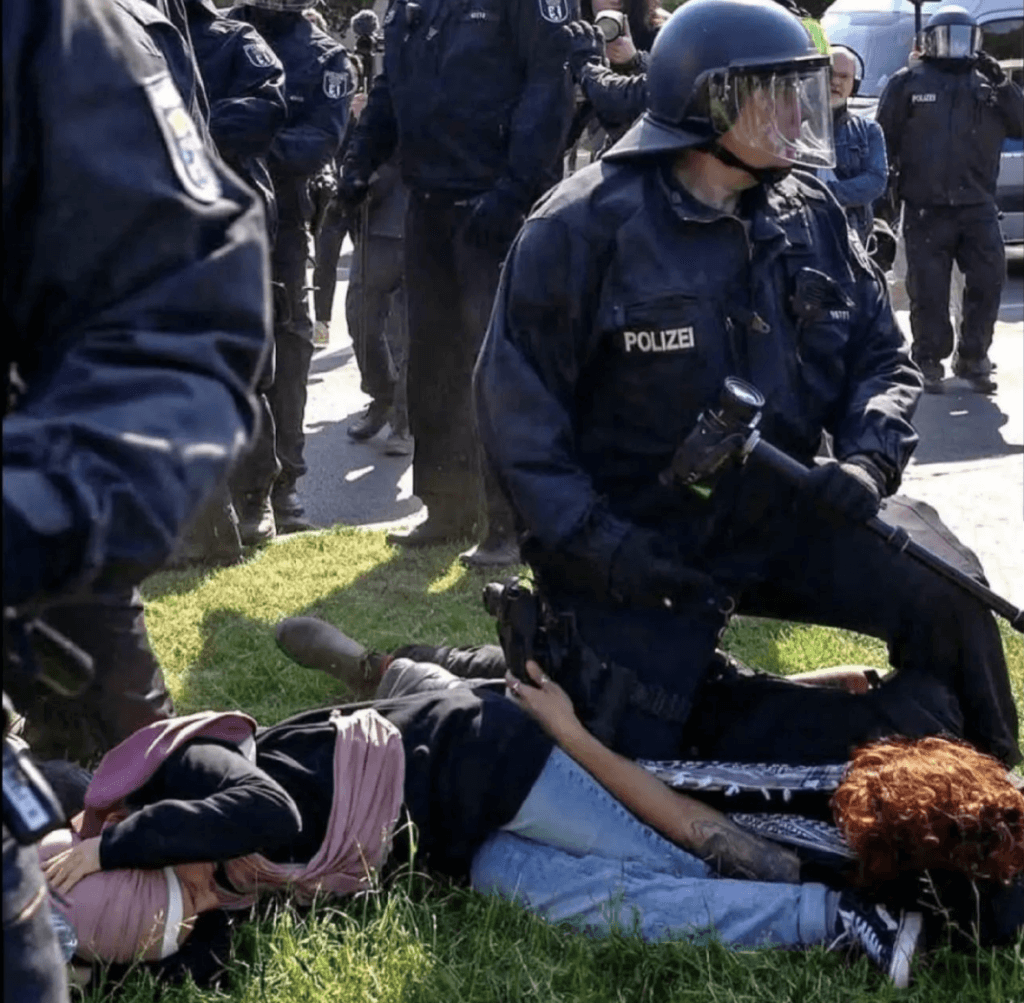
A Muslim woman in the photo above, who will only be referred to by her first name, Katharina, wrote on social media about the disturbing circulating image of herself. “I am a human being” she wrote, “what I and others experienced was police violence against Palestinians and the many people who stand in solidarity with them.”
Jewish artist and activist Adam Broomberg was another one of the demonstrators who was arrested and set face down on concrete by police forces on Saturday. He tells Mondoweiss that the aggression was unwarranted. “The police pointed video cameras in our faces and suddenly began to violently push us backwards,” Broomberg said.
“I explained that I had a right to protest. It was only when I turned around that the fully armed police grabbed me by my neck and forced me to the ground. I was handcuffed for over an hour, maybe two with no explanation whatsoever.”
Broomberg’s arrest was photographed and put on the face of a German news publication, Berliner Zeitung, with the title, “Anti-Semitism in Kreuzberg: 100 Palestinian supporters disrupt a Jewish rally.”
Judische Stimme, which was the organizing group, released a statement on this irony: “participants were accused of disrupting our rally when in fact they were part of it. With the reference to fictitious anti-Semitic attacks, an image is conveyed in which well-meaning Jewish activists were run over by Palestinian Jew-haters. This perfectly reflects the racist anti-Semitism discourse in Germany. The online edition featured a photo of Jewish activist Adam Broomberg being taken away by police after they violently arrested him. So who was protecting whom from whom, and who was really interfering?”
“It was just barely possible to commemorate the Nakba in Berlin, but the police finally intervened at this single rally, and there was also obvious police violence and arrests. The message: no Nakba commemoration should take place in Berlin,” their statement said.
Anti-Palestinian racism as new status quo
The connection between Israeli police aggression and Berlin police is certainly interconnected. During the same month of May 2022, Israeli Police General, Doron Turgeman, was in Germany as part of a delegation briefing German police on Israeli policing methods. Trugeman gave the order to attack Palestinian journalist Shireen Abu Akleh’s funeral procession, attempting to confiscate the Palestinian flag draped over Abu Akleh’s coffin while he was in Germany.
That same week, in an attempt to mimic their Israeli colleagues, the Berlin police banned the vigil organized by Judische Stimme that was planned in Abu Akleh’s honor.
The Berlin police, however, did not ban any pro-Israel events, and have even allowed demonstrations that invoke neo-Nazi propaganda back in 2017.
The European Legal Support Center warns that anti-Palestinian repression will only get worse as the attacks against Palesine solidarity continue as Germany upholds its unconditional support for the Israeli occupation. “The Berlin government’s actions around Nakba Day reflect Germany’s complicity in the continuing oppression of the Palestinian people, and further constitute a wider assault on the fundamental rights of free speech and assembly. This must be read as a dangerous precedent for further arbitrary curtailments of basic democratic rights.”
Germany’s staunch pro-Israel stance goes farther than other western governments. In 2008, when Angela Merkel declared that Israel’s security was in Germany’s national interest, or their “reason of state,” it re-defined Germany’s memory culture. Instead of fighting antisemitism and the rhetoric that plagued their history with the Third Reich, Germany has allowed a foreign power to do its bidding within their country, effectively allowing anti-Palestinian racism to become the status quo.
Germany’s current motivation to forbid Nakba day demonstrations falls in line with their plan of action to subdue Palestinian voices in order to appease the Israeli apartheid state, and many believe it is going to continue to get worse.

From my experience in Austria and conversations and articles about the situation in Germany, it is pretty clear that the situation there is even worse than in the United States. Bills passed by the national parliament and major cities like Munich equate pro-Palestinian activities with anti-Semitism. As the article shows, demonstrations are regularly pro-actively forbidden. Prominent artists and academics are disinvited or have their appearances cancelled. Germany is rapidly becoming a sham democracy.
German authorities seem to miss the irony of their actions and policies.
Where do the German people stand on this?
Is this what guilt looks like, 80 years after the fact? I suppose Germany’s leadership think it is best to victimize a people they deem subhuman today, in order to placate the people they viewed as subhuman 80 years ago.
Well, to the credit of the German police, profiling someone and arresting them based on the way they look is easier and morally safer. If the targeted population looked the same as most Aryan Germans, German authorities would have had to force them to wear identifying yellow patches.
I realize the hyperbole of my comment. But you must admit that it seems that Germany doesn’t see its own image when it stands in the mirror. Does is not see the fascism that is staring it in the mirror? Are German authorities oblivious?!
By the way, in recent years, Deutsche Welle has lost all credibility it ever had, in my view.