
Key Developments (June 16-19)

- Israeli forces killed five Palestinians, including one child, and wounded dozens of others during a large-scale military raid on the Jenin refugee camp on Monday morning, June 19th. The Palestinian Ministry of Health (MOH) identified the slain Palestinians as Ahmed Yousef Saqr, 15, Khaled Azzam ‘Asa’sa, 21, Qais Majdi Jabarin, 21, Ahmed Khaled Daraghmeh, 19, and Qassam Faisal Abu Sirriya, 29. The ministry added that 91 people had been injured, including 23 in moderate and critical condition. At least one of those in critical condition is a girl who was reportedly shot in the head.
Among the injured was also a journalist, reported to be Hazem Nasser, a cameraman for Al-Ghad TV channel. Several videos circulating on social media showed Israeli snipers targeting journalists, clearly marked as press, with gunfire. A number of journalists were trapped on a rooftop for a period of time, unable to move as they came under relentless sniper fire. According to the Palestinian Red Crescent, Israeli forces targeted at least four Palestinian ambulances during the raid with live fire.
- Monday’s raid on Jenin was the largest scale raid on the area since January 26, 2023, when 10 Palestinians, including two children and one woman, were killed during a single raid on the Jenin refugee camp. The targets of Monday’s raid were reportedly two Palestinians, including 36-year-old Hamas activist Assem Abu al-Haija, Middle East Eye reported.
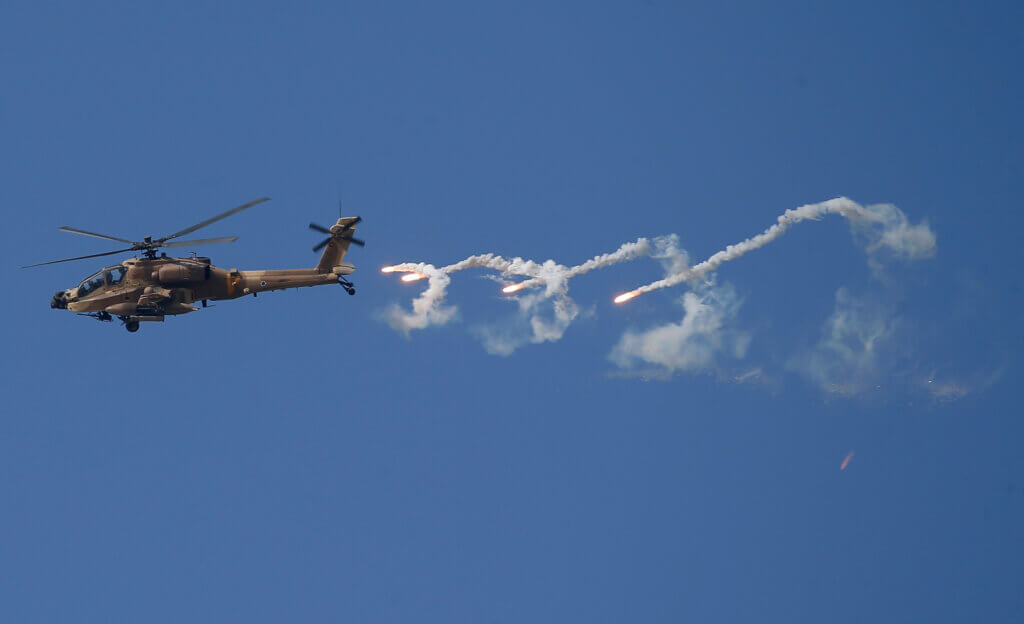
In addition to the large number of Palestinian casualties, the Monday raid was significant for several reasons. The army confirmed that Israeli forces sustained significant casualties, with at least seven soldiers injured, which is uncommon. The soldiers were reportedly injured when resistance fighters planted an explosive device targeting the Israeli military vehicles invading the camp. Additionally, Israeli forces deployed helicopters during the raid in what is reported to be the first time since the Second Intifada of the early 2000s. Videos circulating on social media purported to show helicopters firing towards the densely populated refugee camp. The army said in a statement that the helicopter shot toward Palestinian fighters to help the wounded soldiers exit the camp. Al Jazeera reported that a rocket was fired from the helicopter, and a surveillance aircraft was also hovering overhead during the raid. Israeli forces reportedly retreated from the camp around 3:20 pm local time (12:20pm GMT), but were still stationed on the city’s outskirts more than an hour later.
- On Sunday, June 18, the Israeli cabinet approved a measure, making approving and constructing illegal settlements in the West Bank much easier. The resolution transfers the authority over the settlements from Defense Minister Yoav Gallant, to ultra-right, religious extremist Bezalel Smotrich, Israel’s Finance Minister and a vocal proponent of Israeli annexation of the occupied Palestinian territory.
Sunday’s resolution, according to Axios, limits the powers of the prime minister and defense minister over building plans in settlements, “effectively curbing the ability of the U.S. and other countries to press the government to suspend such plans.” The move also reduces the stages of political approval settlement planning must go through, from around four to five stages to now just two stages of approvals, making it even more difficult for intervention to stop such plans. Smotrich also announced that the committee responsible for approving new settlement construction will convene on Monday to advance planning for 4,000 settlement units in the West Bank. The announcement came ahead of a visit by the US State Department. The US had previously warned that transferring such powers to Smotrich would be a step toward annexation.
- Over the weekend, Israeli forces raided several areas in the West Bank, sparking confrontations with Palestinians, primarily youth. Overnight Sunday, at least 14 Palestinians were detained. Raids were reported in Jenin, Nablus, and Tulkarem – all three primary targets of Israeli military raids in recent months due to the presence of armed resistance groups in those areas. The Israeli army also raided Ramallah area villages and refugee camps, as well as the Tubas district in the northern Jordan Valley. According to local reports, one Palestinian was injured after being run over by an Israeli military vehicle during a raid on the Askar Refugee Camp in Nablus, during which one person was arrested. Confrontations were also reported in the Nur Shams refugee camp in Tulkarem, where Israeli forces killed two Palestinian fighters in May.

In-depth
Last week’s dispatch considered the recent marked decline in the armed resistance activities in the West Bank, “Carving a resistance haven in an era of defeat.” It took stock of the claims that Jenin refugee camp had become a “liberated area” that the Israeli army would be reluctant to enter for fear of suffering casualties, and it argued that while many of these optimistic formulations carry elements of truth, Jenin was still not an adequate guerilla haven, and the armed resistance will have to continue operating from the margins so long as it exists in a hostile terrain of colonial counterinsurgency and systemic native collaboration. While this basic dynamic remains true, at least in the quantitative sense — many of the resistance fighters have either been martyred or imprisoned, leaving fewer bodies active in the field — the events of this week show the first signs of what might be a qualitative shift in the tactics of the resistance (although this prediction may in and of itself also be premature).
This morning, the Israeli army launched a massive raid on the outskirts of Jenin refugee camp — noticeably, not the heart of the camp — in an attempt to target the Hamas-affiliated Assem Abu al-Haija, 36. The army killed five Palestinians and injured over 91 in a raid similar to previous incursions into Nablus and Jenin this year, described as massacres. But the events in the field did not follow the typical formula of an Israeli military invasion, which usually sees a few skirmishes with Palestinian resistance fighters on the defensive and a subsequent Israeli withdrawal after having successfully completed the operation’s objective. Instead, a number of unexpected things happened.
Most notably, resistance factions detonated a remote explosive device directly underneath a new state-of-the-art Israeli armored troop carrier, “the Panther,” which was particularly designed to withstand IEDs. The vehicle was significantly damaged, and several more vehicles had to be summoned to the field to drag it back during the army’s retreat. During this period, particularly intense clashes took place between the army and resistance fighters. Seven Israeli soldiers were reported injured as a result of the explosive, and were airlifted to Rambam Hospital in Haifa. What’s more, an Israeli military helicopter entered the fray and launched several rockets toward the buildings from which the resistance fighters were engaging the army. This is the first time since the Second Intifada that Israeli air power has been marshaled against Palestinians in the West Bank, and the reported reason for the air assault was to secure the retreat of the army’s ground forces.
The meaning of these developments with respect to a possible evolution in the resistance’s capabilities remains unclear, but what is clear is that the Israeli army did not expect the explosives made by the resistance would improve so quickly. At the same time, the Israeli government has been pushing for a more wide-ranging and longer-term invasion of Palestinian population centers in the West Bank, perhaps something resembling a small-scale version of Operation Defensive Shield from 2002 during the Second Intifada, when Israel reoccupied all of the West Bank’s PA-controlled territories. While the Israeli army has expressed hesitation to carry out such an invasion, the Shabak, Israel’s intelligence services, has come to be surprised by the level of improvement of Palestinian IEDs and fears that Palestinian armed resistance might spread to other areas of the West Bank.
The result has led to a constellation of competing views within the Israeli security establishment, with the government pushing for a more aggressive army re-invasion, the army counseling restraint for fears of the potential entanglements that might result from a lengthy military reoccupation, and the Shabak expressing concern at the apparently growing capabilities of the resistance. The question of which of these views will ultimately prevail hinges on what will happen in the field during future raids into Jenin. These raids are all but guaranteed, as the Israeli army cannot let this kind of development slide without retribution or the restoration of Israeli military “deterrence.” The battles to come will shape the direction that the armed Palestinian resistance might take, with many different possible outcomes, some more or less optimistic than others, but we can say that the resistance today is very much alive.
Important Figures
- More than 160 Palestinians have been killed by Israel since the start of the year in the occupied West Bank, Gaza, and East Jerusalem
- 28 Palestinian children have been killed by Israel in 2023

Why is that helicopter firing flares? Does the IDF assume that the average Palestinian family down below has a supply of heat-seeking missiles?
What is the scenario by which a secular state without apartheid can be created by force of arms? Its a political problem requiring a political arrangement? Expecting surrender?
Many Palestinians already live under an Israeli govt., apparently without much objection. Their main complaint being their government is not cracking down enough on Palestinian crime.
https://www.youtube.com/shorts/S4SuRBC9jo4