
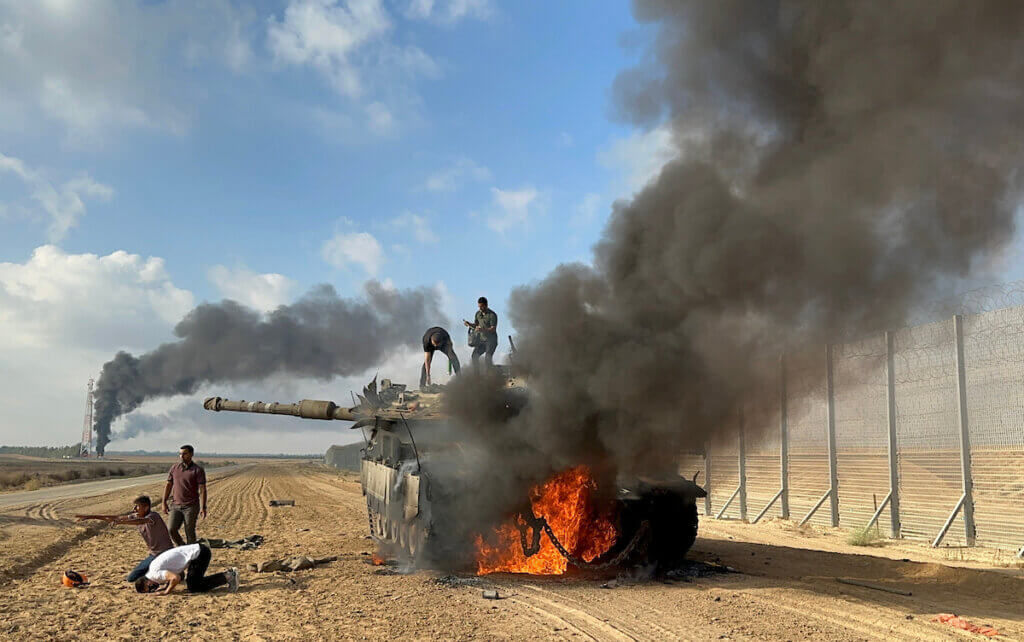
Ever since the Palestinian resistance launched its wide-ranging surprise attack, Israel struggled to push back the resistance fighters that continued to fight in the colonies bordering Gaza for over 48 hours. The blow this attack has dealt to the settler colony cannot be overstated: it is not only in the killing of over 900 Israeli colonists or the injury of thousands more, or in putting Israel in a state of war and bringing it to a standstill — but in the catastrophic loss of its superiority within the equation of deterrence. This also means that Israel is now gearing up to attempt to restore it, and is preemptively letting its Western allies know that it will go crazy in its response.
Already, PM Netanyahu has warned that Israel will “operate forcefully everywhere,” and that he spoke with President Biden and world leaders to ensure “freedom of action for Israel in the continuation of the campaign.” It hardly takes an expert to discern that this means Israel is demanding impunity for the wanton and indiscriminate massacres that it is already committing, and will continue to commit, in Gaza.
What it entails, it seems, is the objective of completely wiping out the Palestinian resistance in Gaza. This is at least what heads of state, politicians, and political pundits are declaring and calling for, and it’s what analysts from the Israeli security establishment are advocating.
Deterrence underlies every aspect of Israel’s security doctrine — from its regional calculation regarding regional actors and rivals, to its strategy of discouraging armed Palestinian resistance in the West Bank, and to its policy toward the resistance in Gaza. In large part, this deterrence is bolstered by the perception of an undefeated and invincible army, one that would use disproportionate force to discourage any challenge to its might. In the past 48 hours, that perception has been irrevocably shattered. The amount of carnage and destruction it will have to sow in order to regain it will be on a scale we have never seen before.
Yet such bloodshed is exactly what most “rational” and “level-headed” Israeli analysts are proposing — often using euphemistic language to conceal near-genocidal intentions, or more often than not saying it outright.
The “moderate” analysts from the security establishment have argued that the international legitimacy and sympathy that Israel currently enjoys in the wake of the surprise attack will allow it “freedom of offensive action” that would “enable high aggressiveness.” But, they argue, because the nature of this international legitimacy has a time limit attached to it, “the Israeli blow needs to be swift, deep, and significant” before Israel “has to face a host of pressures from the international community.”
These “pressures” are, of course, the belated international outcry against the carnage Israel will unleash. Central to keeping such outcries contained and ineffectual is the continued U.S. commitment to granting Israel freedom to “react as it sees fit,” according to INSS director Tamir Hayman, who believes that U.S. support will only continue so long as Israel’s actions proceed according to a “national consensus” with a “clear and viable strategic purpose.”
What is that purpose? What we can glean so far from Israeli intentions is clouded by the fog of war, but one of the most prominent aims being publically promoted is no less than the destruction of Hamas’s military capabilities. Yet this objective, if it is to be truly realized beyond mere bluster, cannot be achieved with Israeli airpower and the imprecise and indiscriminate destruction it causes. A ground invasion of Gaza would have to be mobilized, and that would mean a fundamental change in Israel’s reigning military field strategy.
Wrestling with defeat
The eventuality of a ground invasion is not off the table. Hayman admits that “basic assumptions have collapsed,” and that a complete overhaul in military thinking is required to deal with the current reality. A part of that overhaul entails coming to terms with the fact that Israeli ground forces have grown weak, and that the cost it would have to pay in its soldiers’ lives during a ground invasion will be far beyond anything to which it has accustomed itself.
During the invasion of Jenin refugee camp last summer, an entire brigade of over 1,000 elite Israeli soldiers was marshaled to lead a limited invasion of the camp with the aim of avoiding close combat with Palestinian resistance fighters at all costs. This strategy, which has become the institutionalized military approach of the Israeli army, is based on what Abdaljawad Omar has called an “impossible criterion of zero tolerance for Israeli casualties.”
And the Qassam Brigades in Gaza are nothing like the resistance in Jenin. The Israeli army will lose entire units in any ground invasion it launches, but in order to truly restore deterrence, it might not have a choice in the matter. If that happens, all bets are off.
We can already see this newly emerging tendency in Israeli thinking, evident in the reflections on the failures that led to the resistance’s surprise attack — not only in the colossal security failure of being unable to uncover the plot, but in the complete inability to even fathom that Palestinians were capable of such a move. It was a failure of the imagination, born of colonial arrogance and the racist conviction that the “natives” had been cowed and would remain docile.
What this meant in practice was that Israel was totally ill-equipped to deal with such a scenario, from the insufficient deployment of troops, to the disorganization and slow response time after the surprise attack, to inadequate transport arrangements to bring fighting forces to the front lines, and a host of other deficiencies resulting from the same mistaken delusion that Gaza had grown used to its prison.
The Israelis are now wrestling with this fatal mistake. Retired general Yaakov Amirdor said that it was a “huge failure of the intelligence system and the military apparatus in the south” due to the “stupidity” of assuming that Hamas was not interested in war — most recently displayed by National Security Adviser Tzachi Hanegbi’s statement that Hamas was “very, very restrained” in an interview with the Army Radio a week before the attack.
INSS senior researcher Kobi Michael said that the “colossal intelligence and operational failures” were the product of the post-2009 “paradigm of restraint” and “addiction to calm,” which Israel would have to replace with “an iron sword and a confident hand.”
Liberal military analyst Amos Harel said it wasn’t simply the lack of intelligence or combat readiness that led to the failure: “the entire system simply collapsed,” which Harel maintains did not happen when Israel fought Hezbollah in 2006 or Egypt during its surprise attack on October 6, 1973. Yet the reason for this collapse wasn’t simply operational, but a “conceptual failure.” Harel quotes a senior reserve officer on this score, who said: “We convinced ourselves that Hamas is deterred and frightened, and that we’ll always have intelligence warnings in time. We thought we knew how to analyze their intention and thoughts.”
This is beyond the humiliation of October 1973 and the failure to anticipate the attack of the Egyptian state, which was supported by the Soviet Union and commanded an entire army of tanks, heavy artillery, and an airforce. This is the humiliation of October 2023, where Israel’s entire southern military and security apparatus crumbled before a few hundred resistance fighters, who descended from the skies on paragliders. The Israeli failure of imagination, based in racial and cultural perceptions of Arab inferiority and Jewish supremacism, was its most fatal error. Now, Israel is determined to make Gaza pay the price of its mistake.


A very good analysis by Faris Giacaman.
“Israeli ground forces have grown weak, and … the cost it would have to pay in its soldiers’ lives during a ground invasion will be far beyond anything to which it has accustomed itself.”
One reason why they have grown weak is the sheer effort of maintaining the occupation of the West Bank. Squaddies trained to do little more than harass unarmed civilians don’t acquire much expertise in using armoured vehicles. Hence the elementary mistake in 2006 of sending armoured columns along roads and Hezbollah simply crippling the first and last tanks to paralyse the whole column (the Russians made the same mistake in their invasion of Ukraine last year). Now we see Merkava tanks abandoned at the Gaza border – not that they will be much use in a ground invasion of the densely populated streets of Gaza. That will require house-to-house fighting with horrendous casualties on both sides.
There’s another cost, too: the military expenditure required to reimpose superiority over its neighbours is likely to wreck the Israeli economy.
Israel’s blood lust and thirst for revenge has taken over completely and it is openly walking into a trap it cannot avoid. Even though it knows that there are no achievable strategies and no viable outcomes and facing an enemy with absolutely nothing to lose.
This overconfident generation of babysoft Israelis has spent decades bullying children armed with nothing more than the rubble of their demolished homes, relying on the largesse of the best weapons and munitions American taxpayers can buy, and living off the legends, reputation, and previous military aptitude of a long retired generation of hardened and battle-worn warriors.
Israel is about to march thousands of its inexperienced troops into Gaza and to their demise, out of suicidal pride and for no other reason than they have just been utterly humiliated and embarrass by rag tag militants armed with some of the most basic tools, weapons, and tactics imaginable.
And for what? Does Israel honestly think it can manage an all out ground invasion of Gaza or utterly destroy Hamas?
The best fighting force on Earth armed with the greatest weapons humanity has ever known and a military budget that rivals the GDP of most nations on this planet tried to do this to Al Qaeda and the Taliban after 9/11.
Twenty years, trillions of dollars, and tens of thousands dead and wounded personnel later and the Taliban’s hold on Afghanistan is stronger than ever, Al Qaeda runs unchecked across Africa, and they managed to single-handedly create ISIS and IS in the process.
If it overreaches on a ground invasion its massive losses will force a retreat and they’ll have to resort to an intolerable brutal and indiscriminate ranged assault causing mass genocide. If it tries to reoccupy Gaza it will be a meat grinder and guarantee an entire new, far worse, and more extreme group than Hamas. It will also certainly compel an existential military response from Lebanon and possibly Syria, Egypt, Jordan, Iran and maybe even Saudi Arabia and Qatar.
Neither the international community nor Israel’s geopolitical foes across the region will tolerate mass genocide or the re-occupation of Gaza.
The Six Day War was more than 50 years ago and fought by a previous generation of far more capable and determined Israelis that sucker-punched a completely unprepared Egypt, and swatted away a weak and overconfident, poorly trained, ill prepared, and under-armed Jordan, Lebanon, and Syria.
Israel was inches away from not existing 6 years later when they fought Lebanon. Today’s Lebanon with hundreds of thousands of long range precision missiles and its vast military would utterly overwhelm Israel today. An Israel whose greatest accomplishment on the battlefield since 1967 has been bullying unarmed children in the West Bank and shooting fish in a barrel in Gaza using F-16s, white phosphorus, and laser guided missiles,
In short, there is no military victory to be had in Gaza for Israel. Period.
Perhaps the cutting of food and water was designed to eventually force a halt so Israel can avoid destroying Hamas in order to keep the benefits received.