
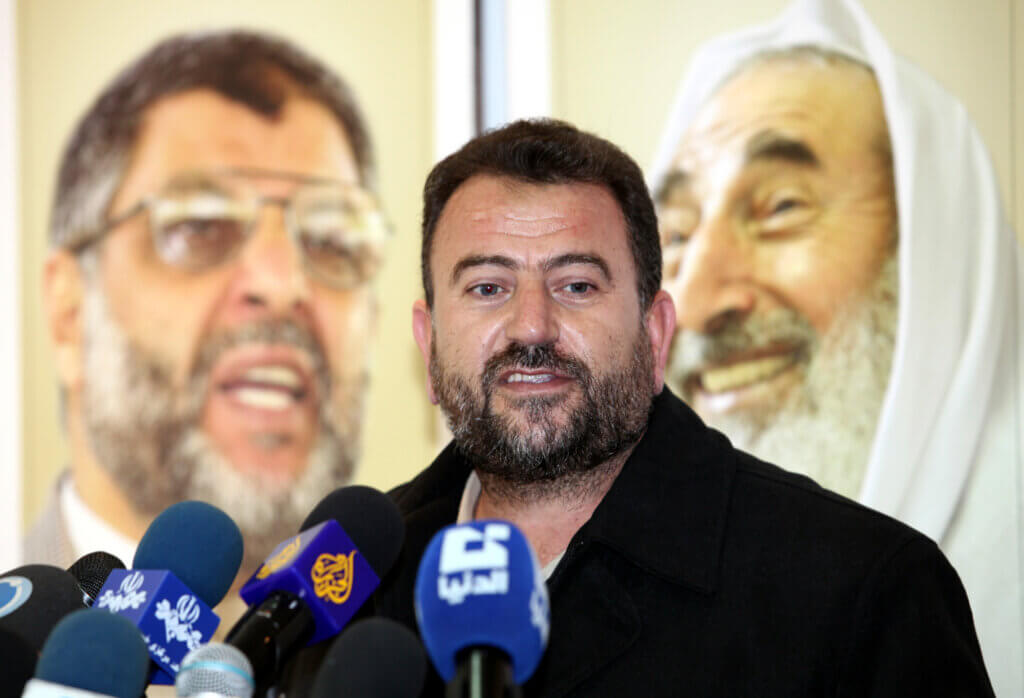
At least six people have been killed in an alleged Israeli drone strike in the Lebanese capital of Beirut on Tuesday evening, including senior Hamas leader Saleh al-Aruri.
Initial reports by Lebanese state media said that “four people were martyred and a number of others injured when the Hamas office was targeted” in the Mashrafiyah neighborhood of the southern Beirut suburb of al-Dahiya, an area where both Hezbollah and Palestinian groups operate out of. Lebanese news channel Al-Mayadeen later reported that the death toll had climbed to six, while sources told Mondoweiss that the toll had reached seven.
Reuters and Lebanese media reported that the strike was carried out by Israel. The Israeli government and military have yet to officially confirm any involvement in the assassination.
Reports indicated that the primary target of the strike was 57-year-old Saleh al-Aruri, the deputy chairman of Hamas’ political bureau, and a founding commander of the movement’s military wing, the Izz al-Din al-Qassam Brigades. Though Hamas has yet to confirm the identities of the other six killed in the strike, sources told Mondoweiss that among them were Samir Abu Amer, a top Hamas military leader in Lebanon, and Abu Ahmad al-Aqraa, a senior Hamas military leader in charge of West Bank operations.
The strike took place around 5:30 p.m. local time. Sources told Mondoweiss that initial evidence seemed to indicate that two high-precision missiles were fired toward a building in the neighborhood, reported to be the Hamas offices. One was fired at an apartment, and the second at a vehicle on the street, alleged to have belonged to Aruri. According to Al Jazeera, Lebanese civil defense crews were still fighting flames caused by the strike more than an hour later.
Hamas confirmed the killing of Aruri, calling it a “cowardly assassination” that “proves once again the abject failure of the enemy to achieve any of its aggressive goals in the Gaza Strip.”
“The cowardly assassinations carried out by the Zionist occupation against the leaders and symbols of our Palestinian people inside and outside Palestine will not succeed in breaking the will and steadfastness of our people or in undermining the continuation of their valiant resistance,” senior Hamas official Izzat al-Rishq said in a statement.
Who is Saleh al-Aruri?
Saleh Aruri spent 15 years in Israeli prison until 2010, and was exiled from Palestine upon his release by Israeli authorities. During those years, he operated out of various capitals over the years, including Istanbul, Damascus, and most recently, Beirut. He is widely credited as the primary mastermind behind financing and organizing military cells in the West Bank from outside of Palestine during his period of exile, and in solidifying military and financial ties with various regional actors.
In the years following 2014, Aruri was engaged in serving as an intermediary between on-the-ground Hamas operatives in Palestine and sources of Hamas funding internationally. This included fomenting armed cells and planning for various kidnapping operations, including the 2014 kidnapping of three Israeli settlers in Hebron. In the past two years, armed resistance in the West Bank has witnessed a resurgence, and while the Palestinian Islamic Jihad (PIJ) has been recognized as responsible for funding many of the armed groups that arose in Nablus and Jenin, Aruri has also been mentioned as playing a significant role in mobilizing support for armed resistance in the West Bank during this period.
With the winding down of the Syrian Civil War and the rapprochement between Hamas and the “resistance axis” alliance of Iran, Hezbollah, and Syria in 2018, Saleh al-Aruri played a significant role in strengthening ties with Hezbollah. The building of Hamas’s military capabilities in Gaza is partly due to Hezbollah’s assistance to the movement in recent years, with Aruri serving a crucial intermediary role in this regard.
In late October last year, Israeli forces took over and occupied Aruri’s family home in his hometown of Arura, near Ramallah in the occupied West Bank, and used it as an “intelligence base” before destroying it. Residents of the village said at the time that the home was uninhabited and that Israel’s takeover and destruction of the home was largely a symbolic act of revenge for the Hamas attacks on October 7.
Israeli ministers applaud strike, analysts warn of major escalation
The assassination of Aruri comes a day before Hezbollah Secretary General Hassan Nasrallah is expected to appear for a televised address, the third such address made by the leader since last October.
Nasrallah previously warned in a speech last summer that any assassination of any Lebanese, Palestinian, or Iranian individual on Lebanese territory would be met with a strong reaction from Hezbollah.
Since October 7, however, Israeli strikes and artillery fire targeting Hezbollah positions, as well as journalists and Lebanese civilians along the southern Lebanese border, have failed to materialize into a strong reaction from Hezbollah, beyond cross-border skirmishes and rocket fire toward Israeli military positions and towns along Israel’s northern border.
Tuesday’s assassination could change that, analysts warn. Speaking to Al Jazeera, Imad Harb, director of research at the Arab Center Washington DC, called the strike a “dangerous escalation,” noting that it marked the first assassination of a Hamas leader outside of occupied Palestine since October 7. The fact that the strike took place in Beirut, not on the southern Lebanese border, and in the heart of Hezbollah’s stronghold in the city, sends the message that Israel “can reach anyone, anywhere in Lebanon,” Harb said.
He added that Hezbollah may respond “by allowing more Hamas attacks from southern Lebanon on Israel. And definitely, it’s going to be more vigilant regarding its own leaders,” though both Israel and Hezbollah appear uninterested in “blowing up the front” completely.
A spokesperson for the Iranian foreign ministry condemned the assassination, saying Iran condemns “the violation of Lebanon’s sovereignty and territorial integrity by the Zionist regime.”
Lebanese Prime Minister Najib Mikati issued a statement responding to the attack, condemning the Israeli “crime,” and warning against Israel’s attempts to drag Lebanon into a larger-scale confrontation.
In the occupied West Bank, a general strike in mourning over the assassination of Aruri was called by the Ramallah branch of Fatah, the ruling party of Palestinian Authority President Mahmoud Abbas.
Meanwhile, Israeli Hebrew media reported that Israel is “expecting retaliation” for the attack, “including possible long-range rocket fire on Israel,” the Times of Israel reported.
While Israel has yet to officially claim responsibility for the strike, it is being regarded as a major win for Israeli Prime Minister Benjamin Netanyahu, while celebrated by Israeli officials.
Likud MK and former Israeli representative to the UN Danny Danon tweeted out his praise to Israeli security forces for the killing of Aruri, saying, “I congratulate the IDF, the Shin Bet, the Mossad and the security forces for killing senior Hamas official Salah al-Aaruri in Beirut.
Anyone who was involved in the 7/10 massacre should know that we will reach out to them and close an account with them.”
Far-right Finance Minister Bezalel Smotrich also tweeted in celebration of the strike, saying, “So let all thine enemies perish,” referencing The Book of Judges, the seventh book of the Hebrew Bible and the Christian Old Testament, Times of Israel noted.
Times of Israel added that Israeli Channel 12 reported that Netanyahu’s cabinet secretary Yossi Fuchs sent a directive to Israeli ministers ordering them “not to speak publicly about the alleged Israeli strike.”
Though there is no confirmation about what role, if any, Aruri played in planning the October 7 attacks, dubbed by Hamas as “Operation Al-Aqsa Flood,” Netanyahu and other Israeli military leaders have vowed to target Hamas officials both in Gaza and abroad.
Back in November, Netanyahu said that he “instructed the Mossad [Israeli intelligence agency] to act against the heads of Hamas wherever they are.” Israeli Defense Minister Yoav Gallant described Hamas leaders worldwide as “walking dead,” saying “they are living on borrowed time” and are “destined to die.”

So will Hamas or the Qassam Brigade now try to knock off an Israeli official. Would Israel kill 22,000 more innocent Palestinians if Hamas or the Qassam Brigade did so.
” An eye for an eye makes the whole world blind” Gandhi