

Four years ago, a dozen or so Jewish justice groups began to meet monthly, online. We called ourselves the International Jewish Collective for Justice in Palestine (IJCJP). We learned about the others’ contexts, shared experiences, and ideas about resisting the IHRA Working Definition of Antisemitism. While we each work integrally with Palestinian partners on Palestine issues, we had been reacting to the IHRA definition in isolation. We learned the hard way: the definition rolled over us all.
The IHRA definition is now the backdrop for the genocide which is being done in our names. Its power is pervasive. The IHRA definition has hemmed in the space of speech and protest, rendered statements of Palestinian identity and rights suspect, foreclosed on millenia of Jewish pluralism, and elevated political difference to the absolute wrong of racism. It diverts from urgent, lifesaving speech: permanent ceasefire now, sufficient humanitarian provision now, peace with justice forever. Every message must now be filtered (or rammed) through a language that places Zionist-Jewish discomfort before Palestinian survival.
Last weekend, the IJCJP held its first in-person congress in London. We know that our local work is both essential and insufficient, and we met to act strategically. How do the local and the national differ from the international? The member groups of the IJCJP reflect Jewish communities, and we have models of deep organization-building experience, methods that harness the wisdom of small communities, and fluid, decolonizing chat-based groups. We have begun to formulate a real, transnational organizational culture, led with a light touch among autonomous members. We are now 16 countries strong, from six continents, launching a new phase of our work as partners of Palestinians in pursuit of justice.
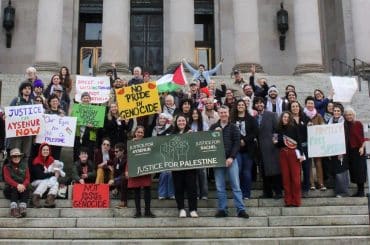
We met each other for the first time, marveling at it and yet feeling desperate. We who work closely with Palestinians and we who know Palestine now live through our messages. Our friends and colleagues are surviving minute by minute. Our imaginations falter at the world we are being shown in Gaza but we do not have the luxury of helplessness. Inspirationally, we began our gathering by feeling the power of being among 200,000 people marching through the streets of London – we, within the Jewish Bloc, within a sea of purpose. Palestine will be free.
We as pro-Jewish anti-Zionist allies work in an intentional space. We support and focus on the Palestinians who seek their own liberation. That means more than deflecting disingenuous charges of antisemitism. It means disavowing the exceptionalism that diverts conversation from Palestine toward Zionist-Jewish discomfort. It means reckoning with wider systems of oppression and our implicated status within them because we are part of the change that we seek. It means being there, turning up, earning trust, and being the walking proof that we Jews are not threatened by others’ equal claims in this world. On the contrary, we are all threatened by a world in which genocidal violence is met with silence and complicity.
We also have work to do in our own communities. Israel has spent decades trying to place a flag at the center of Jewish identity. Our good name and our thousands of years of rich, pluralist identity need restoration. We need to build Jewish community that does not replicate the harms we are witnessing in Palestine, and the door has been flung open to do that.
The Jewish institutions that defend one genocide in the name of another are driving a wedge between themselves and every Jew who knows that the slaughter must end. Younger Jews who have been shown only Israel need ways to explore the expansive Jewish space that opens up beyond the Zionist fence.
The IJCJP will add one more dimension to the growing presence of Jewishness beyond Zionism. The rabbis who brought Jewish prayer into the rotunda of Congress and brought Pesach food to the walls of Gaza are already everyone’s rabbis. The students who joined encampments and teach-ins are already everyone’s pride. The thousands of Jews who march and protest in the sea of protestors are already proving to neighbors that Israel does not speak for us. We speak for justice.
We are taking back the power of definition. We are breathing life into a 21st century Jewishness.
IJCJP member organizations
- Alternative Jewish Voices of Aotearoa NZ – Sh’ma Koleinu (Aotearoa/New Zealand)
- Another Jewish Voice /Een Andere Joodse Stem (Belgium)
- Boycott From Within/Israeli Citizens for BDS (Israel)
- French Jewish Peace Union/Union Juive Francaise Pour La Paix (France)
- Independent Jewish Voices (Canada)
- Independent Australian Jewish Voices (Australia)
- International Jewish Anti-Zionist Network (IJAN)–Canada
- Jewish Call for Peace (Luxembourg)
- Jewish Network for Palestine (UK)
- Jewish Voice for a Just Peace in the Middle East/Jüdische Stimme für gerechten Frieden in Nahost (Germany)
- Jewish Voice for Labour (UK)
- Jews for Palestine–Ireland (Ireland)
- Jewish Voice for Peace (USA)
- Jews Against the Occupation ‘48 (Australia)
- Jews Say No! (USA)
- South African Jews for a Free Palestine (South Africa)
- Tzedek Collective Sydney (Australia)
- Erev Rav (Netherlands)
- Associació Catalana de Jueus i Palestins – JUNTS (acjp.cat) Spain (Catalan)
- Tsedek! Collectif Juif Decolonial (France)
- Coletivo Vozes Judaicas por Libertação (@vozesjudaicasporlibertacao) • Instagram photos and videos (Brazil)
Mission Statement of the IJCJP
We are Jews from diverse countries, part of local, national, international networks and organizations. We are connected by our involvement in the struggle for Palestinian rights, and by our determination to work for justice. We oppose Zionism and all forms of racism. We came together to share our experiences of the International Holocaust Remembrance Alliance (IHRA) Working Definition of Antisemitism. Although it claims to protect Jews, the IHRA Working Definition is in fact being used to shield Israel from valid political challenge, silence Palestinians, and suppress any mention of Palestinian rights. The IHRA’s weaponization of antisemitism sets a dangerous precedent for limiting speech on many issues. We take this as our immediate priority, but it is only a starting point for our collective commitment to build a more just world.
There was no doubt about the plan for Nazi atrocities in 1933 after the disclosure of the Boxheim documents. A few weeks later there were already over 100,000 political prisoners in concentration camps and scores of people had been shot trying to flee while being arrested. The published plans revealed the ruthless measures the Nazis were planning against Jews and political opponents upon their accession to power and the whistleblower’s dead body was thrown off a fifty foot bridge onto the railroad tracks below. https://history.state.gov/historicaldocuments/frus1947v05/d804
There was a worldwide boycott of the Nazi regime, the Evian Conference on Jewish refugees, the Atlantic Charter declaration that those responsible for atrocities would be brought to justice, the Nuremberg Tribunals, and the Genocide Convention. None of that prevented subsequent genocides in Cambodia, Yugoslavia, Rwanda, Darfur, or what’s happening in Gaza today. Here in the USA we don’t even have a viable Presidential candidate from either party who is not pro-Israeli and pro-genocide.
The problem isn’t that there aren’t good Jewish people in Israel, but the political parties that officially advocate a state for all of its citizens doesn’t attract enough voters to meet the minimum electoral threshold of 3.25 percent. While King Abdullah and the Arab states offered the Jewish people equal rights, Arab citizenship, and nationality, the Jewish people have never been willing to extend equal rights or Israeli nationality to non-Jews. See Dean Rusk’s Secret memo for record on Jewish aggression prior to termination of the Mandate and King Abdullah’s position on equal rights in the footnotes:
https://history.state.gov/historicaldocuments/frus1948v05p2/d210
Ñote that there was no desire on the part of the Chairman of the Zionist Executive for equal rights. He was asserting Jewish supremacy and minority rule:
“For the first time in the history of Zionism and in the history of the Jewish people after the Roman conquest we faced a serious combat with a mighty power and did not rely only on pleading, requests for mercy or appeals for justice. For the first time we used a new argument: our own strength in Palestine. At first the British thought we were speaking rhetorically. But when they saw we spoke the truth, they became angry.
When we told the Government firmly and an inner confidence that they could not set up an Arab State in Palestine and that the Arabs could not rule Palestine against our will, they could hardly believe their ears. I told Halifax and Malcolm that we did not need any guarantees and that the Jewish minority in Palestine could look after itself. And they were surprised.
When they understood that we were right and that we could indeed prevent an Arab State being formed, they said: Since you can prevent the Arabs’ ‘independence,’ we’ll give the Arabs the right to prevent your immigration . . . But this ‘punishment’ will not frighten us. The ‘independent’ Palestinian State will not arise, unless the Yishuv betrays itself and the Jewish people.
We have also taught the Arabs something. We had two meetings with the representatives of the Arab countries (Iraq, Egypt and Saudi Arabia), one on February 23 and the other on March 7. The chief spokesman on the Arab side at both meetings was the Egyptian delegate, Ali Maher Pasha. The first time he spoke about the Jews in Palestine as if they were Jews living in Egypt and Iraq, and promised us equal rights . . . The second time he did not think of talking that way. By then he understood that the Jews of Palestine are not like the Jews in Egypt and Iraq. And although we have not yet persuaded the Arab countries to support Zionism, they now understand Zionism better than they did before, and they also respect it more.”
Letters to Paula and the Children, David Ben-Gurion, London March 16 1939 page 236
After a consensus on two states or one is achieved, practical ideas on how to make Palestine free can unfold. Unburdened by the elimination narrative.