

I’m sitting on a bench at the Cardiff University Encampment for Palestine, listening to the birds singing and hearing the quiet voices from a community talk taking place about the genocide in Sudan.
The site is one of friendship and solidarity. Quite the opposite of what a statement released by Cardiff University wants you to believe:
“The existence of the camp is disturbing for some of our community. Some staff and students have written to me to tell us that some of the materials being displayed at the camp and on social media are causing them distress.”
I read these lines on my Instagram feed, and I look up at the posters that surround me.
“Kick imperialism off campus,” “You cannot build a Holy Land for your children on the graves of other children.” These are the signs displayed at the camp. Simple messages of hope and peace.
The moment I set foot on the encampment, I was greeted with smiles and warmth and offered a big bowl of food. The sense of community at the camp is like no other.
Cardiff is the capital city of Wales, in the United Kingdom, to the west of England. Wales is home to several immigrant communities, with around 18% of the population being Black, Asian mixed, or other ethnic groups. Cardiff University is not particularly known to be much of an activist hub, so this makes the strength and size of the Cardiff encampment even more impressive.
I’m speaking to Emily (who asked for her surname not to be included), a student at Cardiff University who has been at the encampment for 16 days now.
She speaks on her experience at the encampment, and we touch on how it’s strange to live through the dichotomy of a privileged normal life, while wanting to acknowledge the genocide.
“Here you’re somewhere where being deeply upset that there’s a genocide happening isn’t strange. In the way it is in the rest of the world where it comes second, whereas here it comes first. A lot of people have felt like they’ve been going crazy for a long time. We’re all thinking, is anyone else seeing this?”
I ask Emily how the encampment has been received by the university. She softly sighs and says, “It’s clear that their priorities are themselves and their jobs. In their first meeting with us, they said, ‘We’re not talking about demands. We want to talk about health and safety.’ The audacity of them to talk about safety when they’re actively pouring money into bomb factories through investments into Israeli weapons, and then lying about it!”
We talk about the local community, since Cardiff is almost 10% Muslim. The presence of brown immigrant communities in Cardiff is prevalent, with a vast number of local shops and restaurants owned by Muslims.
“We owe so much to the local Muslim community,” Emily says. “They’re incredible and have treated us so well. They set up a rota bringing us hot food, with people coming by every day. They often pray here, and we set everything up. It’s beautiful.”
She also mentions that the protests in America have made people very scared about police brutality.
“A speaker came here from CAGE International for a talk,” she says, referring to the advocacy charity in London that which works to empower communities impacted by state oppression of Muslims. “And the police were involved because they were worried about terrorism. It was blatantly racist. The university even called CAGE an extremist organization. We held it in the park because we couldn’t have him on university grounds. We haven’t had police brutality yet. South Wales police are very racist, but they’re not violent with us.”
Just three days later on June 3, South Wales Police arrested around 16 protestors (most of whom came from the encampment) outside Cardiff Bay police station, using unprecedented levels of violence to do so. The protestors and members of the camp were there to demand the release of a fellow activist by the name of Neezo, who was disabled and who they believe was unlawfully arrested two days beforehand.
The violence involved pulling their hair, kicking them to the floor, pushing them to the ground, and twisting their limbs so aggressively they have physical signs of bruising and cuts.
One protestor was heard crying out, “You’re hurting us. I can’t breathe. I can’t breathe.” Witnesses said they saw specific instances of racial profiling, with police officers intentionally reaching for girls wearing hijabs and people of color, in one instance even arresting a Palestinian girl who wasn’t even involved in the protest. She was simply standing by the police station.
They were held for roughly 19 hours before being released, but not before they had their phones confiscated.

I speak with Qasim Falasteen, a local activist and photographer who has several first-hand experiences with the South Wales police. We talk specifically about the course of events that led to the police brutality experienced on June 3.
He says, “Because of the way we felt Neezo was unlawfully detained and arrested, we as a community proceeded to the police station to hold a peaceful demonstration for his release. Over a couple of hours we saw police officers gathering to the rear of the building, and we knew it could only mean one thing. We were protesting peacefully. There was no criminal damage, there was no violence.”
Around 45 police officers gathered. They were kneeing us in the back, pinching our arms, pushing, shoving, and kicking people. We were told that if we didn’t vacate we would be arrested, to stand up and leave now, so people got up to leave and were pulled back down and arrested.”
Qasim tells me how one boy was aggressively thrown to the ground and then dragged away. He says, “I saw the police officer ‘accidentally’ fall on his back. He was a 21-year-old first-year student. He told me he thought he was about to die. Six or seven big officers were holding him down, and the way they threw him to the ground was so violent and brutal. He was somebody of color, young, and very peaceful.”
“Out of the 16 people that were arrested, three were white. Everybody else was Palestinian, Jordanian, Middle Eastern, or other Muslims. It was very aggressive and it’s always a different response when it’s a non-white person. Whether it’s attacking a group or singling out the people of color or religion, those people are receiving worse treatment than others. That’s really visible.”
“South Wales police can employ 40 or 50 people with vast amounts of technology, vehicles, surveillance equipment etc., but they can’t employ a single person that is representative of the community,” Qasim goes on to say. “Not a single person speaks Arabic, not a single officer can translate. They’ve openly said, ‘yes we have been labelled as institutionally racist, but we are trying to change that,’ what are they doing to change that? On the 3rd of June, every single police officer was white!”
“The police don’t get involved until we respond in an angry way,” he continues. “They’ll let people drive their motorbikes through our protests, throw food and drinks at us. The police just wait until we say something, and then they get aggressive towards us. This is designed — it’s not by accident. This is designed to intimidate and bring out the worst in us. We’ve shown for nine months that we are not violent and not aggressive.”
As of today, Cardiff University has finally agreed to sit down, open negotiations, and discuss the demands with the students.
Something in particular that Emily said rings loud in my mind: “I think a university should inherently be about activism. The point of university is to research, educate, and make the world a better place. If it’s not working to improve the world, why is it existing?”
I think about this as I re-read Cardiff University’s statement, “We appreciate and understand that many would like the University to take up a clear position in relation to the conflict. The conflict has been, and remains, incredibly distressing to many members of our community. We will not be issuing a statement as requested.”
As an alumni student from Cardiff University and an Arab myself, I can’t help but feel disappointed at the university’s stance on the genocide. Instead of condemning the violence from Israel and now the South Wales Police, they have chosen silence.
One can only hope it’s up from here.
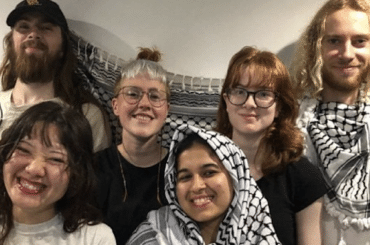
Are these the same peaceful protesters who were arrested for illegally occupying a roadway and blocking rush hour traffic? And subsequently “occupying” the lobby of the police station?