

Last month, on World Refugee Day, U.S. Representative Pramila Jayapal (WA), Senator Dick Durbin (IL), Representative Greg Casar (TX) and Representative Debbie Dingell (MI) led almost 70 Democratic members of Congress on a bicameral letter calling on the Biden administration to grant refugee status to Palestinians fleeing Israel’s brutal assault on Gaza.
“We urge you to consider opening pathways to Palestinian refugees, particularly those with family members in the United States, to seek relief in the United States,” reads the letter. “Historically, the U.S. has resettled very few Palestinian refugees, including only 56 refugees, or 0.09 percent of the total number of resettled refugees, in fiscal year
2023 and only 16 so far in fiscal year 2024. Given the dire conditions currently on the ground in Gaza, it is time for this to change.”
The push has been bolstered by the efforts of organizations like the U.S. Campaign for Palestinian Rights (USCPR), the Arab American Anti-Discrimination Committee (ADC), and MPower Change.
Mondoweiss U.S. correspondent Michael Arria spoke with USCPR Manager of Policy and Advocacy Campaigns Mohammed Khader about the letter, Biden’s track record on the issue, and the Republican efforts to block Palestinians from entering the country.
Mondoweiss: What are the demands of the congressional letter?
Mohammed Khader: The core focus of the letter is to provide refugee services for Palestinian-Americans’ relatives in Gaza. This really kind of centralized around the core issue of the U.S. embassy abandoning Palestinians in Gaza, but also the U.S. government’s failure to protect Palestinian Americans and their family members in Gaza.
There was a whole conversation around what could possibly be done to help provide relief to Palestinian-Americans and their family members here. The core purpose of the letter would be to provide what’s called a Priority-2 (P-2) designation, which is a refugee processing status that would allow Americans with family members in Gaza to either get them out or help them provide relief.
Obviously, there are a lot of things that could be added here, but the major issue is the fact that we have Palestinian-Americans crowdfunding, using GoFundMe, and other such efforts to help their families, but the U.S. government actually has processes and programs that can help get them out
We stepped in to try to offer some type of pathway in terms of doing that. Again, there are a lot of different ways that help could be provided, but this is one of many ideas in terms of leveraging the Biden administration.
Can you talk about the support you’ve got from Democratic lawmakers? This isn’t something that just The Squad, or more progressive members have signed onto. You’ve had 70 Congress Members back the effort.
There were several organizations that did outreach and leveraged their relationships and we were proud to be a part of a coalition of groups pushing on this. We were one of the first organizations pushing for it.
I would say in terms of the member level, um you know, I do have to give credit to the Representative Greg Casar of Texas. His team has been very much engaging in the process and have taken it on to ensure there’s a wide engagement on this issue in the House. Senator Dick Durbin of Illinois is another person who has helped lead this, as he has a lot of constituents that are directly affected.
We can count on members of The Squad, but we were also engaging with more moderate and centrist Democrats. So for example we have people like Reps. Nanette Barragán (CA) and Tony Cárdenas (CA) on the letter, but at the same time, we have people like Cori Bush and Jamal Bowman.
I think that just shows that there is a significant kind of engagement that we’ve been having. Not just us, but other organizations as well. There’s a wider engagement on this letter and it’s one of the higher letter signatures collections that we’ve seen regarding Palestine.
This letter is obviously directed at Biden. Can you talk about how the administration has handled this issue?
The issue of Palestinian refugees is very much compounded with the attack on UNRWA and the kind of scapegoating of international organizations by the Israel government.
In terms of the Biden administration, they’ve fallen flat. Initially, when they came into to power, they put the issue on the back burner. We actually saw a lot of maneuvering by the administration, trying to hand this off as an issue for the Saudis and others to take on, as a way to essentially to reinforce the Abraham Accords.
They’ve failed on the issue of evacuating Afghan refugees, they failed significantly with the evacuation of Sudanese refugees. This seems to be a running theme here. Also, when refugees have had to flee conflict, war, genocide, atrocities we’ve seen a double standard. The U.S. government has done a lot for Ukrainians, for instance, whereas their efforts for Sudanese and Afghans have fallen flat too.
The issue of Palestinian refugees is obviously much broader than just what’s happened since October, but there’s a specific reason why the letter was put put out on World Refugee Day. While we are trying to provide relief, there is also a need to continue to ensure that things like Right of Return and other core principles for Palestinians are recognized.
But again, the bottom line is that the administration has fallen flat. Their embassies have fallen flat. The embassies have not helped Palestinians at all. If you actually look at what happened after October, the administration mobilized its resources to essentially airlift Israelis out of Israel if they were American citizens through through U.S. charter airplanes.
We did not see any type of mobilization, certainly not that scale or scope, but not even a small percentage of that to help Palestinians in Gaza at all. We know that the administration knew that there were about a thousand Palestinians in Gaza who were a American citizens. We still did not see anything done. So this letter is kind of a longer intervention, if you will, to push the administration to do something.
The policy of immigration is very difficult here in the U.S.. We actually saw a Republican member of Congress introduce a piece of legislation, supported by MAGA Republicans, that would have forcibly removed Palestinians from the United States. That was something that was done several months ago, but there are continuing attempts to alienate Palestinians, to isolate Palestinians as a unique group.
So this letter is trying to force the administration to use the tools that it already has on the books to extend relief to Palestinian Americans and their family members in Gaza. There are already tools that could provide relief to Palestinians. And, again, if our tax dollars are going to these tools and going to the administration, we should be demanding that these tools are used to help Palestinians and not further isolate them in the international community.
You mentioned that Republican bill. I was wondering if you could talk a little bit more about GOP efforts on this issue. I know there was also a letter a couple months ago from GOP lawmakers demanding Biden withdraw from his Palestinian refugee resettlement plan. What are we seeing from the right and how should we interpret it in the wider context of anti-Arab sentiment and Islamophobia?
Throughout this entire situation we’ve seen Republicans, the entire Republican caucus, with the exception of one member, Thomas Massie of Kentucky I believe, in addition to some Democrats, really deeply, deeply embed anti-Palestinian racism into policymaking.
Last week, members of Congress actually voted to include an amendment as part of the annual State Department appropriations bill, that would prevent any funding from going to the State Department to be used to cite the death toll of Palestinians and Gazans.
We’ve seen a lot of different anti-Palestinian things that have been arisen throughout this entire ordeal. The bill I mentioned earlier, that would revoke the visa or refugee status in asylum of Palestinians. There are many things that we’ve seen that target and attack Palestinians. Around the time too, there was also hate crime against the Palestinian six-year-old, where he was murdered.
There are lawmakers who have rebuked these Republican efforts, including Jewish Democrats like Sarah Jacobs (CA) and others. But at the same time, you know, we’re seeing we’re seeing anti-Palestinian racism become more deeply embedded in the policymaking process. Not just in the congressional posture relating to Gaza, but also Palestine in general. This is something that we’re very concerned about because it feeds into our communties.
In upcoming months, we will obviously see rhetoric intensifying towards the election. We know that anti-Palestinian racism did not begin on October 7th, but we’ve seen it reinforced since. In the language of Joe Biden himself, to Republican members of Congress and others.
This is something, again, we’re very concerned about and we have tried to push back internally within on the Hill, because we know that there are anti-Palestinian groups circulating memos and talking points to attack our community, to target students who are leading divestment efforts, who are raising the alarm on college campuses in regards to divesting from genocide and settler colonialism.
It’s not solely a Democrat issue or a Republican issue, both parties need to address it.
That’s a good segue to my final question. You mentioned how Democrats typically run to the right on immigration during election years. We just saw a very right-wing border bill pushed by the Biden administration. We’ve also seen some really disturbing rhetroic from the presumptive Republican nominee Donald Trump. He’s promised to, once again, bar people from certain parts of the world from entering the U.S., after October 7th he said he wouldn’t let anyone from Gaza in. He’s even threatened to deport protesting students and set back the U.S. Palestine movement What have you made of these kinds of comments from Trump and how seriously should people be taking them?
That’s a really good question. I do think like we should be taking everything very seriously, especially after the Supreme Court decision on immunity.
We saw Trump’s rhetoric in 2015-2016 and there was almost a kind of an arrogance from Democrats’ rank and file. They thought Clinton would win the election, and we were left again to deal with fascism on our own.
We’ve seen the rise of things like Project 2025, in addition to these recent Supreme Court decisions and I think the transition from where we are now to November is going to be very concerning. Our communities are already under attack and they’ve been under attack for months. A new administration would definitely increase targeting of our communities.
We’re not just concerned about the resurgence of things like the Muslim ban, but really a recreation of what the climate was after 9/11. Steady targeting, monitoring, and surveillance of our communities. Congress already passed a reform of the FISA Act, for example, a few months ago.
These kinds of things can already be used to weaponize against our communities, whether that be surveillance, monitoring, or repression. We already know that these things are happening. We don’t know about the scale and scope, but we know that under Trump or whatever Republican administration, these things will be very much heightened. We also know that, regardless of if it’s Biden or Trump, our community will continue to be attacked and that we have a role here to ensure that our communities are protected and that people know, ah you know, the risk and also like what things are happening.
Trump has shown that there is no red line, especially in the wake of the immunity ruling, and we’ve seen that Biden has been unwilling to fully use his authority here to step in and actually do something. He’s been a very selfish president by not doing things that he said he would.
We know these things always come back in our communities. We know that people are going to shift blame for the President’s refusal to do anything. Whatever the precedent is after the election, we still have a role to play in ensuring that our communities are protected and that our priorities are continuing to be focused on here.
Beyond that I think it’s going to be a waiting game and a guessing game for us, but our priorities will be unchanged. Our priority is solidarity with Palestinians on the ground and ensuring that Palestinians here in the U.S. have what they need to in order to continue to be active and vocal.

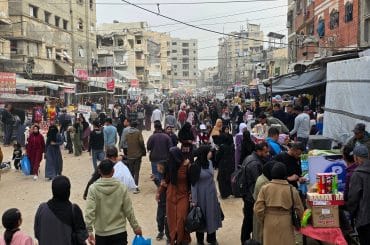
A bit peripheral to the topic of congressional efforts to provide Palestinians with refugee status, but if we’re talking about Palestinian refugees, there is an effort to build The Centre for Documentation on the Nakba:
Our immediate goal is to build a new centre in central London, which will be called the Centre for Documentation on the Nakba. This centre will gather together all the documentation currently available on the Nakba and the process of ethnic cleansing which accompanied and followed it, and be used for the wider activities of NMF.
Check it out:
https://nakbamf.org/vision/
“regardless of if it’s Biden or Trump, our community will continue to be attacked and that we have a role here to ensure that our communities are protected…. we’ve seen that Biden has been unwilling to fully use his authority here to step in and actually do something….. Whatever the precedent is after the election, we still have a role to play in ensuring that our communities are protected and that our priorities are continuing to be focused on here.”
_________________________________________________________
Is there a better way forward than advocating for one person, one vote and equality under the law?
Settling for so many Americans buying that the Palestinian agenda entails the elimination of the Jews of Israel is a betrayal of the Palestinians. As is making an enemy of Biden or Trump.