
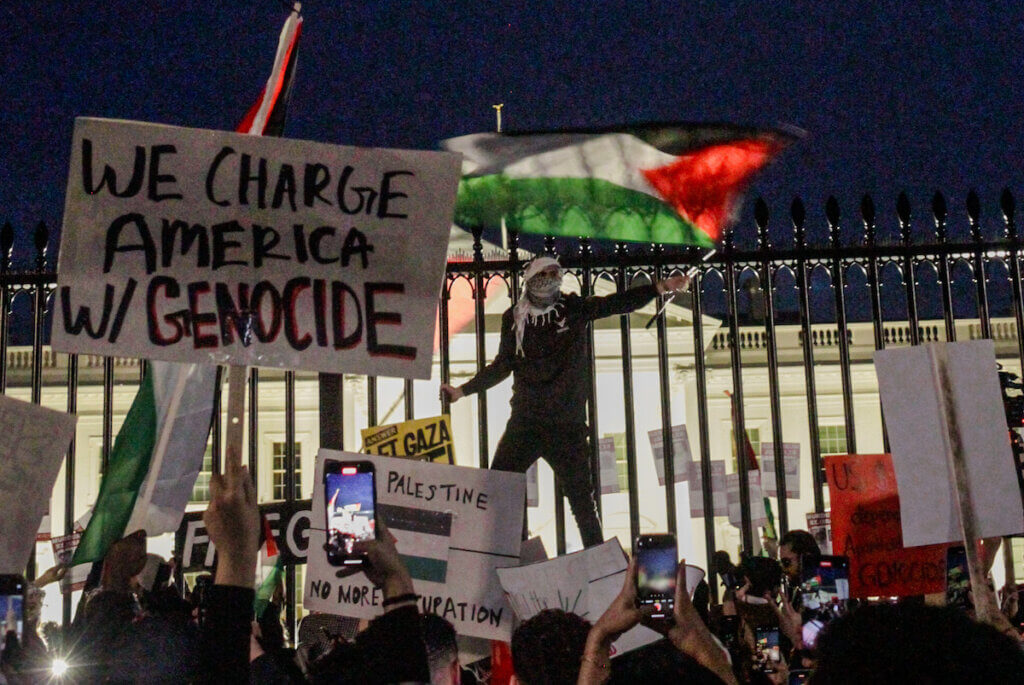
“The substance of surface” is an apt motto for considering the liberal corrective to Trumpism, because at its heart corporate Democratic liberalism counters Trumpism with nothing but surface—and even that diversionary surface is growing ever-thinner.
– Omar Zahzah
Only one month ago, the disdain for both Joe Biden and Donald Trump was palpable. The former’s abysmal handling of the genocide and the latter’s haunting legacy have incited a ubiquitous wariness of the 2024 elections. This year, in large part due to the widespread mobilization of Arabs, Muslims, and progressives, ongoing intergenerational mass protests in support of Palestine have delivered a catalyzing blow to the Democratic party, forcing incumbent Biden to step down one month out from the Democratic National Convention.
After months of disapproval ratings drowned their reputation, the reality that Democrats will lose the 2024 election due to their ineptitude, weakness, and fundamental alignment with moderate conservatism became undeniable. And so, the party did what it does best: scapegoat and rebrand.
On July 10, a slew of Democratic representatives began demanding Biden step down from the primary, alleging he was a senile liability — conveniently sidestepping that Palestine was the public catalyst for his loss of influence. Despite maintaining his aptitude, Biden rescinded his election bid, endorsed Vice President Kamala Harris, and on July 22 Harris became the candidate for the Democratic Party’s nomination.
Although there was widespread condemnation of Biden, Antony Blinken, and Harris’s actions this past year for their facilitation of Zionist militarism, mass protest of politicians on city and state levels all across the country, and targeted campaigns at U.S. private industry for their culpability in the ongoing genocide of Palestinians, once Biden stepped down it appeared as though he would become the singular scapegoat for the systematic operation behind the U.S.-Zionist alliance.

Kamala For President
Lotus for POTUS. #KHive. Brat summer. #Girlboss, #WeGotHerBack.
In 2020, when Kamala Harris won the vice presidential election, there was an onslaught of liberal feminist soundbites. Mindy Kaling talked about the happiness of seeing “herself and her daughter” in the White House. Mainstream outlets ushered in the new feminist era.
Today, Kamala Harris’s candidacy is less than a month old and has already fully capitalized on tired identity politics, including race, gender, ability, and age to secure voters previously disillusioned by Joe Biden. And the tactics are seemingly effective.
Within her first week, Kamala’s ratings significantly surpassed Biden’s — enough to close the gap on Trump’s wide lead and even surpassing him as of the time of writing. Hoards of public figures previously critical of the actions of the Biden-Harris administration welcomed the bid with open arms, invoking pseudo-feminist rhetoric to cushion the otherwise lackluster announcement. Even supposedly critical activists, like Patrisse Cullors, posted vehement support for Harris, relying on tired lesser-than-two-evils logics that undoubtedly reify a false binary that has never existed between Democrats and Republicans with respect to Palestine. In other words, there is a convenient avoidance of attributing any political responsibility to Kamala Harris despite the past four years being the Biden-Harris presidency.
An essential indicator of the political reality of the situation can be found in one simple fact: Harris does not position herself in opposition to Biden. At all. There are no meaningful condemnations of Biden’s actions, no critiques of his policies, and no promises to do anything significantly different. Her allure as a mixed-race, younger woman serves as a shallow diversion from the fact that her platform on Palestine has not changed to respond to the dissent that has taken the world by storm. In fact, Biden said it best when he stated, “The name has changed at the top of the ticket, but the mission hasn’t changed at all.”
On July 30, the Zionist entity bombarded Lebanon after alleging Hezbollah recently attacked Majdal Shams, a Druze neighborhood in the Zionist-occupied Golan Heights. This sensationalist accusation was vehemently denied by the militia, and reputable news outlets reported that it was a Zionist rocket that struck the neighborhood and took the lives of 12 Druze children. The people of Majdal Shams themselves condemned Zionist co-optation of their loss and threw multiple Israeli politicians out of their neighborhood, saying “He [Netanyahu] is a liar, is corrupt, and is coming to use the bodies of our children for TV.” The Zionist entity used this opportunity to assassinate a Hezbollah official in Lebanon, and hours later, attacked Iran, assassinating a senior Hamas official. On August 6, Israel again attacked Lebanon using psychological warfare to trick civilians into thinking an onslaught was coming.
Harris’s response to all this? Her national security advisor said her support for Israel was “ironclad” despite estimates that the death toll could exceed 200,000 in Palestine, let alone the regional impacts on Lebanese and Iranian civilians. Though alleging stern expectations of Netanyahu and emphasizing sympathy for Palestinians, there is not a single quantitative offer Harris has made toward the plight of the Palestinians, even for posterity. Even her running mate, Tim Walz, has been described as a “proud pro-Israel Democrat with a strong record of supporting the U.S.-Israel relationship.”
If Biden was ousted due to a low approval rating, what does it mean that Harris simply promises to continue holding the torch?
Are we supposed to believe that she magically absolves our current government of its role in facilitating the ongoing genocide of Palestinians? That it will reverse the catastrophic immigration policies the Biden-Harris administration has pushed through? In other words, did Biden actually step down? And will Harris do anything meaningful in response to popular demands on the ground? Or will she just capitalize on liberalism to secure her party’s seat in the White House and continue looking the other way at mass repression of dissent and ongoing Palestinian genocide?
History repeats
In 1968, Democratic incumbent Lyndon B. Johnson stepped down from the forthcoming presidential election as a direct result of the U.S. losses in Vietnam. Between widespread condemnation of U.S. actions by its own constituents, U.S. loss of political influence, and the economic hit it had taken from the war, the U.S. found itself in a moment similar to today’s: Either accept systematic responsibility for the perpetuation of the military-industrial complex or find a scapegoat. In 1968, Johnson became that scapegoat and opened the door for democratic corporatism to stifle anti-war candidates, which left status quo VP Hubert Humphrey to take the presidential bid. It is at this moment we see Richard Nixon rise in fame and easily take the election from the Democrats, laying the foundation for the ascension of mass repression via the prison-industrial complex, massive economic de-regulations and conglomerate building, and unprecedented military bolstering throughout the 1970s and 1980s. In essence, the radical wave of dissent ignited by U.S. imperialism was substantially diminished by bipartisan tag-teaming to ensure no possible next steps would undo U.S. interests.
Given mass protest, civil unrest, devastating casualties, and no end in sight, it is easy to see a 1968 parallel to our moment today. Public distrust of the government is high. Palestine has re-ignited mass mobilizations in a manner this country has not seen in decades. And, most importantly, an entire Democratic Party has seemed to scapegoat one individual for its war crimes, a sacrifice to ensure the wheels of operation continue onward.
Though no Democratic candidate is amenable, putting forth Kamala Harris, the public figure most culpable for the last four years outside of Biden, is undeniably the Democratic party’s commitment to bipartisan collaboration in service of a larger U.S. agenda. Just as the 1968 election left the nation choosing between the existing status quo or the Republican variation of it, today, we see fear-mongering around Trump as the only lifeline the Democrats have. No other politics undergird their appeal to voters and, regardless of which party wins, the outcome will be the same for the people living in the U.S., in Palestine, Puerto Rico, and elsewhere.
Palestine is our torch
It has been 56 years since the U.S. last had an incumbent drop out. It has also been 56 years since the nation has seen sustained dissent of this caliber.
Like the Vietnam moment over 50 years ago, the anti-Zionist current following October 7 has undoubtedly shifted the U.S. political terrain. With monumental mobilizations among Arab, Muslim, and progressive communities, we have seen the mass adoption of an ideological commitment to Palestinian sovereignty that has expanded to even include Olympic athletes, Bridgerton stars, and mainstream pop singers. Whereas support for Palestine has historically been a heavily enforced red line in the U.S., as can be seen in the cases of Marc Lamont Hill, Steven Salaita, or the thousands of students who have been surveilled and punished for their Palestinian activism on campuses, today the tide is turning and critical space is opening.
Ultimately, it has been the popular support for Palestinian autonomy that swept across the U.S., inciting ongoing intergenerational mass protests all over the country that delivered a critical blow to the Democratic party. Long rejected by critical leftists across the U.S. due to their expansion of surveillance, immigration policing, commitment to war, and allegiance to capitalism, Biden, Harris, and Netanyahu botched Palestine so badly that even liberals and moderates began to question their support.
Make no mistake, Palestine is at the heart of why Biden is out, not his age. And the fact that his removal was spurred by mass protest is a revolutionary win that cannot be understated. For critical people across the globe, the U.S. administration is not at all representative of the political will of the people, including those living in the belly of the beast. That being said, the fact that less than one year of protesting can inspire a political shift as massive as forcing an incumbent out of the presidential race is only one indication of what this movement can achieve.
Former Bernie Sanders campaign manager Jeff Weaver naively said, “You can be opposed to Biden’s policy with respect to Israel and Palestine and still support his reelection in the face of Trump,” implying Biden’s poor politics on Palestine are better than Trump as a whole. However, if the last 10 months have taught us anything, it is that the people of the U.S. and the world do not agree. Palestine is an all-encompassing catalyst.
What makes this moment profound is the overarching relevance of the Palestinian struggle to all struggles for justice.
Palestinian resistance and its supporters have worked hard to further the struggle in its own right, mobilizing millions previously untapped. What makes the moment profound is the overarching relevance of the Palestinian struggle to all struggles for justice. There is no such thing as a singular issue and Palestine has driven that point home this past year. Biden, Harris, and Trump’s commitment to Israel is indicative of their ideological alignment with U.S. political and economic systems that function best when they create war and promote incarceration, deportation, and shoddy social services. White supremacy, anti-Black racism, capitalism, colonialism, xenophobia, misogyny, ableism, and so on all undergird this project and also produce police brutality, immigration repression, reproductive injustice, defunded educations, medical neglect, and the abandonment of the working class in the U.S. and around the world.
When we fight for Palestine, we are fighting all the ideologies that uphold U.S. economic, militaristic, and legal abuse of its own people and third-world economies all over Asia, Africa, and Central and South America. These webs dictate the role the Zionist entity will play in bolstering repressive governments across the globe to retain U.S.-Israeli imperial influence.
When we fight for Palestine, we are fighting to dismantle a key pillar of global structural oppression in its entirety.
The masses have been successful in leveraging U.S. ineptitude surrounding Palestine to their advantage thus far. Moving forward, it is essential not to allow our hard-earned impact to be so easily co-opted by the Harris nomination. If the ceasefire resolutions the Biden-Harris administration brought to the UN were “not a clear message of peace, and would have allowed for more Palestinian civilians to be killed,” or contain “vague parameters” regarding Zionist accountability, then the bare minimum of our people is not guaranteed, let alone autonomy, economic stability, and liberation from colonialism. In what context can Kamala Harris broker a ceasefire that in any way mirrors the demands of Palestinians on the ground? Is the U.S. capable of — or invested in — facilitating anything but Oslo 2.0?
It is for this reason that we must continue to hold Palestine as our torch and refuse to acquiesce to liberal cop-outs. We can and should tally them as ideological victories reflective of our people power, but we also must remember that we cannot put all our efforts toward moving Congress on Palestine — this must be one of many tactics deployed at once. If our dissent can shake the presidential election, it can certainly do much, much more. They revealed their reliance on us by withdrawing Biden, and we cannot stop now. Biden’s loss is the floor, and though the ceiling is infinitely higher, it is at hand. Dismantling U.S. and Zionist imperial-colonial rule is attainable, and popular mobilization can disrupt imperial cogs.
The United States, as well as its Zionist imperial proxy, have lost more standing this past year than the world has seen in decades. The wizard behind the curtain is quivering, the time is now.
As a source of information about the reality on the ground in Palestine, and in international discussion of the matter, some of your editorials are not doing their reality checks, e.g., “Biden Out, Harris In”
While it is true that the public movement in support of Palestine is more robust than any since opposition to the invasion of Iraq, we are deluding ourselves to think that it is the primary issue in the Democratic Party forcing Biden out. They simply understood that, for many reasons, he could not win. Given that the Republican Party,thanks to Adelson money and its base among evangelicals is even more fervently in support of Israel, and there has been, as noted in the article, no change toward Israel and the Gaza genocide from Kamala Harris, who are we fooling?
Extending the analysis to the terrifying increases (and public acceptance) of censorship and denial of 1st and 4th amendment rights under the current administration, as critical as Palestine is, we need to demand a much more radical change. The Democrat Party is more deeply embedded in the ruling elite of this country than the Republican at this point, but neither is committed to democracy, or the interests or working people, and both are devoted to US military intervention globally in total disregard of the sovereignty of any other country, despite tactical differences on specific projects.
Whoever is elected president, our genocide in Palestine will continue. Think more broadly.The militant, but trite, bombastic, aspirational rhetoric in this editorial does not help us organize.
Keep in mind that back in 1968, about one month after the Democrat’s disastrous Convention, candidate Hubert Humphrey, being down in the polls, was forced to make concessions to the anti-war movement by calling for peace talks. The same thing can be done this time. So, now is the time to increase pressure on Harris!
As a vision for peaceful co-existence becomes clear, beautiful changes will follow.