

The walk to the graveyard where Ayşenur is buried in Didim, Türkiye felt like stepping back into rural Palestine: the olive groves, the dirt roads, the farmers harvesting olives as I’d seen them do countless times in the West Bank, and simply the serene beauty of the landscape.
It felt strange visiting her grave when, exactly two months ago, I met her for the first time in Ramallah, four days before she was brutally murdered by the Israeli Occupation Forces (IOF). She arrived in Ramallah on Tuesday, completed her training on Wednesday and Thursday, and was murdered on Friday. Knowing she was planning to visit her hometown of Didim, around the same time I visited her grave filled me with an unusual sense of guilt. Why could I visit here, speak with her family, and see where she grew up and not her? The survivor’s guilt is compounded by the fact I, on many previous occasions at demonstrations in Beita, had stood in the exact spot where she was martyred, looking up at the same group of snipers perched on the same rooftop they shot her from and yet I am still here, and she isn’t. The decision to pull the trigger when it was her in the sniper’s crosshairs and not me was likely an arbitrary decision for the sniper, and yet it is a decision I will never understand and always carry with me.
In the wake of her death, numerous well-meaning people have said to me, “Any one of you could have been killed like Ayşenur was,” but I think this misses the point: many Palestinians are shot like Ayşenur was, and many more are bombed and burnt to death, and unfortunately, as Ayşenur herself would say, their deaths receive a fraction of the attention her death received. Case in point: on the same day Asyenur was murdered, the IOF also shot and murdered 13-year-old Bana Amjad Bakr through the window of her home in Qaryut, near Nablus. She was transported to Rafidia Government Hospital in Nablus, just as Ayşenur was, and pronounced dead shortly after her arrival. Only an hour separated these killings, and if Ayşenur could speak right now, she would say the only reason her murder got far more attention than Bana’s was because she was an international and Bana was Palestinian. I believe she would unfortunately be correct in thinking that.

Her grave in Didim was incredibly peaceful. On top, a beautiful array of flowers, keffiyehs, and Turkish flags was arranged, as well as traditional Turkish clay pots and two beautiful pictures of Ayşenur temporarily acting as a headstone. I was the only one in the graveyard apart from the birds above me, whose chirping added to the scene’s serenity.
The peacefulness brought me comfort as it stood in stark contrast to the chaos of the days following her death. From the moment her ambulance arrived at Rafidia Hospital, those who attended the protest with her were speaking with journalists and giving interviews for hours on end, only taking breaks to cry or seek comfort from one another. Those of us who were not at the protest, such as myself, were doing our best to support them in any way we could, providing food, water, or anything else the others may have needed. While it was incredibly difficult to appear in front of a camera and recount an immensely traumatic experience over and over again, especially when her murder only occurred a short while before, we understood the importance of getting her story out there. We hoped that if we made enough noise about her death, the U.S. government would feel pressured to make changes to its policy regarding the obscene amount of weapons it transfers to Israel, especially in the last year. We continued giving as many interviews as we could over the next few days, often staying up until late into the night in order to not let any opportunity to speak about Ayşenur and the broader context of violence, genocide, and ethnic cleansing committed by Israel against the Palestinian people go to waste. We never got a chance to mourn our friend in the midst of all this.
Unfortunately, her funeral in Palestine was equally chaotic. It was originally planned for two days after she was killed, and we arrived alongside a large crowd of journalists, trade unionists, and members of the community from Beita at Rafidia Hospital only to be told her funeral would not be going ahead that day due to diplomatic disagreements between the U.S. and Turkish governments over where she was to be buried. Fortunately, this was quickly resolved, and her funeral was able to go ahead the day after.
Our hopes of some sort of change to U.S. policy in the wake of Ayşenur’s murder were quickly dashed when we realized the U.S. government was planning to use the same trick they always use when faced with the undeniable horrors its empire creates: say they are awaiting a ‘thorough investigation to ascertain the facts’, then repeat this line ad nauseam until the story has left the news cycle. This then repeats the next time the U.S. is faced with an undeniably horrible and inhumane crime it or one of its proxies, such as Israel, commits.
This is not only true for Ayşenur but also for Shireen Abu Akleh, the U.S.-Palestinian journalist killed by a shot to the head by the IOF in 2022, and Hind Rajab, the 6-year-old Palestinian girl from Gaza who was shot 355 times by Israeli forces in January of this year and unfortunately many others.
To date, members of the Biden-Harris administration have refused to meet with Ayşenur’s family and have also refused calls for an independent investigation into her killing. As Craig Corrie, father of the late Rachel Corrie, another American activist killed by the IOF in 2003, stated: “Israel doesn’t do investigations, they do cover-ups.” The closest thing we saw to any sort of action by the U.S. government was Secretary of State Anthony Blinken calling Ayşenur’s killing “unprovoked and unjustified” and calling for “fundamental changes” in how Israeli forces respond to nonviolent demonstrations across the West Bank. However, as of today, there has been no further action beyond these meaningless words.
Contrast this with the killing of Hersh Goldberg-Polin, an Israeli-American killed by Hamas who served in the IOF and whose body was recovered six days before Ayşenur was shot. Joe Biden and his administration were quick to condemn his murder, claiming he was “devastated and outraged” and describing the attack as “brutal” and “savage.” There was no need to wait for a thorough investigation to ascertain the facts in this case. What this clearly shows is the value of your life is dependent on which side of the US empire you find yourself on. A former IOF soldier who contributed to ethnic cleansing and genocide in the name of US-Israeli colonial expansion? Your death is a tragedy that is mourned by the U.S. government, and Biden is devastated. However, if you dare to stand against the US and Israeli empires, your death is meaningless to them and your killer will never be held accountable.
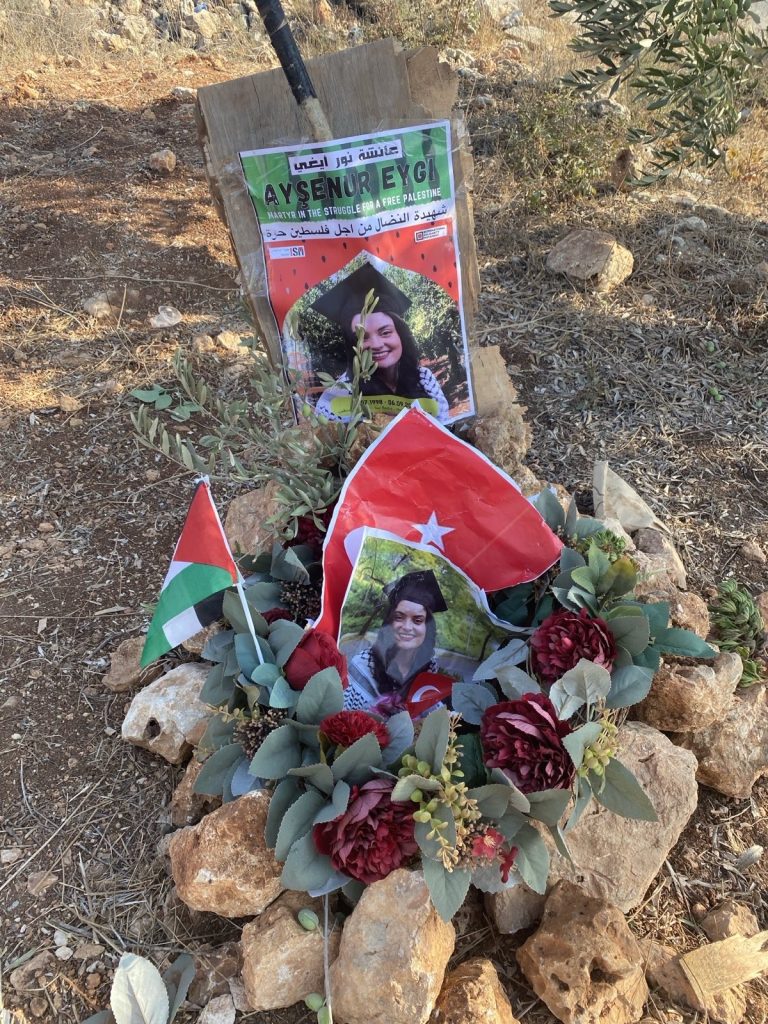
Ayşenur’s death may have been meaningless to her government, but it was not meaningless to the community in Beita. They have embraced her as one of their own martyrs and deeply honor and respect her sacrifice. They have attended her funeral, held ceremonies honoring her life, and placed placards dedicated to her around the site where she was martyred. Ayşenur is not the first martyr of Beita and, unfortunately, probably won’t be the last as Israeli state violence against the community continues to escalate. Since 2020, there have been 17 martyrs in Beita, with ages ranging from 13 to 47. Ayşenur would want each of those martyrs to be remembered and honored just as much as she is.
Of course, Ayşenur is but one out of hundreds of thousands who have been killed by the IOF in the last year alone. Now, two months after her murder, settler attacks and deportations of foreign activists have ramped up in the West Bank, the north of Gaza has been under siege and has been subjected to massacre after massacre, and many parts of Lebanon have been bombed (along with Syria, Iraq, Iran, and Yemen) and the IOF shows no signs of slowing down any time soon.
It can be easy to feel hopeless and helpless in the face of such monstrosities, but if the Palestinians on the ground haven’t given up the popular struggle for an end to the occupation, then we shouldn’t either. I think Ayşenur would have said the same thing.
Rest in power.
Horrible that all that she stood for has been trampled on by the boots of millions of her fellow Americans