
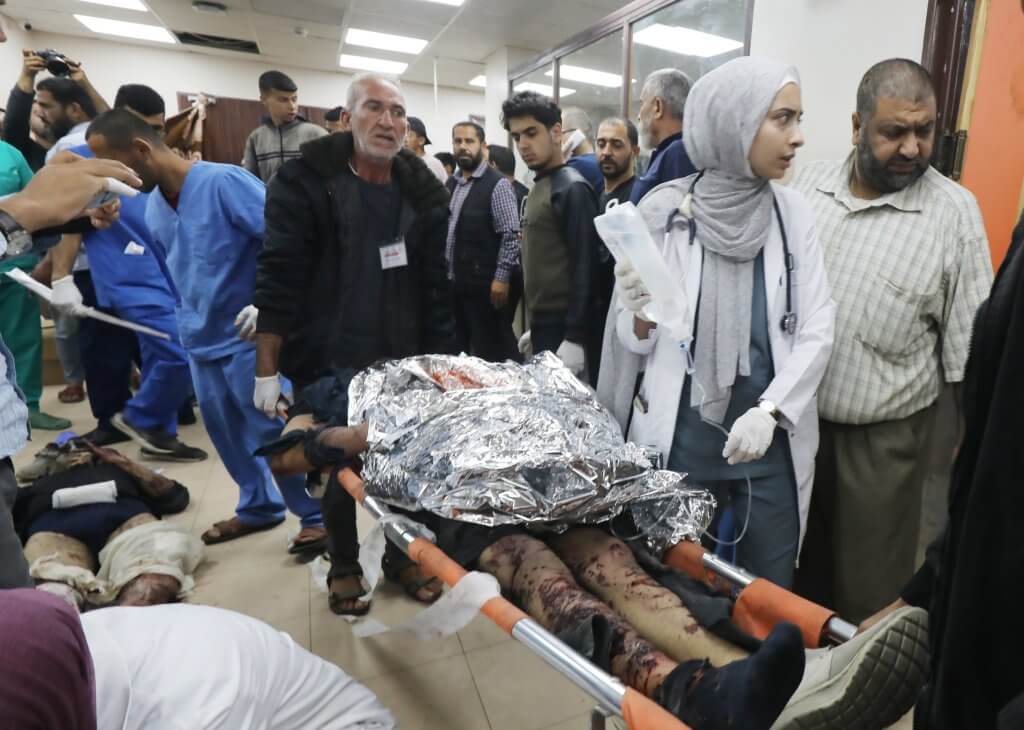
Since the beginning of the war, I have volunteered as an emergency doctor in Gaza to help my people. Over more than a year, I have witnessed countless horrors and been repeatedly displaced by Israeli bombardments and invasion. I have lost loved ones, seen patients die in horrific ways, and feared for my own life — and yet, even in the darkest moments, I have found glimpses of light.
Awaiting death in Al-Shifa
From the very beginning, the situation at al-Shifa hospital in Gaza City was catastrophic. There weren’t enough beds for the wounded, who were scattered everywhere. Dead bodies piled up in a “martyrs tent” in the hospital courtyard.
On November 9, 2023, I found among the martyrs my cousin, his wife, and their two little daughters. Their bodies were torn into unrecognizable pieces, victims of the indiscriminate Israeli shelling that ravaged their neighborhood. I didn’t realize it was them until I saw their ID cards, which had fallen from the remnants of their tattered clothes.
It was a scene drenched in heartbreak — a cruel mosaic of innocence and tragedy.
Unable to distinguish one from the other, we laid them to rest together, wrapped in a single shroud, as if even death could not separate their bond. The silence that followed was deafening, but their loss echoed in every corner of my soul.
In November 2023, Israel barred entry of fuel, food, and water into Gaza, as Israeli forces besieged Al-Shifa. In the hospital, some of us drank saline solution we found in the storage room to survive.
Hospital officials pleaded with the Israeli military to allow patients to evacuate. As soon as this happened, the electricity was cut off, leaving medical staff trapped for two days, surrounded by the enemy, awaiting death.
We were gathered in a dark reception in total silence, surrounded only by the sounds of gunfire, tanks, and shelling. I remember missing my family, who had already evacuated to southern Gaza at the time. I had no way of contacting them, and I didn’t know if I would ever see them again.
Suddenly, one of the doctors started singing Sawfa Nabqa Huna (We will stay here), a song about life and its beauty. I think he wanted to distract us, and himself, from the fear. His voice was beautiful as he sang the words: “We will stay here until the pain disappears, we will live here, and the melody will become beautiful, my homeland, my homeland.”
We eventually evacuated the hospital, taken away in ambulances. Before we cleared the area, we were searched by Israeli soldiers, who detained several senior doctors.
New places, same horror
When I reached the south, I immediately went to find my family. While I felt happiness and safety finally being reunited with them, I could feel a familiar sadness, almost like it was lodged in my throat. After the time I spent in al-Shifa, after witnessing what was happening to my homeland, I was filled with a painful sense of loss. I spent that day hiding so no one would see me cry. I wondered: what is left of martyrs after death? Bones and memories, are those all that remains of a person? Who inherits their fear, anxiety, and sadness?
As soon as I got to Khan Younis, I began to work at Nasser hospital. It was a different place, but there I witnessed the same horror.
One heartbreaking scene remains etched in my mind. A pregnant woman lay on the floor, her abdomen open, her intestines and liver exposed. A doctor fought to save her, but both she and her unborn child were lost. The blood, the screams, and the tragedy froze me in place.
How could a child who had yet to see life die alongside his mother? How could a mother leave the world without holding her baby?
That baby became just another number in an unimaginable toll. All we can hope is that they rest together in peace.
Eventually, the Israeli military also reached Nasser hospital. In March, we were evacuated again and I went to work at al-Kuwaiti hospital in Rafah.
On March 25, 2024, while I was on duty at al-Kuwaiti, the reality of war hit me in the cruelest way. At around 1:00 am, bodies of martyrs were brought to the hospital, victims of the relentless bombardment. Among them was Razan Mohammed Barhoum — a 24-year-old medical graduate, my friend, my classmate, my sister in spirit.

Razan, who had memorized the Qur’an and was in the first few months of her pregnancy after a long struggle to conceive, had been killed in her sleep, alongside others in her family, when their home was bombed.
I will never forget the moment I wrapped her body in a shroud with my own hands, tears streaming down my face. She was not just a friend; she was an example of grace and resilience, someone who balanced her duties as a wife, student, and soon-to-be mother with extraordinary strength.
The morgue was filled with dozens of martyrs, placed in a special tent awaiting burial. As I said my final goodbye to Razan, I couldn’t reconcile with the fact that this was the last time I would see her.
Light in the midst of darkness
I wish this had been the final displacement.
In April, after Israeli forces invaded Rafah, I fled to Deir al-Balah, where I joined the Al-Aqsa Martyrs Hospital. Since then, I have been a volunteer doctor in its emergency department.
One unforgettable moment happened in October 2024 while I was leaving work and heading back to the tent where I stay with my family near the hospital. I heard someone shouting, “Doctor Shurooq! The head is coming out!”

Grabbing my emergency kit, I rushed to the woman’s tent and delivered a healthy baby girl with only the tools I had on hand. Thankfully, both mother and baby were safe, and everything went smoothly. It was a proud and grateful moment, a bright light in the midst of darkness.
Her mother named her Shurooq, like me.
This moment illuminated the darkness within me and filled my heart with a glimmer of hope. It made me feel that my existence holds meaning, that we are more than just numbers on a screen. In my hands, I felt the miracle of new life being born — a profound reminder that even amidst the shadows of despair, there is still light, purpose, and the beauty of renewal.


Supporting story:
More than 4,000 amputations and 2,000 cases of spinal and brain injuries have been recorded in Gaza since the start of the Israeli offensive on 7 October 2023…Mohammad Abu Salmiya, Director of Al-Shifa Medical Complex, stated during a conference held to mark the International Day of Persons with Disabilities at Nasser Medical Complex in southern Gaza that “the majority of those who have lost limbs are children.”…
https://www.middleeastmonitor.com/20241208-4000-amputations-2000-spinal-brain-injuries-in-gaza-amid-israeli-ongoing-onslaught/
Sorry off topic, but this was the only post on Mondoweiss today.
Which is my point:
In the post Phil Weiss phase of Mondoweiss, there is no single voice speaking here. Thus no one to comment on the fall of Assad. I’m sure there will be a well considered article about it in the coming hours or days, but a blog that does not take advantage of the immediacy of the internet is slow and without a head, Mondoweiss is an amalgam of voices.