

Amid the vast scale of disaster in Gaza, individual stories often get lost in the devastating statistics. But every day, families do their best to survive the heartbreak of losing loved ones and any last shred of a normal life.
Heba, 26, is my cousin. For the past ten months, she has been struggling to provide for her three children: eight-year-old Youssef, five-year-old Omar, and two-year-old Yasmin. During my regular visits to their small tent in al-Mawasi in the southern Gaza Strip, which they share with her husband’s family, Heba has confided in me about the difficulties of staying strong for her children, who remain too young to fully understand the meaning of this genocidal war.
Their story is one of many; yet no matter how tragically common their experience might be in a Gaza torn by Israeli bloodlust, every mother’s heart breaks the same when faced with the inability to provide her children with the most basic means of survival and safety.
Will this nightmare ever end?
On the outskirts of Khan Younis, where the sounds of Israeli drones, bombings, and the cries of children filled the air amid the sorrow of a broken land, Heba sits with Youssef, Omar, and Yasmin in their dimly lit tent. The days pass heavy and slow, and the famine that has gripped the area makes life more cruel than any human should bear. Nothing is available to them, except for the simple hope in the heart of a child who has no understanding of the war or the injustice surrounding them.
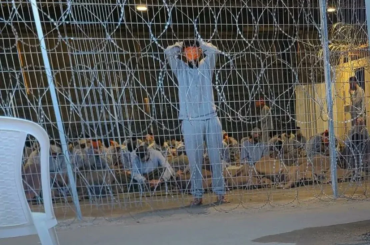
In early March 2024, as Heba was busy preparing a simple meal of canned peas for the family, news came that shook everything in her life. Her husband Mahmoud had been abducted by the Israeli army while out trying to buy some chicken, something small to feed his family in the midst of this hell. There was no trial, no reasonable cause given. The Israeli army showed no mercy and didn’t care about his need or situation.
“Why?” This is the question that echoes in Heba’s mind over and over. “Why did they take him?” Mahmoud’s only crime was trying to feed his family. Heba realized that her husband has become just a number in the hands of those who don’t care for human life. It seemed there was no hope in recovering him, and no way to know what had happened to him.
A few weeks after Mahmoud’s abduction, Heba sat beside her children and spoke with sadness: “Maybe your father will come back… maybe. And if he doesn’t, we have to live and be patient.”
Omar smiled at her with that innocent smile that hides so much sorrow in his heart. “Mom, when my birthday comes, I want you to get me meat as a gift.”
The young boy remained convinced that his father would come back with some chicken to mark his fifth birthday, only a few weeks later. After weeks of surviving on nearly expired canned food, unable to afford even flour to make bread, the smell of meat cooking in a neighboring tent had lit up his imagination. Omar’s dreams were small, yet nearly impossible.
Heba stopped speaking. A small tear fell from her eye, as she wondered: “Will this nightmare ever end? Will my husband return?” But in that moment, she thought of only one thing: to stay strong for Omar, for this child who still carries hope in his heart despite everything he had been through.
Days passed, but nothing changed. Almost a year later, Mahmoud’s fate remains uncertain, and Heba doesn’t know whether he has died or has been imprisoned somewhere far away for who knows how long.
A mother’s resolve
For more than a year, Gaza has been enduring its darkest days, with famine becoming more severe with every passing moment. Bread is a distant dream, fresh vegetables are nowhere to be found, and life has turned into a struggle for survival.
Heba’s thoughts often drift back to the days before the war, when things were simpler. Her husband Mahmoud, 30, would work hard to support the family, who lived near the sea in al-Sudaniya. In March 2023, the whole extended family had gathered at the dinner table to celebrate Omar’s fourth birthday, sharing a meal and laughter by the sea — a precious memory of joy Omar clings to until this day.
But now, those days feel like a distant memory, a life long gone. The pain of not being able to provide even the simplest meals for Omar and his siblings breaks her.
One day, Omar ran up to his mother holding a piece of paper on which he had drawn a simple picture of a meal. Looking at her, he said in his usual bright tone: “Mom, when my birthday comes, I want you to get me meat as a gift.”
Those words hit Heba like a blow to the chest. Her smile faded and her heart sank. Due to the stringent Israeli blockade, the family does not receive humanitarian aid — meaning that any food, let alone meat, is difficult to obtain. How can a child ask for meat as a gift when there was no meat to be had? How can he know that he is asking for the impossible in the world they are now living in? Meat, vegetables, bread — these have become nothing more than memories, dreams that have faded into the past.
Heba tried to smile, but tears were already welling up in her eyes. She thought about everything they have lost — their home, the food they used to eat, and most painfully, Mahmoud. She thought of how he was taken from her so violently while trying to feed his family. It feels as though the war has stolen everything: their happiness, their peace, and even their sense of safety.
“Omar,” Heba said, choking back tears. “Everything will be alright, God willing.” She wasn’t sure she believed it, she told me, but she needed to say it, if only for his sake. She looked into his innocent eyes, and for a moment, it felt like the whole world had stopped.
But the world hasn’t stopped. Outside, the bombs continue to fall. Inside the tent, the silence is broken only by the sound of distant explosions, as the nightmare of war rages on. Heba can only hold onto Omar, Youssef, and Yasmin tightly, wishing more than anything that things could go back to the way they were. But she knows that isn’t possible. In the midst of all the pain, all the loss, she has to be strong — for her children, for Mahmoud, and for herself.
In three months, Omar will turn six years old. He talks about his father often, and he and his siblings believe that Mahmoud will return home soon, with some chicken.
Despite her deep sadness, Heba tries to appear strong and cheerful for her children. She is heartbroken and anxious about Mahmoud’s fate, and clings to the hope that the war will end and that her husband will come back alive.
As the nights wear on, Heba sits with her sons and daughter, her heart heavy with the weight of a thousand unspoken fears. But there is one thing she knows for sure: she has to keep fighting, no matter how hard it gets.
“I will survive, because I have to,” she told me. “I have my children to protect, and even if I don’t know what tomorrow will bring, I know I will face it with all the strength I have left.”

NYT Rejects Quakers’ Ad Calling Gaza a ‘Genocide’January 8, 2025
“An outrageous attempt to sidestep the truth” — that’s how an American Friends Service Committee spokesperson responded to the paper’s refusal to run paid digital ads that call for an end to Israel’s genocide in Gaza.”
By Eloise Goldsmith
Common Dreams
“The American Friends Service Committee, a Quaker organization, announced Wednesday that it has cancelled planned advertising with The New York Times after the outlet rejected one of the group’s proposed ads that read:
AFSC alleges that after receiving the text of the ad, the Times suggested they swap the word “genocide” for the word “war.” The word war has “an entirely different meaning both colloquially and under international law,” the Quaker group wrote.
AFSC said they rejected this proposed approach and then received an email from the outlet’s “Ad Acceptability Team” which read, in part, according to AFSC:
“New York Times Advertising works with parties submitting proposed ads to ensure they are in compliance with our acceptability guidelines. This instance was no different, and is entirely in line with the standards we apply to all ad submissions,” a spokesperson for the Times said in an email to Common Dreams.
AFSC counters that a number of entities and individuals, such as the international human rights organizations Amnesty International and Human Rights Watch, have determined that Israel is committing genocide or acts of genocide in Gaza.
“The New York Times advertises a wide variety of products and advocacy messages on which there are differing views. Why is it not acceptable to publicize the meticulously documented atrocities committed by Israel and paid for by the United States?” said Layne Mullett, director of media relations for AFSC, in a statement.“
https://consortiumnews.com/2025/01/08/nyt-rejects-quakers-ad-calling-gaza-a-genocide/
Indecency follows indecencies. Civil wars are the worst. Revenges have rendered nearly all blinded.