
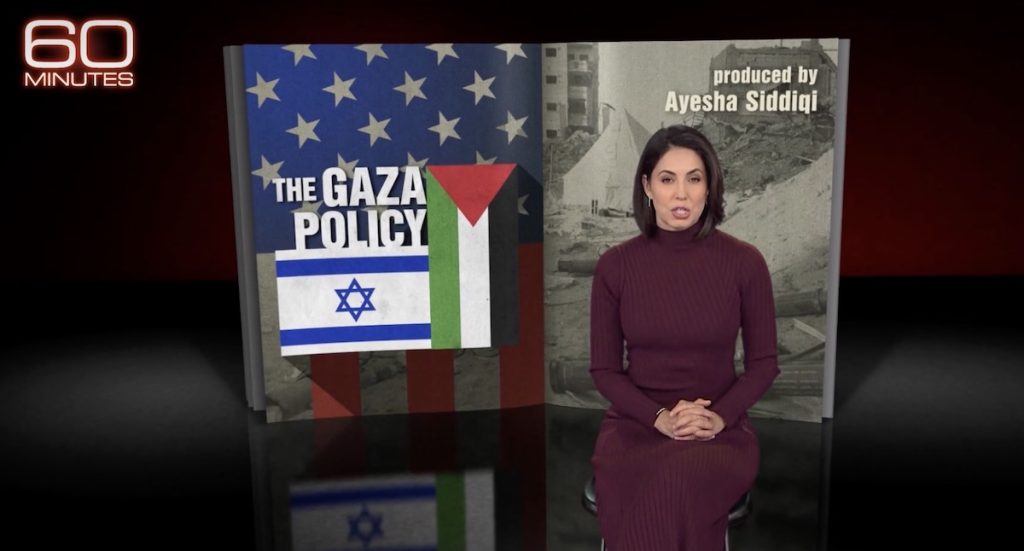
Last week 60 Minutes ran a segment on the Biden administration’s support for Israel’s genocidal assault on Gaza.
It began with a video of children playing with ammunition casings while standing on the rubble of their destroyed homes.
“A close look reveals where they come from — printed on the side: USA… DOD for the Department of Defense,” reporter Cecilia Vega tells viewers. “Across this now decimated 25-mile-long strip of land… America’s stamp is everywhere.”
The segment featured multiple interviews with former State Department officials, all of whom have previously sounded the alarm about what’s happening in Gaza.
“What is happening in Gaza would not be able to happen without U.S. arms,” Hala Rharrit, a diplomat who spent 18 years working in Asia, Africa, and the Middle East before quitting last year, told Vega. “That’s without a doubt.”
Rharrit recounts how she was told to keep quiet after expressing concerns about the carnage.
Cecilia Vega: When you tried to speak out, vocalize what you saw…. like you were told to shut up?
Hala Rharrit: Yes. I would show images of children that were starved to death. In one incident, I was basically berated, “Don’t put that image in there. We don’t wanna see it. We don’t wanna see that the children are starving to death.”
Cecilia Vega: Who told you that?
Hala Rharrit: A colleague.
Josh Paul, a former State Department director who resigned shortly after the October 7 attack, was also interviewed.
Josh Paul: There is a linkage between every single bomb that is dropped in Gaza and the U.S. because every single bomb that is dropped is dropped from an American-made plane.
Cecilia Vega: These Israeli air strikes, you could say, are made in America.
Josh Paul: They are.
Josh Paul: After October 7th, there was no space for debate or discussion. I was part of email chains where there were very clear directions saying, “Here are the latest requests from Israel. These need to be approved by 3:00 p.m.”
Cecilia Vega: Expedited?
Josh Paul: Correct.
Cecilia Vega: Where were these orders to green-light weapons transfers coming from? How high up did this go?
Josh Paul: This came from the president, from the secretary and from those around them.
And here’s Andrew Miller, a former deputy assistant secretary of state for Israeli-Palestinian affairs who resigned last year.
Cecilia Vega: Did the U.S. ever say to Israel, “We support you, but these are our red lines; we are not going to support certain things”?
Andrew Miller: There were conversations from the earliest days about U.S. desires and expectations for what Israel would do. But they weren’t defined as a red line.
Cecilia Vega: The United States has supplied billions of dollars in weapons to Israel. You’re saying the government did that without setting any red lines as to how those weapons would be used?
Andrew Miller: I’m unaware of any red lines being imposed beyond the normal language about complying with international law, international humanitarian law, the law of armed conflict.
Cecilia Vega: What’s the message the U.S. has sent to the Netanyahu government?
Andrew Miller: I believe the message that Prime Minister Netanyahu received is that he was the one in the driver’s seat, and he was controlling this, and U.S. support was going to be there, and he could take it for granted.
Cecilia Vega: The push is, if the U.S. stops supplying these weapons to its ally, that our own adversaries would not only go after that ally, it would make the region significantly less safe.
You certainly don’t see reports of this kind in the mainstream media every day. The segment is strong and important, as it might educate some U.S. viewers who were unaware of these atrocities.
However, the timing is infuriating.
This episode ran just weeks before Biden’s team left the White House and, it turns out, just days before a ceasefire agreement was reached. CBS took the aforementioned video of the kids playing with munitions in May. Every former official they spoke to quit their position months ago, if not over a year ago.
In other words, 60 Minutes declined to run a story like this long after it might have had an actual impact. It also comes just weeks after they aired a segment all but celebrating Israel’s pager attack on Lebanon.
Sticking on media for another moment, there were a couple notable moments on MSNBC last week.
On one hand this Chris Hayes segment on Biden’s legacy might generate some criticisms, as his entire argument hinges on the damage Biden has done to “the liberal international order.” However, this is precisely why I find it notable, as liberals almost never attempt to extend their values to Israel. I was reminded of Senator Jon Ossoff’s speech in support of the Bernie Sanders’ weapons bill in November.
There was also a good segment on Ayman Mohyeldin’s show breaking down how Jimmy Carter’s comments on Israeli apartheid had been largely scrubbed from his obituaries. It even cites a Mondoweiss piece.
Ceasefire, Harris Poll
The world is continuing to gather information about the three-day ceasefire and the question of what comes next remains an open debate, as there are already reports that Netanyahu will work to tank it again.
Having said all that, the news understandably led to celebration throughout Gaza, as many Palestinians are beginning to see a light at the end of tunnel.
Just hours before the ceasefire was officially announced the IMEU published a poll, which was conducted by YouGov, on the 2024 election.
The survey found that Gaza was the #1 reason why 2020 Biden voters did not vote for Harris. Harris refused to break from Biden’s genocidal policies in the region, despite overwhelming public pressure from activists, progressives, students, and other concerned parties throughout the country.
Voters who went Biden in 2020 but neglected to back Harris were asked, “Which one of the following issues was MOST important in deciding your vote?”
Here’s the breakdown of their replies:
29% – Ending Israel’s violence in Gaza
24% – The economy
12% – Medicare and Social Security
11% – Immigration and border security
10% – Healthcare
9% – Abortion policy
5% – Don’t know
Among Biden 2020 voters who did not vote for Harris, 53% said Biden’s support for Israel was “too much” vs. just 6% who said it was “not enough.” Asked about what kind of candidate they’d support in the future, 56% said one who voted to withhold weapons to Israel.
“The Democratic Party needs to come to terms with the real reasons it lost the presidency in November, including that after over a year of unprecedented protests and calls for Biden to stop sending weapons to Israel, party leadership failed to listen to its own voters who overwhelmingly want their government to end its complicity in Israel’s genocide in Gaza,” said the IMEU in a statement.
Reading this poll I was reminded of something political consultant Peter Feld told me after Trump’s victory. He pointed out that the issue of non-voters is not often a component of political analysis.
Here’s Feld:
You really can’t do this to people and expect them to turn out to vote. I think Abdaljawad Omar on your site did one of the best and most gracefully written post-election pieces that I’ve read. He points out that this stuff probably deflected volunteers and killed so much of the enthusiasm. Nobody is going to get excited about the “politics of joy” and “endless brat summer” when they’re watching a kid raising his hands while he’s being burned to death attached to an IV. It pretty much puts an end to any of the vibes that they were trying to run on.
We’ll have to look and see who stayed home, not just how the voters voted. I don’t think you can explain this election without explaining the non-voters and I think some of the post-election polling that’s come out and attempts to explain it by talking to voters is going to miss this story. If you haven’t spoken to non-voters, you haven’t explained the election.
Biden was an unpopular incumbent and Harris had less than 100 days to run a campaign. Maybe Trump would have prevailed regardless of her foreign policy stance, we’ll never know.
However, the optics couldn’t be worse for the Democrats. They refused to shift their position in the face of widespread opposition and a continuing genocide, ended up losing the election anyway, and now a ceasefire deal might be secured as soon as they leave. A real masterclass.
Odds & Ends
❓ Did Donald Trump force the ceasefire deal the Biden administration refused to?
🌎 The Biden team is working to spin their foreign policy legacy, but it’s too late.
🙏 The Gaza ceasefire will not cure the wounds of genocide
⚖️ Palestinian Americans sue Biden administration over failure to evacuate families from Gaza
🇵🇸 Ceasefire announced after 476 days of genocide
🇮🇷 What will Trump’s Iran policy look like?
🗳️ Drop Site News: Kamala Harris Paid the Price for Not Breaking With Biden on Gaza, New Poll Shows
🤝 Axios: Gaza hostage and ceasefire deal reached
🫂 Truthout: In Gaza, Ceasefire Will Be a Chance to Finally Breathe
🇮🇱 The Nation: We Have a Ceasefire Deal, but This Isn’t the End
📺 Counterpunch: How U.S. Media Hide Truths About the Gaza War
🕌 In These Times: Michigan’s Muslims Take Matters Into Their Own Hands
⛔ Middle East Eye: After 15 months of brutality, Israel has failed on every front
Stay safe out there,

Another piece for Odds & Ends: yesterday Pro Publica posted “A Year of Empty Threats and a “Smokescreen” Policy: How the State Department Let Israel Get Away With Horrors in Gaza“, a handy guide to how the Biden administration looked the other way at Israel’s human rights violations:
Authorities in and outside government said the acquiescence to Israel as it prosecuted a brutal war will likely be regarded as one of the most consequential foreign policy decisions of the Biden presidency. They say it undermines America’s ability to influence events in the Middle East while “destroying the entire edifice of international law that was put into place after WWII,” as Omer Bartov, a renowned Israeli-American scholar of genocide, put it. Jeffrey Feltman, the former assistant secretary of the State Department’s Middle East bureau, told me he fears much of the Muslim world now sees the U.S. as “ineffective at best or complicit at worst in the large-scale civilian destruction and death.”…Biden’s warnings over the past year have also been explicit. Last spring, the president vowed to stop supplying offensive bombs to Israel if it launched a major invasion into the southern city of Rafah. He also told Netanyahu the U.S. was going to rethink support for the war unless he took new steps to protect civilians and aid workers after the IDF blew up a World Central Kitchen caravan. And Blinken signaled that he would blacklist a notorious IDF unit for the death of a Palestinian-American in the West Bank if the soldiers involved were not brought to justice.
Time and again, Israel crossed the Biden administration’s red lines without changing course in a meaningful way, according to interviews with government officials and outside experts. Each time, the U.S. yielded and continued to send Israel’s military deadly weapons of war…Throughout the contentious year inside the State Department, senior leaders repeatedly disregarded their own experts. They cracked down on leaks by threatening criminal investigations and classifying material that was critical of Israel. Some of the agency’s top Middle East diplomats complained in private that they were sidelined by Biden’s National Security Council. The council also distributed a list of banned phrases, including any version of “State of Palestine” that didn’t have the word “future” first. Two human rights officials said they were prevented from pursuing evidence of abuses in Gaza and the West Bank….
https://www.propublica.org/article/biden-blinken-state-department-israel-gaza-human-rights-horrors
The current political situation, also evidenced by this article, calls for a discussion and debate on a realistic and plausible arrangement to settle the Palestine Question. Is there a deal Trump and America will support as realistic and logical in the long run?